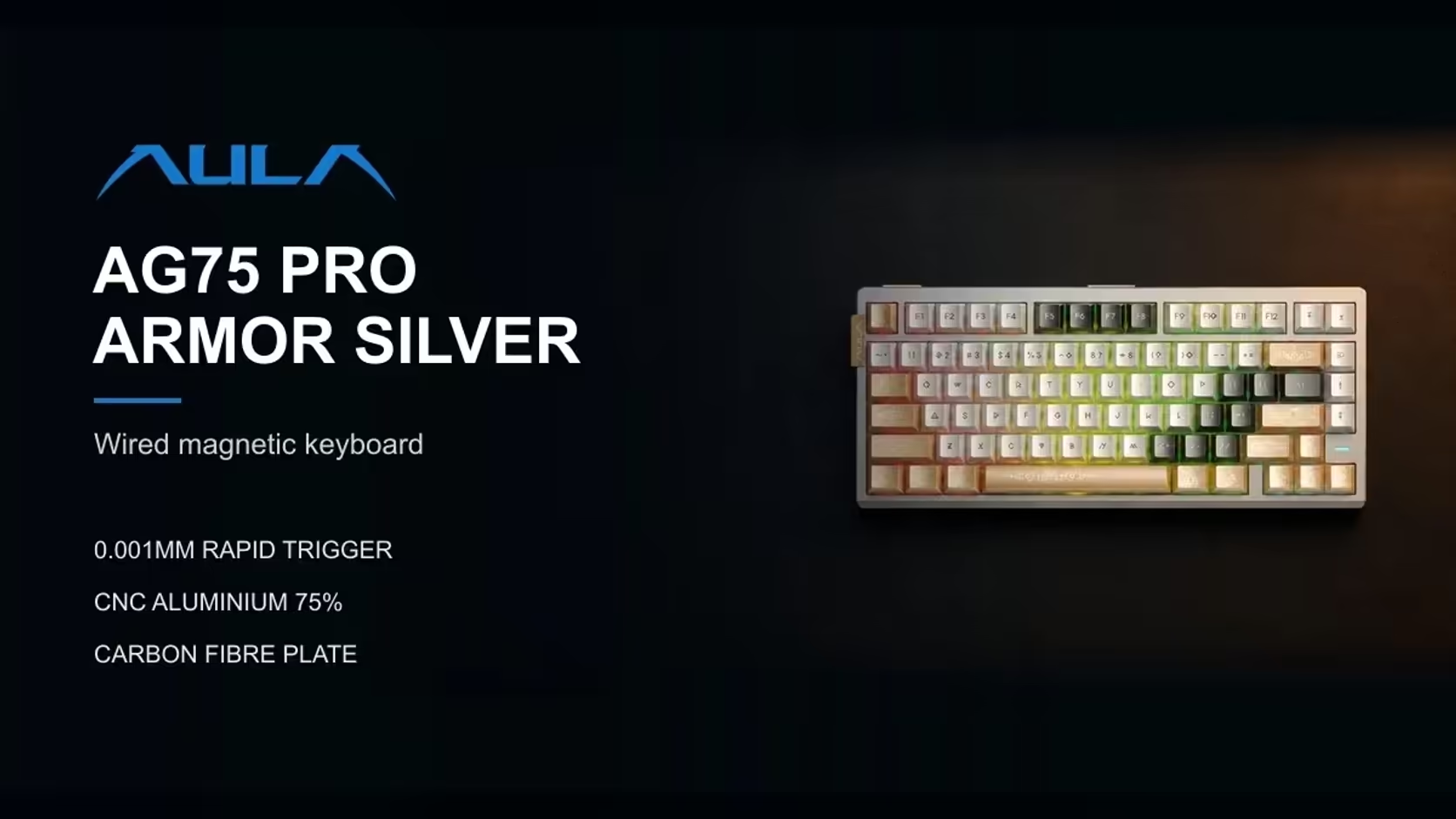
"75%" sounds like a precise standard, but it is closer to a family resemblance. Two boards can both carry the label and still differ in how many keys they have and where the smaller ones sit. AULA's own range shows it: the AG75 has 81 keys, while the HERO 75 HE and HERO 84 HE each have 84. For most people three keys make no difference at all. For anyone who leans on navigation keys, the 75% keyboard key count deserves a closer look before buying.
Quick Answer
The AULA AG75 fits 81 keys into its 75% layout, three fewer than the 84 on the HERO 75 HE and HERO 84 HE. AULA does not say which keys the AG75 leaves out, so check the layout image on the product page if your hands depend on Home, End, Page Up or Page Down. All three are magnetic boards with Rapid Trigger, and the programmable key modes can take over for a missing key. Evetech's prices are R2,399 to R2,799 for the AG75, R899 for the HERO 75 HE and R719 for the HERO 84 HE.
⌨️ What a 75% layout keeps, and where boards differ
A 75% keyboard is a full-size board with the number pad removed and everything else pushed tightly together. The defining features are:
- A full function row, F1 to F12, along the top.
- An arrow cluster in the bottom-right corner.
- A column of navigation and editing keys running down the right-hand edge.
The HERO boards describe their 84-key layout in exactly those terms, keeping the function row and the arrows. Across the wider keyboard market, 75% boards tend to vary most in that right-hand column: how many navigation keys it holds, and what sits in the top-right corner. That is the most likely place for a board with fewer keys to trim.
What we know about the AG75
AULA's AG75 pages state 81 keys in a 75% layout and give the size as 319.8 x 143.8 x 42.1mm. They do not list which keys are absent compared with an 84-key board. Rather than guess, look at the top-down layout photo on the AG75 product page and check the right-hand column for the keys you use most.
📏 How the three boards compare in size
Key count and footprint are related but not identical:
- AG75: 319.8 x 143.8 x 42.1mm, about 1532g without the cable.
- HERO 75 HE: 313 x 139 x 43mm, about 980g without the cable.
- HERO 84 HE: AULA's page does not list dimensions or weight, but it shares the 84-key 75% layout.
So the AG75 is a touch larger than the HERO 75 HE despite having fewer keys. Its machined metal shell, which wraps carbon fibre and a thick damping stack, accounts for some of that space and most of the extra weight. On the desk, the difference in footprint is small; in the hand, the difference in weight is large.
🧩 Making up for a missing key
If one of your regular keys turns out to be among the three, all three boards give you tools to work around it.
Remapping
AULA's page for the HERO 84 HE lists key remapping in its web driver, so a key you rarely press can take over the job of one you miss. The AG75 and HERO 75 HE pages describe their drivers through key modes instead, which do a similar job.
Two actions on one key
Mod-Tap is listed for all three boards, splitting a key's job between a quick tap and a longer hold. That is a tidy way to add a missing function without losing the original key. DKS, also on all three, assigns different actions to different press depths on a magnetic switch.
Macros and extra modes
The AG75's web HUB adds macros alongside SOCD, Toggle, END, Multi-Point Trigger and Rapid Switch. The HERO 75 HE lists a similar extended set. For the HERO 84 HE, AULA mentions remapping, Rapid Trigger, DKS and Mod-Tap.
🔌 Connection and switches across the three
Beyond key count, the boards differ in ways that often matter more. It is worth being honest about the scale here: three keys out of more than eighty is a small gap, and most people adapt to a slightly different navigation column within a week. A change of connection type or switch feel, by contrast, affects every single session. If you are weighing these three, settle the connection question, then the switch feel, and only then count keys.
The AG75 is wired, connecting over USB-C at 8000Hz, with Rapid Trigger precision of 0.001mm. The HERO 84 HE is also wired, using an angled USB lead, and adjusts actuation in 0.01mm steps. The HERO 75 HE is the tri-mode board of the three, adding a 2.4GHz receiver at 8000Hz and Bluetooth for three devices, with actuation adjustable in 0.005mm steps.
Switches differ too. The AG75 Pro uses LEOBOG Frostcore and the AG75 Ultra LEOBOG Eight Treasures. On the HERO 84 HE you get factory-lubed Black Kings, light at 33gf. The HERO 75 HE's switch follows its colour: Stormrise for black, Spiritcloud for the orange and green boards. All are magnetic Hall Effect switches, and all three boards let you swap them without soldering.
Cover is identical: each board has a 2 Years Local Warranty through Evetech. Evetech groups all three under its gaming keyboards category. The keyboard best sellers page also shows how they stack up against other popular boards. Prices sit on each product page.
Frequently Asked Questions
Which three keys does the AG75 leave out?
AULA does not say. Check the layout photo on the AG75 product page, paying attention to the right-hand column.
Do all three keep F-keys and arrows?
The HERO pages confirm both; a 75% layout by definition keeps a function row and an arrow cluster, and the AG75 is a 75% board.
Can key modes cover a missing key?
Yes. Mod-Tap and DKS appear on all three, and the HERO 84 HE also lists remapping, so another key can take on the missing function.
Is the AG75 smaller because it has fewer keys?
No. At 319.8 x 143.8mm it is slightly larger than the HERO 75 HE, and much heavier.
Which of the three is not wired only?
The HERO 75 HE, which adds a 2.4GHz receiver and Bluetooth to its cable.
Are all three magnetic?
Yes. Each uses Hall Effect switches with Rapid Trigger.
Counting keys before you commit?
Compare the AG75, HERO 75 HE and HERO 84 HE side by side in Evetech's gaming keyboard range.