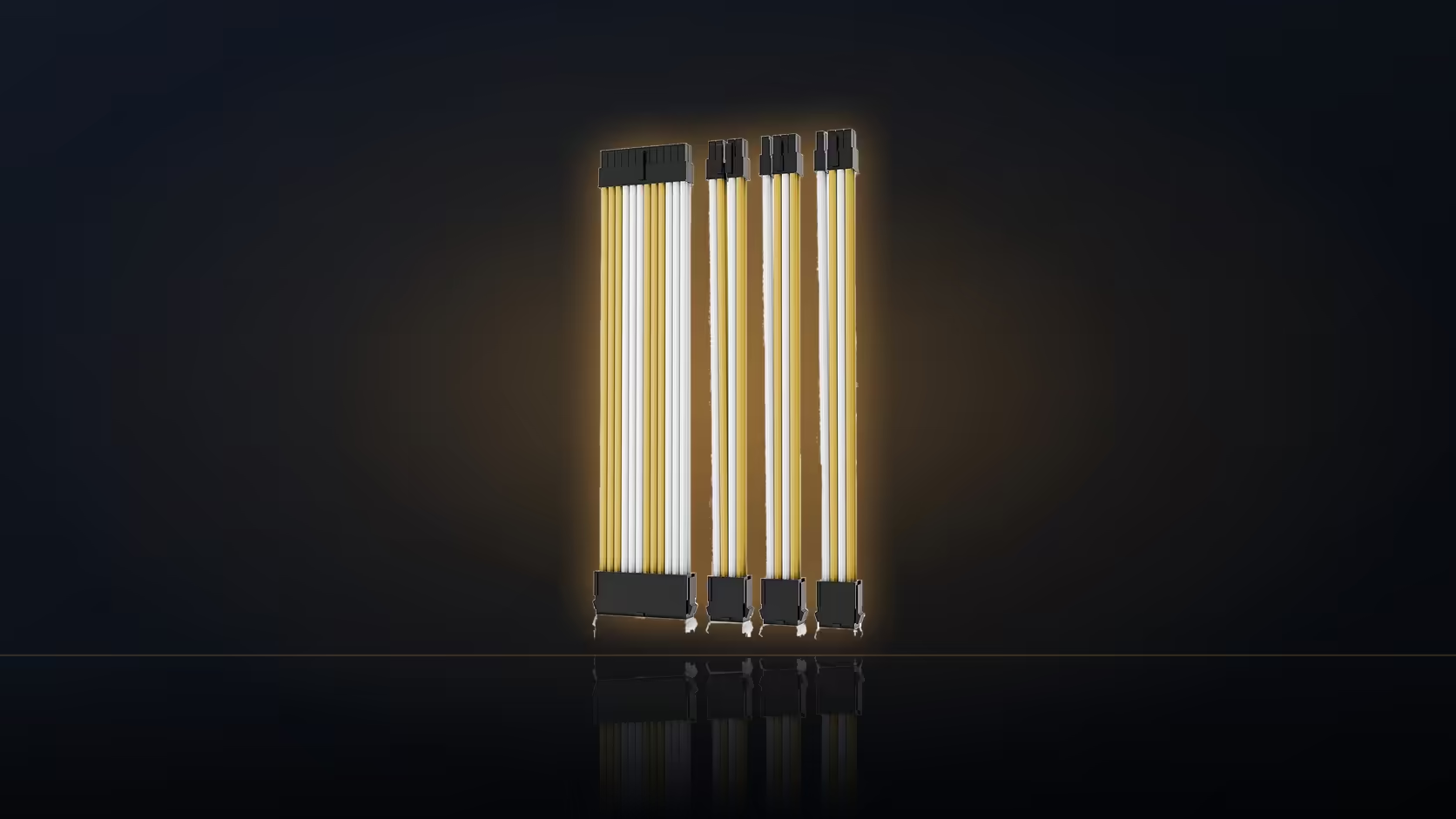
Every cable inside a case has to go somewhere, but it does not have to go there the same way. A visible cable arc across open space and a direct dive through the nearest grommet solve the same routing problem with opposite instincts, and picking between them says more about what you want the build to say than it does about the cable itself.
Quick Answer
Both routes are legitimate, and the right one depends on what the cable is. A sleeved or lit extension is worth showing off with a deliberate arc, while a plain factory lead is usually better disappearing through the closest opening. A single 30cm AsiaHorse sleeved extension costs from around R549, and its whole appeal is wasted if it is buried rather than curved somewhere visible.
🎨 When the arc earns its place
A cable is worth arcing when it is actually worth looking at. The AsiaHorse sleeved extension kits exist specifically for this: nylon-braided 18AWG or 16AWG runs in colours from black through red to two-tone weaves, meant to be seen doing a graceful curve across the interior rather than stapled flat against the glass. The Hydrus ARGB 24-pin cable takes this further, adding a right-angle connector and a lit head so the curve itself becomes part of the lighting scheme. A cable cover follows the same logic once fitted, since the covered run wants a straight, visible section to actually present its ARGB strands rather than a curve hidden behind a shroud.
🕳️ When the direct route wins
Not every cable deserves the attention. A component's stock factory lead, a SATA cable feeding a hub tucked behind the tray, or anything that is functionally necessary but visually unremarkable is usually better taking the shortest path to the nearest grommet and disappearing from view entirely. This matters more in builds where the components themselves are the feature, a striking graphics card or an exposed cooler, and cable arcs elsewhere would only compete for attention rather than support it.
📏 The length constraint that decides for you
An arc costs cable. A 30cm extension has a fixed amount of length to work with, and every centimetre spent on a deliberate curve is a centimetre not available to actually reach the component. Measure the direct distance first, then work out whether there is enough slack left over for a real arc without the run pulling taut at either end. A cable cover adds a related constraint, since it needs a genuinely straight section of its own fixed length, roughly 205mm for the board cover and 260mm for the graphics one in the standard kit, and an unsupported curve without combs or a cover tends to sag rather than hold a line.
🧮 Reading the interior before you decide
Before committing to either approach on a given run, look at what the case is asking the eye to do at that point. A large open span between the power supply shroud and the graphics card, with nothing else competing for attention, is exactly where a deliberate curve reads as intentional rather than accidental. A cramped section crossing behind a drive cage or squeezed under a fan bracket rarely has the room for a graceful arc anyway, and forcing one there usually looks worse than simply routing the lead directly out of sight. The case itself tends to tell you which approach a given cable run wants, if you look at the space before deciding.
🧰 Tools that make either route easier
Combs are the obvious aid for an arc, holding a bundle of sleeved leads in a fixed curve rather than letting them settle into whatever shape gravity prefers. A cable cover goes further, giving a run a rigid shell that holds its line permanently regardless of how the cables underneath want to move. For the direct route, the tools are simpler: cable ties or velcro straps pulling a lead flat and close to the tray, and a grommet placed as close as possible to the component being fed, minimising how much of the run is exposed before it disappears. Neither approach is difficult once you know which one a particular cable is meant to take, and having the right small parts on hand before starting makes the decision easy to execute cleanly rather than something you compromise on halfway through.
🖼️ Mixing both inside one build
Most finished builds use both approaches rather than choosing one throughout. Dressed, sleeved or lit runs arc visibly through the parts of the case the window actually shows, while plain leads take the shortest hidden route the moment they cross out of the sightline. This is not indecision; it is matching the treatment to what each individual cable is actually for, run by run, rather than applying one blanket rule to the whole interior regardless of what each lead is carrying or where it sits. Look at your case's window layout, then work through Evetech's case fans lineup and the rest of the case accessories shelf before deciding which cables in your build deserve the arc treatment and which ones should simply vanish.
Frequently Asked Questions
When does a visible arc actually work as a design choice?
When the cable is worth showing, which describes sleeved extensions, lit ARGB cables, and any run passing through a cable cover with a straight section to present.
And when is the direct route the better call?
When the cable is plain and functional, or when the build's real interest sits in the components rather than in the wiring connecting them.
Does an arc genuinely use more cable than a straight run?
It does, which is a real constraint on a fixed-length extension like the 30cm AsiaHorse kits, where every curved centimetre is length not available elsewhere.
Is an unsupported curve difficult to keep tidy?
Yes, an arc without combs or a rigid cover tends to sag over time rather than hold its intended shape reliably.
Which routing style suits a lit cable cover best?
An arc, since the cover needs a straight run and a gentle curve into it reads far better than forcing a sharp turn right at the shell's edge.
Does the case's own layout decide this for me?
Often, since where the grommets and openings sit determines how much genuinely visible cable run exists before a lead can vanish out of sight.
Can a single build reasonably use both approaches?
Easily, and most finished builds do, with dressed runs arcing through the visible chamber while plain leads take the shortest exit the moment they leave the sightline.
Working out the routing for your next build?
Browse Evetech's case accessories and case fans ranges before committing to a cable plan.