




IPS vs VA for Strategy and Sim Games in SA
IPS vs VA for strategy and sim games should be judged by fit, not a single winner. Compare compatibility, latency, capacity, upgrade path, cost planning, and South African setup needs.
Read moreUp front: lightweight wireless mice run near zero latency on a 2.4GHz dongle. For the spec gap matters more under sustained load than in peak benchmark numbers. Inside: sensor, weight, battery, and connectivity notes.
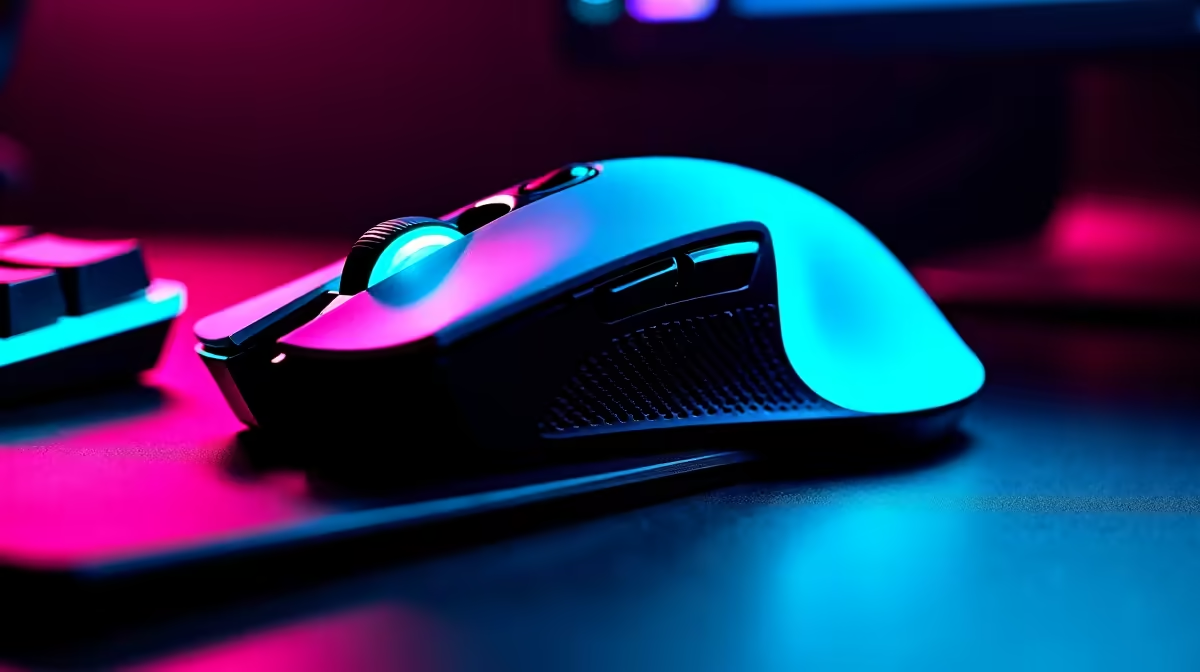
AA batteries make more sense for most wireless gaming mice because they hold more energy (roughly 3,000 mAh versus 1,200 mAh for AAA), are available at every SA convenience store, petrol station, and pharmacy, and cost under R25 for a twin pack. AAA mice trade capacity for lighter weight, only a meaningful advantage if you are minimising every gram for competitive play.
AA cells carry approximately 2,500 to 3,000 mAh. AAA cells carry around 1,000 to 1,200 mAh. In a wireless gaming mouse drawing around 3 to 5 mA during active use, a single AA provides 500 to 800 hours of operation while a AAA delivers 200 to 400 hours. The Razer Orochi V2 illustrates this: it uses one AA and achieves 425 hours on HyperSpeed or 950 hours on Bluetooth. A AAA-equipped mouse would run approximately half as long per battery. For SA users who prefer to minimise interruptions, the longer AA run time reduces the frequency of battery changes during gaming or work sessions.
A single AA battery weighs approximately 23g. A single AAA battery weighs around 11g. On a mouse targeting sub-70g total weight for competitive play, choosing AAA saves 12g, significant at that weight class. However, very few mice on the market deliberately use AAA for this reason; most lightweight competitive mice use built-in rechargeable cells to achieve sub-60g weights without the capacity penalty of smaller replaceable cells. The AAA category is largely occupied by budget wireless mice that happen to use the smaller cell rather than high-performance designs that chose AAA for engineering reasons.
AA batteries are stocked by virtually every SA retailer: Checkers, Pick n Pay, Clicks, Dischem, Makro, and petrol station forecourts. Rechargeable NiMH AA batteries, available from R60 to R120 for a four-pack with charger, offer ongoing cost savings for heavy users. At an average of one AA per month for a moderately-used gaming mouse, a rechargeable pack pays for itself within four to six months compared to buying alkaline cells regularly.
Investing in Eneloop or Energizer Recharge AA batteries and a basic charger costs around R120 to R180 at SA electronics retailers. Over a year of mouse use, this saves purchasing twelve or more alkaline batteries and means a charged cell is always ready to swap in immediately when the current one runs low.
Yes. Rechargeable NiMH cells output 1.2V versus 1.5V for alkaline. Most wireless gaming mouse circuits operate down to 1.0V, so NiMH cells work without issue, though the mouse may show a low-battery warning slightly earlier in the discharge cycle.
No. Battery type does not affect sensor performance or wireless connection quality. Performance is consistent from full charge to approximately 20 percent remaining capacity, at which point most mice trigger a battery warning.
Do not dispose of batteries in household waste. SA retailers including Clicks, Dischem, and many electronics shops have battery recycling drop-off points at major shopping centres across South Africa.
Looking for a long-lasting wireless mouse? Browse wireless gaming mice at Evetech to find AA-powered and rechargeable options that match your battery preference and gaming schedule.
IPS vs VA for strategy and sim games should be judged by fit, not a single winner. Compare compatibility, latency, capacity, upgrade path, cost planning, and South African setup needs.
Read more
Gen 5 NVMe SSD guide for Bloemfontein gamers should be shortlisted around the job it must do. South African buyers should compare capacity, speed, thermals, and motherboard support, warranty path, and upgrade room before treating any pick as best.
Read more
Skip the RTX 5070 if your first-time builder budget needs better balance. Better SA picks can free room for the right CPU, PSU, case, monitor, storage, and cooling while still giving a strong first gaming PC experience this year in South Africa.
Read more
RTX 5080: weighing the pros and cons for SA should be shortlisted around the job it must do. South African buyers should compare GPU tier, VRAM, cooling, and PSU headroom, warranty path, and upgrade room before treating any pick as best.
Read more
Core i5-13400F gives South African PC builders a capable mid-range CPU choice with clear limits. Check its gaming fit, discrete GPU requirement, LGA1700 platform costs, and upgrade path before locking in your parts list.
Read more
Pros and cons of the Wi-Fi 7 routers for SA should be shortlisted around the job it must do. South African buyers should compare WiFi standard, coverage, latency, and device support, warranty path, and upgrade room before treating any pick as best.
Read more
Steam content servers unreachable needs a download-path check, not an immediate reinstall of every game. Restart the client, inspect download settings and compare another connection when practical. Clearing the download cache is separate from deleting installed games.

Keychron G6 HE has built-in and swappable battery versions with different weights. The product brief lists 42g and 46g respectively, each with a 3g tolerance. Choose by grip and battery preference before treating one headline weight as universal.

Corsair HS80 v2 MAX supports 2.4GHz wireless and Bluetooth. Its maximum battery figures use RGB-off conditions and differ by connection. Check microphone routing, comfort and the exact device support before assuming every wireless mode behaves alike.

Windows taskbar notification badges can be shown or hidden in Taskbar behaviours. This changes the small app indicators, not the underlying messages. Choose a calmer desktop while keeping a deliberate routine for checking important conversations and app updates.
Windows taskbar notification badges can be shown or hidden in Taskbar behaviours. This changes the small app indicators, not the underlying messages. Choose a calmer desktop while keeping a deliberate routine for checking important conversations and app updates.

Windows USB device in use can mean a program still has the drive open. Finish transfers and close files before retrying ejection. Better performance caching requires safe removal; a replacement drive is not the first fix for an open-file warning.

Windows Nearby Sharing not working starts with feature, Bluetooth and visibility checks on both PCs. My devices only depends on matching Microsoft accounts. Test a small harmless file before buying networking hardware or changing your home router.

Windows hardware reserved RAM is different from memory used by applications. Compare installed memory with firmware detection and the usable amount before buying modules. Reservations and reporting limits vary by system; no universal setting restores every byte.

Windows title bar window shake can minimise other open windows when you shake the active window by its title bar. Inspect the Multitasking setting and switch it off if that gesture interrupts your work. The preference costs R0 and does not require new hardware.

Windows Print Screen opens Snipping Tool when its keyboard preference is enabled. Change the option under Accessibility, Keyboard to choose another workflow. Test whether you need a clipboard image or a saved file.

Windows desktop icons missing may be a visibility setting. Right-click the desktop, choose View and inspect Show desktop icons. If only system icons are absent, use Desktop icon settings. Check the Desktop folder before assuming files were deleted.

Windows set time zone automatically greyed out calls for a location and device-policy check. Automatic time-zone selection relies on location services. A manual time-zone choice is separate from synchronising the clock; check both before replacing hardware.