Quick Answer
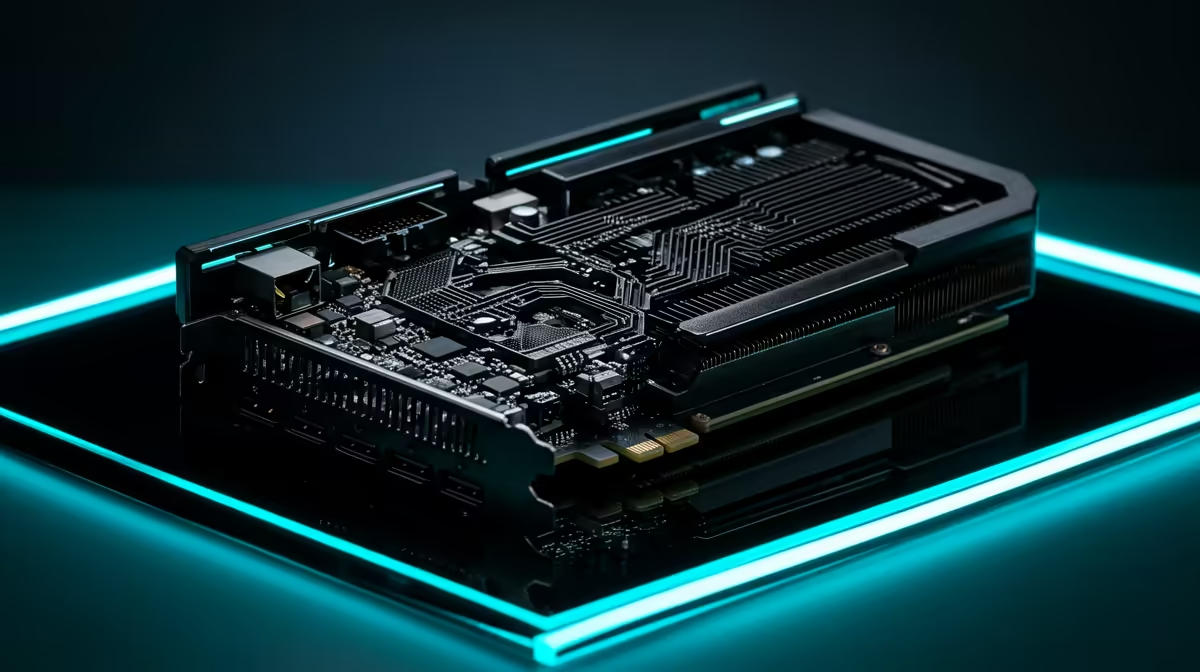
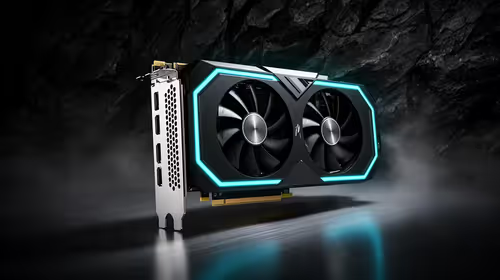
For 1440p gaming, the best alternative to the RTX 5080 Super is usually RTX 5080, RTX 5070 Ti, or RX 9070 XT if it reaches your real target for less money. Target 90-144 fps at 1440p High. In South Africa, use about R26,000-R40,000 for upper-tier territory as a broad planning band, then confirm the live Evetech listing, cooler size, warranty path, and PSU requirement before checkout. If RTX 5080 Super is not listed locally or is priced like early stock, compare available non-Super cards first.
Best Alternatives To Shortlist
Start with RTX 5080 as the closest step-down, then compare RTX 5070 Ti and RX 9070 XT when VRAM, noise, or price matters more. A R3,000-R8,000 saving can fund a stronger CPU, 32GB DDR5 memory, a 1TB NVMe SSD, better airflow, or a 144 Hz to 240 Hz monitor.
The useful comparison is not only peak benchmark speed. Check VRAM capacity, board length, recommended PSU wattage, display outputs, and whether the cooler will fit a normal mid-tower case.
Match The Card To 1440p gaming
Demanding games reward VRAM, upscaling, and stable 1% lows; the best value card is the one that clears the real monitor target. Set one target before buying: 1080p high refresh, 1440p High, 4K 60 fps, 90 Hz VR, 1080p60 streaming, or a quiet two-display workstation.
If the current PC already has a quality 650W-750W PSU, 16GB-32GB RAM, and decent airflow, many alternatives make more sense than stretching to RTX 5080 Super. If the platform is old, the saved GPU money is often better used on CPU, memory, storage, or cooling.
SA Buying Checks
Use broad price bands as filters, not promises. GPU pricing moves with exchange rate, cooler design, and local stock, so the live product page must settle the final choice for SA buyers.
FAQ
Is RTX 5080 a better buy for this use?
Yes, when it reaches the target settings and costs meaningfully less. For many SA builds, the better buy leaves money for CPU, RAM, storage, cooling, and the monitor.
How much should South African buyers budget?
Use about R26,000-R40,000 for upper-tier territory as a cautious planning band. If two cards are close in price, choose the one with stronger VRAM, quieter cooling, and easier PSU fit.
What spec matters most here?
Start with VRAM, target fps or app workload, power draw, and cooler size. For gaming, frame consistency matters more than peak fps; for creator work, 8GB-16GB VRAM and stable acceleration matter more than card size alone.
Pro Tip
Check monitor resolution, refresh rate, PSU wattage, case clearance, and the exact game or app target before choosing the final card.