


PCIe 5.0 vs PCIe 4.0 for Strategy and Sim Games in SA
PCIe 5.0 and PCIe 4.0 differ most in lane support, compatibility, and upgrade value for strategy and sim games. SA buyers should match the choice to their actual hardware and games.
Read moreThe enclosed engineering 3d printer choice in SA: X2D at R16,499 is a compact CoreXY for high-temp filaments like ABS and PA-CF, K2 Plus at R32,999 adds a 350mm bed for larger parts. Both are locally stocked in SA.
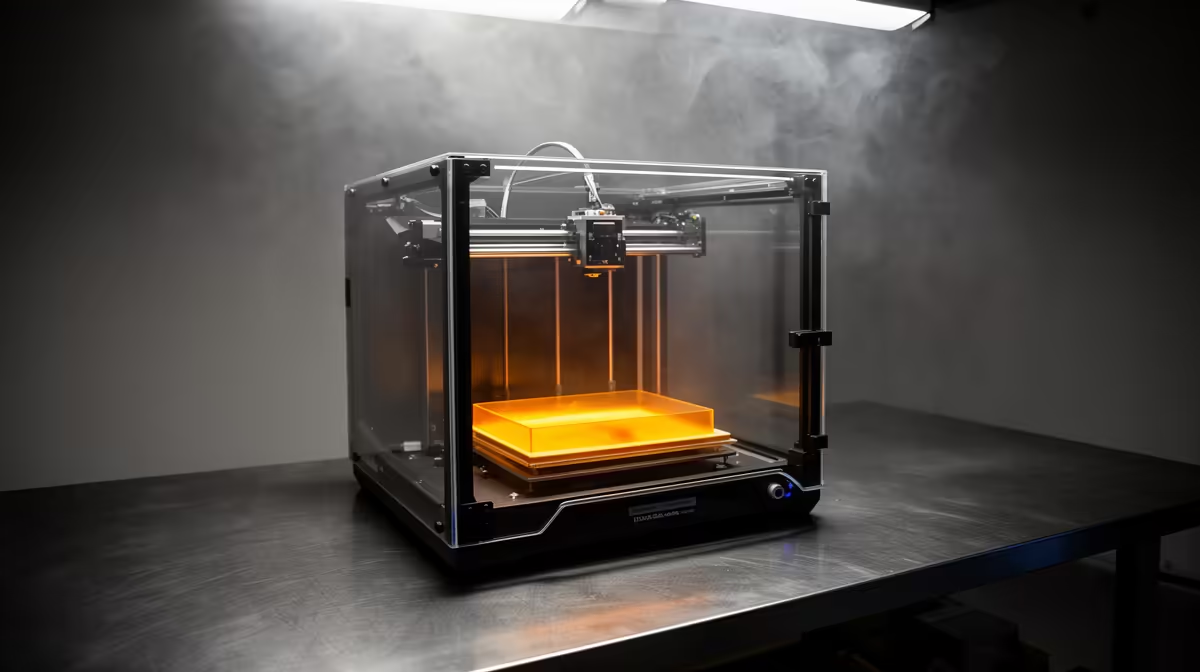
Engineering filaments like ABS, ASA and PA-CF warp the moment they cool unevenly, which is why an open-frame printer struggles with them and an enclosed engineering 3D printer earns its keep. In South Africa the realistic shortlist comes down to two locally stocked CoreXY machines: the Bambu X2D at R16,499 and the Creality K2 Plus at R32,999. They solve the same heat-management problem at very different scales, so the right pick depends almost entirely on how big your parts are.
For most SA makers printing functional brackets, jigs and ABS housings, the Bambu X2D at R16,499 is the smarter buy: a compact enclosed CoreXY built for high-temp filaments. Step up to the Creality K2 Plus at R32,999 only when you genuinely need its 350mm bed for large single-piece parts.
An enclosure traps the heat the hotend and bed throw off, holding the chamber warm enough that the bottom layers of a print do not contract faster than the top. That differential contraction is exactly what causes the corners of an ABS print to lift off the plate and the layers to split. Keep the chamber stable and warm, and ABS, ASA and nylon blends behave far more predictably.
The second half of the equation is the CoreXY motion system. Both these printers move the toolhead on a fixed-mass gantry rather than flinging a heavy bed back and forth, so they hold accuracy at higher speeds. For engineering parts where a 0.2mm dimensional error means a press-fit bearing no longer presses in, that rigidity matters as much as the heat.
At R16,499 the X2D is the entry point into serious enclosed printing. Its 300 x 300 x 300mm build volume handles the work most people actually do: tool holders, RC chassis parts, drone frames, replacement housings and mechanical prototypes. The active chamber heater is rated up to 90 degrees C, which puts high-demand materials like PEEK and carbon-fibre-filled nylon within reach, not just ABS. The print speed tops out at 800mm/s thanks to a stiff Titanium-Carbon hybrid motion system, so engineering parts that need multiple walls and dense infill do not take a full day.
Carbon-fibre-filled filament is abrasive, so check that you are running a hardened nozzle before you load it.
If your parts fit comfortably inside a 300mm-class footprint and you care more about reliable high-temp results than raw bed size, this is the machine. It is also the easier one to live with in a flat or a small home workshop, since it does not dominate a desk. You can browse the current enclosed and engineering models on the 3D printer range at Evetech to confirm the exact configuration in stock before you commit.
The K2 Plus costs roughly double at R32,999, and most of that premium pays for one thing: a 350 x 350 x 350mm bed. That is a meaningful jump. A 350mm build area lets you print a full helmet shell, a large enclosure or a structural bracket in a single piece rather than splitting it and gluing the seams, and glued seams are almost always the weak point in a functional part.
The K2 Plus runs at up to 600mm/s and uses heavy-duty all-metal linear rails on all axes, which keeps large-mass print moves accurate even when the geometry is complex. Its active chamber heats to 60 degrees C, which is enough for reliable ABS and ASA results though it falls short of the X2D's 90-degree ceiling for exotic engineering materials.
A bigger heated chamber also makes large ABS prints more achievable, because the volume of air being held warm is more consistent across a tall part. If your work routinely runs past what a compact printer can hold, the K2 Plus stops being a luxury and becomes the tool that lets you finish the job at all.
For accessories, spare nozzles and maintenance gear to keep either machine running, the accessories best sellers are a sensible place to stock up before your first long engineering run.
Engineering filaments cost more than standard PLA, and both printers will go through hardened nozzles faster on carbon-fibre blends. Budget for spare nozzles up front rather than discovering you need one mid-project. Ventilation also matters: ABS and ASA give off fumes, so position either printer in a room you can air out, not a sealed cupboard. PA-CF needs the highest temperatures of the common engineering filaments, so confirm the hotend rating for your chosen material before ordering a roll.
Match the machine to your part size, not the spec sheet. If your largest parts fit a 300mm bed, the X2D delivers the same enclosed high-temp capability for half the money, plus a higher chamber ceiling for advanced materials. If you are regularly printing parts past 300mm and splitting them is hurting your results, the K2 Plus and its 350mm bed pay for themselves in fewer failed glue joints and rejected assemblies.
In practice, yes. ABS contracts as it cools and an open printer lets the lower layers cool too fast, causing warping and layer splitting. An enclosed chamber holds the heat steady so the part cools evenly.
Yes, it is built for high-temp engineering filaments including PA-CF. Carbon-fibre blends are abrasive, so run a hardened nozzle and expect to replace it sooner than a standard brass one.
Only if you need the size. The main thing the extra R16,500 buys is a 350mm bed for large single-piece parts. For typical brackets and housings the X2D gives the same enclosed high-temp performance at a higher chamber temperature ceiling.
The K2 Plus 350mm bed handles large enclosures, helmet shells and big structural parts in one piece. The X2D suits the more common run of tool holders, drone frames and mechanical prototypes that fit a 300mm footprint.
Yes, both the X2D and the K2 Plus are stocked in South Africa, so you avoid import waits and have local support for parts and service.
The Bambu X2D's 90-degree active chamber is the relevant spec here. The K2 Plus reaches 60 degrees, which covers ABS and ASA but is not enough for PEEK. If exotic engineering polymers are on your roadmap, the X2D has the edge despite its smaller footprint.
Ready to print functional parts that actually hold up? Compare both enclosed CoreXY machines and check current stock on the 3D printer range at Evetech, then pick the bed size that fits your work.
In practice, yes. ABS contracts as it cools and an open printer lets the lower layers cool too fast, causing warping and layer splitting. An enclosed chamber holds the heat steady so the part cools evenly.
Yes, it is built for high-temp engineering filaments including PA-CF. Carbon-fibre blends are abrasive, so run a hardened nozzle and expect to replace it sooner than a standard brass one.
Only if you need the size. The main thing the extra R16,500 buys is a 350mm bed for large single-piece parts. For typical brackets and housings the X2D gives the same enclosed high-temp performance at a higher chamber temperature ceiling.
The K2 Plus 350mm bed handles large enclosures, helmet shells and big structural parts in one piece. The X2D suits the more common run of tool holders, drone frames and mechanical prototypes that fit a 300mm footprint.
Yes, both the X2D and the K2 Plus are stocked in South Africa, so you avoid import waits and have local support for parts and service.
The Bambu X2D's 90-degree active chamber is the relevant spec here. The K2 Plus reaches 60 degrees, which covers ABS and ASA but is not enough for PEEK. If exotic engineering polymers are on your roadmap, the X2D has the edge despite its smaller footprint.
PCIe 5.0 and PCIe 4.0 differ most in lane support, compatibility, and upgrade value for strategy and sim games. SA buyers should match the choice to their actual hardware and games.
Read more
AM5 vs AM4 for video editing in 4K Difference explained is mostly about compatibility, budget, upgrade path, and setup fit. SA buyers should check device support and real needs before expecting a clear win from either option.
Read more
OLED vs QD-OLED for strategy and sim games buyers - what changes is mostly about compatibility, budget, upgrade path, and setup fit. SA buyers should check device support and real needs before expecting a clear win from either option.
Read more
DisplayPort 2.1 and 1.4 differences matter when SA PC builders match GPUs, monitors, and refresh targets. Use this difference between displayport 2 1 and displayport 1 4 explained pc builders guide to avoid mismatched parts.
Read more
Ray tracing vs Path tracing depends on Strategy and sim games needs, platform limits, and budget fit. Compare compatibility, latency, upgrade path, and real setup constraints before choosing for an SA build.
Read more
wireless mouse guide for Gqeberha gamers should be shortlisted around the job it must do. South African buyers should compare sensor, shape, weight, and wireless latency, warranty path, and upgrade room before treating any pick as best.
Read more
From 1 October 2026, WhatsApp Business Platform service replies in South Africa are expected to cost about $0.0076, or 12 cents, per delivered message.
DDR5-8000 RAM Kits pros and cons depend on the build, budget, and workload. Weigh gaming needs, platform fit, power, cooling, warranty support, and South African pricing context before shortlisting it.
Wi-Fi 6E vs Wi-Fi 6 depends on AAA single-player gaming needs, platform limits, and budget fit. Compare compatibility, latency, upgrade path, and real setup constraints before choosing for an SA build.
Ryzen 9 9950X3D dead pixel checks should isolate the panel first. Run colour fills, inspect the monitor menu, test another cable or input, and capture proof before linking it to the SA CPU upgrade.

YouTube will count public views from the first frame across video formats from 24 August, while earnings and eligibility remain tied to engaged viewing.
Canonical expects Ubuntu on WSL users to outnumber native Ubuntu desktop users before the end of 2026. The software is open source and runs inside supported Windows PCs.
Telkom's daily bundles pair WhatsApp access with 10 all-network voice minutes. The R15 option includes 300MB, while the R17 option uses a fair-use threshold.

A 10,000-hour test found similar image retention across older and newer OLED TVs, while newer panels were brighter and more efficient. Local OLED monitors started at R9,999.

Windows 11 update KB5121003 is linked to crashes in several multiplayer games on versions 24H2 and 25H2. Check the build, report the fault and avoid risky file or update changes unless the problem is confirmed on your PC.

Comsol's standalone 5G network covers about one million Gauteng homes and starts commercial ISP service in September. Early packages range from R275 to R875 a month, but coverage and fair-use rules still decide the real value.

Sennheiser's Momentum True Wireless 5 adds user-replaceable batteries, 12-hour playback and a $299.95 launch price. There is no confirmed South African date, so compare longevity with live earbuds from R199 to R2,999.

AVerMedia's GC531 and GC535 are professional HDMI capture devices for continuous streaming, with RGB24 capture up to 2K30 and 4K30. South African creators should compare them with live 4K capture cards from R2,099.