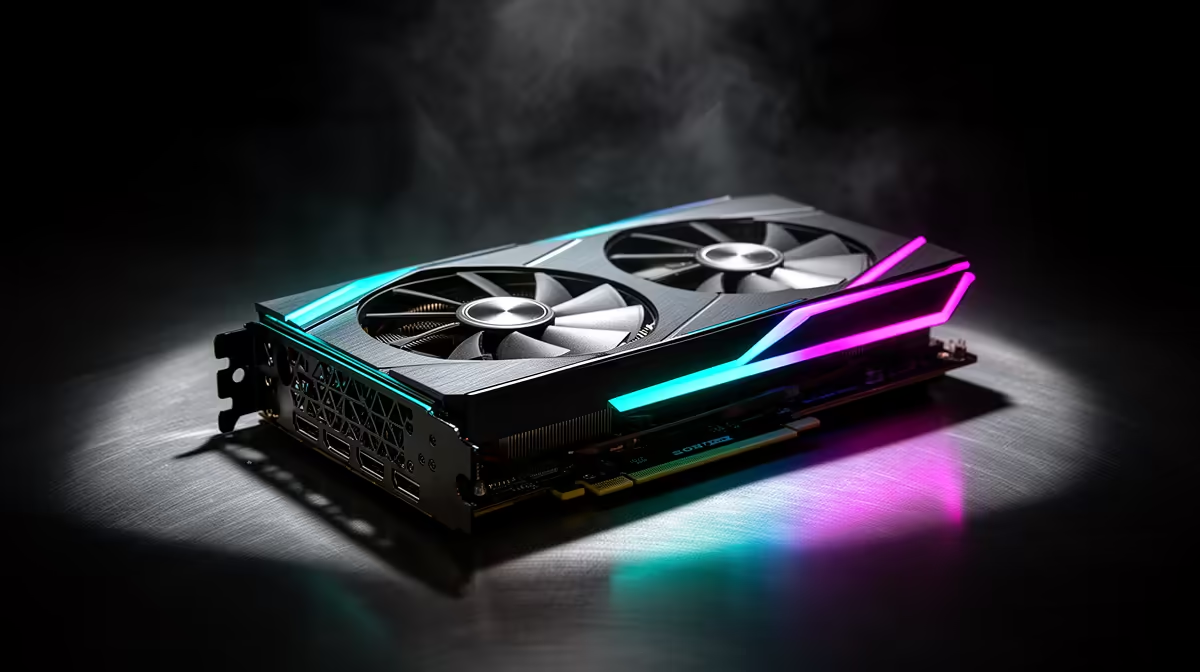
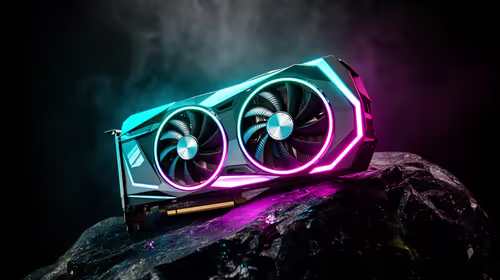
VRAM, not raw speed, decides whether a graphics card can run modern image models at all, which is why the best GPU for Stable Diffusion is a question about memory tiers first and frame rates never. South African buyers can source NVIDIA RTX cards locally across the full range, so the practical job is matching the right VRAM tier to the workflow you actually run, from basic SD1.5 prompts to high-resolution SDXL and Flux.
Quick Answer
Treat 12GB of VRAM as the floor and 24GB as the comfortable ceiling for Stable Diffusion. For most serious users the 16GB RTX 4070 Ti Super is the sweet spot, the 24GB RTX 4090 is the no-compromise flagship, and 24GB cards are effectively unlimited for current 2026 models. In SA, budget from roughly R15,000 for the value tier up to flagship pricing for a 4090.
Why VRAM is the deciding spec
Stable Diffusion loads the model, the text encoder and the working image into video memory. If the model and your target resolution do not fit, generation either fails or falls back to painfully slow shared-memory workarounds. That is why a card's VRAM capacity matters more than its gaming benchmark numbers for this specific task.
The inflection points are well established. 12GB is the bare minimum for SDXL and forces real compromises at higher resolutions. 16GB is comfortable for most normal serious workflows, including SDXL and Flux. 24GB is essentially unlimited for everything current, handling the largest models at full precision without you ever thinking about memory. Bandwidth matters too: a 256-bit bus moving data quickly will finish a batch far faster than a narrow 128-bit bus on a card with the same VRAM number.
The 12GB floor: entry into SDXL
A 12GB card gets you in the door. You can run SDXL, but expect to manage your settings carefully: lower batch sizes, modest resolutions, and the occasional out-of-memory error when you push too far. For someone learning the ropes or generating at standard resolutions, 12GB is workable and keeps the spend down. It is the tier to choose if image generation is a curiosity rather than a daily tool, but you will feel its limits the moment you chase high-resolution output or run heavier models.
The 16GB sweet spot: RTX 4070 Ti Super
For most people, the 16GB RTX 4070 Ti Super is the card to buy. It has enough VRAM for SDXL and Flux, generates images quickly, and avoids flagship pricing. Critically, its 16GB sits on a 256-bit bus with around 672 GB/s of bandwidth, which is far healthier than a budget 16GB card hamstrung by a narrow memory interface. That bandwidth is the difference between a batch finishing promptly and a card that technically has the memory but crawls through the work.
Who the 16GB tier suits
Hobbyists who generate regularly, freelancers producing client work, and anyone running SDXL or Flux as part of a routine. It handles serious workflows without the cost or power draw of a flagship, which makes it the default recommendation for the majority of SA buyers.
The 24GB ceiling: RTX 4090
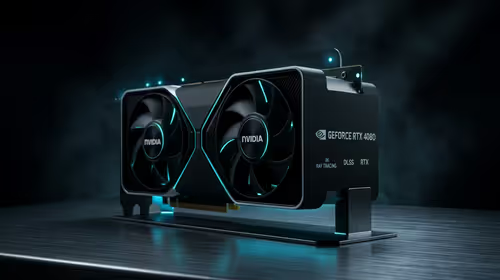
The RTX 4090 is the best GPU for Stable Diffusion if budget is not the constraint. Its 24GB handles every current model at native precision without compromise, and it generates SDXL images in a few seconds. Memory bandwidth is never a bottleneck, batch sizes can be large, and you simply stop thinking about VRAM limits. This is the tier for professionals, studios, and anyone whose income depends on throughput, where the time saved across hundreds of generations justifies the outlay.
For a sense of where these cards sit against each other and what is moving, the GPU best sellers list is a quick read on current demand and value across tiers.
Where the RTX 50 Series Fits
The Blackwell generation introduced a new reference point at the top. The RTX 5090 delivers roughly 1.79 TB/s of memory bandwidth versus the 4090's approximately 1 TB/s, and its 32GB GDDR7 pool handles Flux 2 Dev at FP8, which needs about 32GB on the newest variant, something no 24GB card can manage. For SDXL and Flux.1 Dev the 4090 and 5090 are both overkill, running those models in seconds, but if Flux 2 or heavier 2026 models are in your pipeline, 32GB starts to look like a serious ceiling rather than an extravagance.
For most SA buyers who are not specifically chasing 2026's newest models at native precision, the 4090 remains the no-compromise pick and the 4070 Ti Super remains the value recommendation. The 5090 earns its place for professionals whose income depends on throughput or who need to stay current with the newest model releases.
Matching the tier to your work
Pick 12GB if you are starting out and generating at standard resolutions on a budget. Pick the 16GB 4070 Ti Super if Stable Diffusion is a regular part of your week and you want headroom for SDXL and Flux without flagship cost. Pick a 24GB 4090 if you generate professionally and want zero memory constraints at full precision. Whichever tier fits, sourcing locally avoids import hassle, and the AI PC range at Evetech packages these GPUs into complete systems built for generation workloads rather than leaving you to assemble the rest.
Frequently Asked Questions
How much VRAM do I need for Stable Diffusion?
Treat 12GB as the absolute minimum for SDXL, 16GB as comfortable for most serious workflows, and 24GB as effectively unlimited for current 2026 models. Below 12GB you are limited to lighter, lower-resolution work.
Is the RTX 4070 Ti Super good for Stable Diffusion?
Yes, it is the best value pick for most users. Its 16GB of VRAM covers SDXL and Flux, and its 256-bit bus delivers strong bandwidth, so it generates quickly without flagship pricing.
Is the RTX 4090 worth it for AI image generation?
For professionals and heavy users, yes. The 24GB of VRAM removes every memory constraint and lets you run the largest models at full precision with very fast generation times. For casual use it is more card than you need.
Does memory bandwidth matter as much as VRAM capacity?
It matters a great deal. Two cards with the same VRAM can perform very differently if one has a wide 256-bit bus and the other a narrow 128-bit bus. Bandwidth determines how fast batches actually complete.
Can a 12GB card run SDXL?
It can, but with compromises. You will manage smaller batches and lower resolutions and may hit out-of-memory errors on heavier tasks. It is fine for learning and standard-resolution work, less so for high-resolution production.
Building a generation rig? Explore complete AI PC systems at Evetech with the right VRAM tier already specced, so you can start creating instead of troubleshooting memory limits.