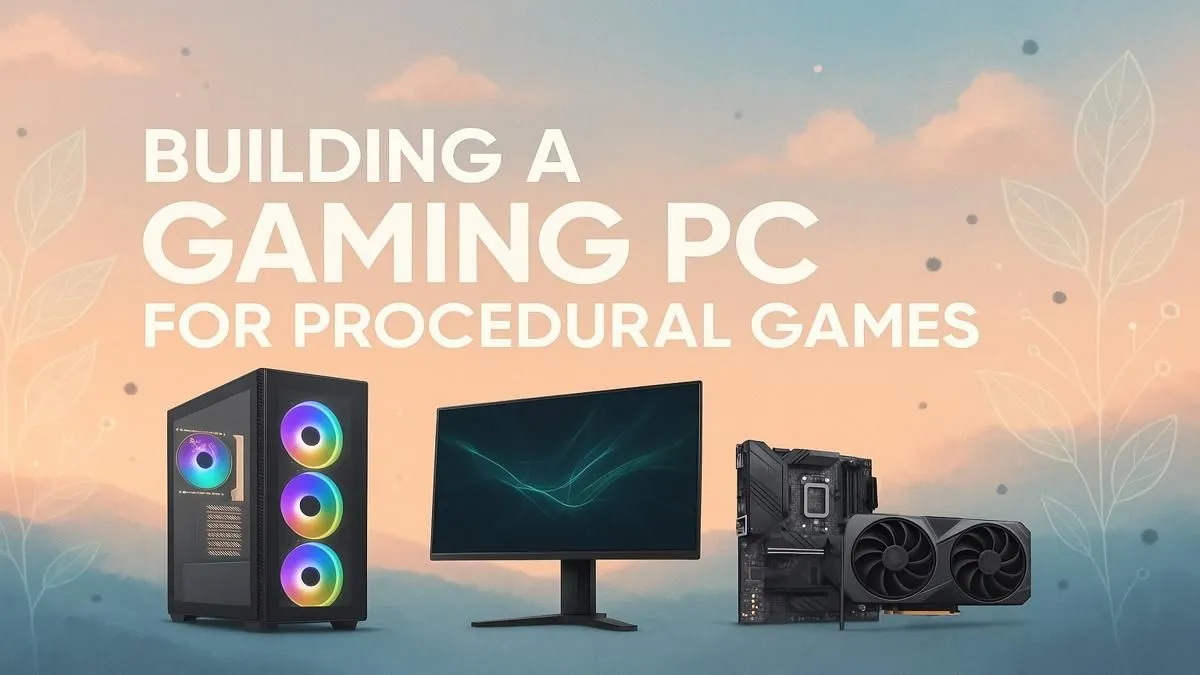
Tired of your rig stuttering every time you warp to a new system in No Man's Sky or discover a new biome in Minecraft? You're not alone. Procedural games, with their endless, unpredictable worlds, are incredibly demanding. They don't just need raw power; they need the right kind of power. This guide breaks down the absolute best PC build for procedural games in 2025, ensuring your only surprise is what's over the next hill... not a frame drop.
Why Procedural Games Need a Smarter PC Build
Unlike a standard game with hand-crafted levels, procedural titles create the world around you on the fly. Think of your PC as having two jobs: your CPU is the architect, rapidly generating terrain, enemies, and loot, while your GPU is the painter, rendering it all in glorious detail. If the architect (CPU) is slow, the painter (GPU) has nothing to work with, leading to those frustrating stutters and hitches.
This is why a balanced PC for procedural games prioritises a powerful processor just as much as a top-tier graphics card. It’s about creating a smooth pipeline from world generation to your screen.
Core Components for Your Procedural Gaming Rig 🚀
Building the perfect rig means focusing on the components that do the heaviest lifting. For a machine designed to handle endless generation, three areas are non-negotiable: the CPU, your storage speed, and having enough RAM.
The CPU: Your World-Building Engine
The Central Processing Unit is the undisputed king here. A CPU with high clock speeds and a strong core count is essential.
- Single-Core Performance: Determines how quickly the game can execute a single task, like generating a specific piece of terrain.
- Multi-Core Performance: Helps juggle the game, your operating system, Discord, and other background apps without a sweat.
For 2025, we recommend aiming for at least an Intel Core i5 (13th Gen or newer) or an AMD Ryzen 5 (7000 series or newer) as a fantastic starting point. For those who want zero compromises, a Core i7/Ryzen 7 is the sweet spot for a high-end build for procedural generation.
RAM and Storage: The Unsung Heroes ⚡
A fast CPU is useless if it's waiting for data. This is where RAM and your SSD come in.
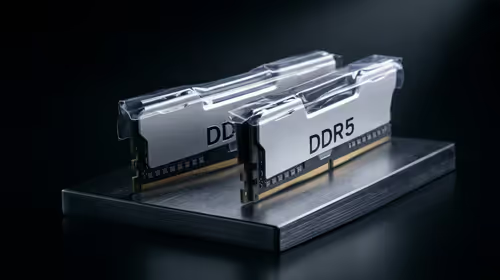
- RAM: Procedurally generated worlds can chew through memory. While 16GB was the standard, 32GB of DDR5 RAM is now the recommended capacity to ensure a smooth experience without needing to close all your browser tabs.
- Storage: A fast NVMe SSD is a must. These games constantly load new assets as you explore. An NVMe drive, especially a Gen4 model, reduces loading screens and eliminates in-game stuttering caused by slow asset streaming.
Pro Tip: Check Your SSD Speed
Not all SSDs are equal. When buying, look for the 'read write' speeds. A Gen4 NVMe SSD can offer speeds over 7,000MB s, while an older SATA SSD might top out around 550MB s. That difference is massive for loading complex, generated worlds.
The GPU: Bringing It All to Life
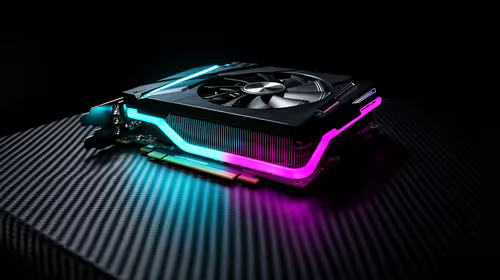
While the CPU does the generating, you still need a solid GPU to render these beautiful, chaotic worlds at high resolutions and frame rates. The key is balance. There's no point pairing a top-of-the-line RTX 4090 with a budget CPU; you'll just create a bottleneck.
For a great 1440p experience, a card like the NVIDIA GeForce RTX 4060 Ti or an AMD Radeon RX 7700 XT provides a brilliant blend of price and performance, perfectly complementing a modern Core i5 or Ryzen 5 processor. This combination creates a truly capable PC for procedural games without needing to sell a kidney.
Putting Together the Best PC Build for Procedural Games
So, what does the ideal build look like? It's all about synergy. A powerful CPU, 32GB of fast DDR5 RAM, and a Gen4 NVMe SSD form the foundation. On top of that, a well-matched GPU ensures the stunning worlds your PC creates are displayed in full, fluid detail.
Whether you're exploring the starfields of... well, Starfield, or surviving the chaos of Valheim, this blueprint for the best PC build for procedural games will keep you immersed and ahead of the curve in 2025 and beyond. ✨
Ready to Build Your Universe Explorer?
Stop letting performance issues dictate your adventures. Let our experts help you configure the perfect custom PC that's optimised for the endless possibilities of procedural gaming. Design your ultimate rig with Evetech today and experience worlds without limits.