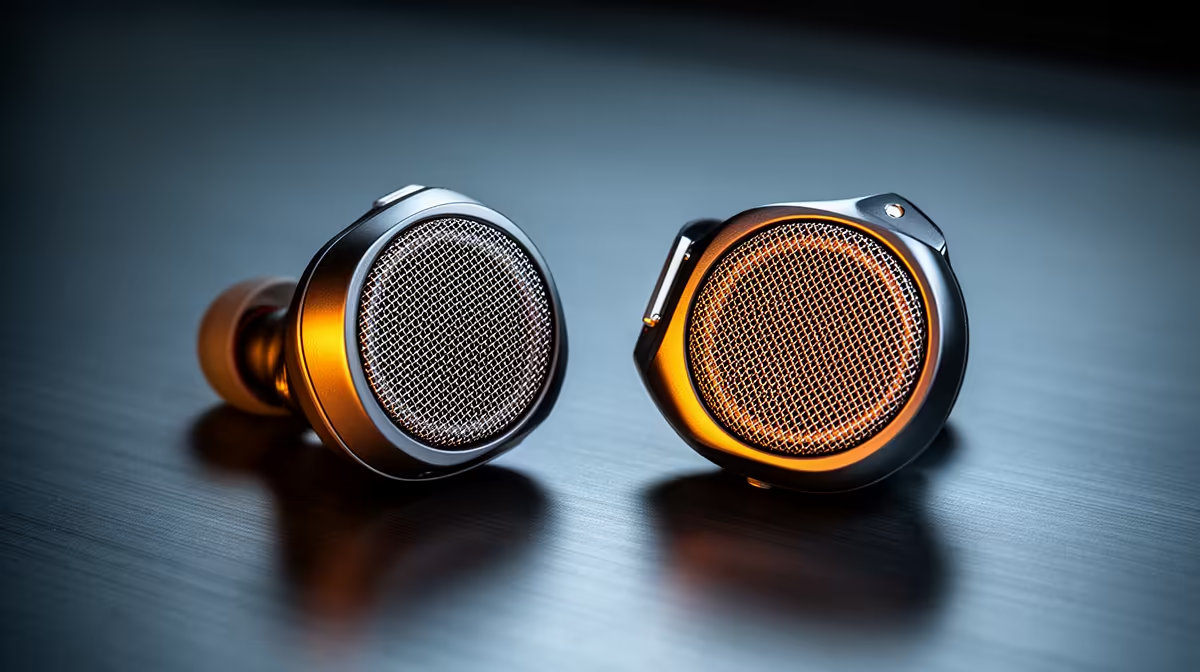
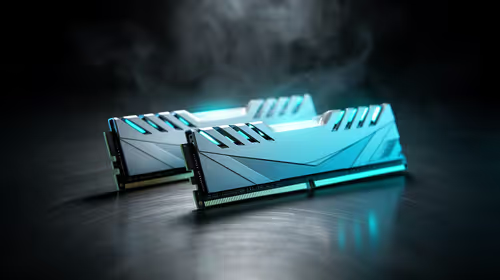
A driver technology that used to live only in headphones costing many thousands of rand now fits inside an in-ear monitor you can buy for the price of a decent dinner out. The best planar magnetic IEMs under R2,000 put fast transients, textured bass, and resolution that punches well above their price into a pocketable shell. The Letshuoer S12, sitting around the $150 tier internationally, is the piece that cracked this category wide open.
Quick Answer
The Letshuoer S12 is the standout planar magnetic IEM in this bracket, built around a 14.8mm large-diaphragm planar driver with 16-ohm impedance and 102dB sensitivity. It delivers planar speed, treble extension, and detail that reviewers compare to monitors several times its price, all comfortably under R2,000.
What planar drivers do differently
A planar magnetic driver suspends an ultra-thin diaphragm with a flat conductive trace between magnets, so the entire surface moves as one piece. Compared to the tiny dynamic drivers in most cheap earphones, that means faster transients, less distortion, and a cleaner, more even response across the range. The result is the snap of a drum hit landing exactly when it should and bass that has texture rather than just weight.
For years this was strictly headphone territory, because shrinking a planar driver into an in-ear shell without losing performance is hard. The S12 managed it with a 14.8mm diaphragm, and that single move dragged the entry point for planar sound down to a price ordinary listeners can reach.
The Letshuoer S12, in detail
The S12 uses a five-axis CNC-machined aluminium shell that sits snugly in the concha, which keeps it light and comfortable for long sessions. The tuning leans toward a balanced, reference-style signature with enough musicality that it never sounds clinical. Note definition is sharp and the resolution genuinely rivals IEMs in a far higher bracket, which is why it earns its reputation as a technical overachiever.
In the box you get memory foam and silicone tips in three sizes, a stock cable, and a carrying case, so it is ready to use out of the gate. At 16 ohms and 102dB it is easy to drive from a phone dongle or any small DAC, though a little extra power tightens the low end further.
S12 versus the Pro and Ultra
Letshuoer extended the line with the S12 Pro and the newer S12 Ultra. The Pro sits in the $150 to $170 USD range internationally and refines the accessories and presentation of the original. The Ultra pushes further, bringing a slightly more polished frequency response while keeping the same core 14.8mm planar architecture. The original S12 remains the value pick for anyone chasing planar sound on the tightest budget. If you can stretch, the Pro adds a slightly more polished presentation, but the core planar character is shared across the family.
Tuning and the Harman target
The S12 is broadly balanced with a mild upper-midrange emphasis that adds air and clarity without becoming fatiguing. It does not strictly follow the Harman in-ear target, leaning slightly brighter in the treble, which suits listeners who prefer a more revealing, analytical presentation. Bass is present and fast rather than warm and thick, which is characteristic of planar drivers at any price. Listeners who want a bassier, warmer sound may prefer a dynamic-driver IEM at this price point; listeners chasing technical detail and speed will find the S12 remarkable value.
Driving them and pairing
Because the S12 is sensitive and low-impedance, you do not need a desktop amplifier to enjoy it. A USB-C dongle DAC or a small portable amp is enough to get the most out of it, and the difference over a phone's built-in output is audible mostly in bass control and stage width. If you are also shopping for over-ear options to compare, the wider headphone and headset range at Evetech shows how planar IEMs stack up against full-size cans at similar money.
For a quick read on what other listeners are buying alongside the S12, the most popular headsets at Evetech are a useful gauge of current demand and pairing choices in the SA market.
Other planar options in the bracket
The S12 dominates recommendations at this price, but it is not the only option worth knowing about.
KZ PR2
The KZ PR2 is the most affordable route into planar IEM territory, sitting well under R1,000 in most markets. It uses a smaller planar driver and the build is less refined than the S12, but for first-time planar buyers on the tightest possible budget, it demonstrates the fundamental character of the driver type: that characteristic speed and controlled treble. Think of it as a proof of concept rather than a long-term endgame.
Hybrid planar designs
A growing category in 2026 pairs a planar magnetic tweeter with a dynamic bass driver, attempting to get the speed and detail of planar in the midrange and highs while recovering the warmth and sub-bass punch that pure planar designs can lack. These hybrids are particularly useful for listeners whose main genres are bass-heavy, since a pure planar at this price can sound leaner than an equivalent dynamic driver earphone in the low end. If your listening skews toward hip-hop, electronic or anything that demands physical bass weight, a hybrid in the same price bracket is worth auditioning alongside the S12.
The upgrade path above R2,000
For reference: the 7Hz Timeless Anniversary Edition sits in the $200 USD tier internationally, above this bracket, and is considered a significant step up in high-frequency refinement for listeners who find the S12 slightly forward in the upper mids. If you finish with the S12 and want to know where the category goes next, that is the usual answer in community comparisons.
Who these are for
Planar IEMs under R2,000 suit anyone moving up from generic earphones who wants to hear what their music actually contains: the texture in a bassline, the decay of a cymbal, the space between instruments. They reward good recordings and a half-decent source. If your library is mostly compressed streaming on a noisy commute, the gains are smaller. For desk listening, careful sessions, and anyone curious about audiophile sound without a painful price, the S12 is the obvious place to start.
Frequently Asked Questions
What makes the Letshuoer S12 special at its price?
It brings a genuine 14.8mm planar magnetic driver to a price point that used to be dominated by basic dynamic earphones. The payoff is faster transients, better detail, and resolution that reviewers compare to monitors costing several times more.
Do planar IEMs need an amplifier?
The S12 is easy to drive at 16 ohms and 102dB, so a phone or a small USB-C dongle DAC runs it fine. A dedicated amp is not required, though a little extra power tightens bass control and slightly widens the soundstage.
Should I buy the S12, S12 Pro, or S12 Ultra?
The original S12 is the value champion and the right pick under R2,000. The Pro and Ultra sit higher up the range with refined tuning and accessories, so choose them only if your budget stretches and you want the more polished presentation.
Are planar IEMs good for everyday listening?
Yes, especially for deliberate listening to well-recorded music where their detail and speed shine. On noisy commutes with compressed streaming the advantage narrows, but for desk and focused sessions they are a clear step up from ordinary earphones.
How do planar IEMs compare to dynamic-driver earphones?
Planar drivers move a flat diaphragm as a single unit, giving faster transients and lower distortion than the small dynamic drivers in most budget earphones. That translates into tighter, more textured bass and cleaner treble at the same price.