Smart lighting only becomes genuinely reliable once it stops phoning home. Run your bulbs through Home Assistant over Zigbee or Matter and they respond instantly, keep working when the internet is down, and answer to you rather than a manufacturer's cloud app. The catch for SA buyers is physical, not technical: our lamps are split between E27 screw and B22 bayonet fittings, so the right protocol means nothing if the base does not fit your fixture.
Quick Answer
For local control in Home Assistant, choose Zigbee or Matter-over-Thread bulbs and pair them through ZHA or Zigbee2MQTT rather than the maker's app, which gives you instant, cloud-free control. Check the fitting before you buy, since SA homes mix E27 screw and B22 bayonet bases. Expect to spend more per bulb than a basic Wi-Fi smart bulb, but gain reliability and privacy.
Why local control beats Wi-Fi smart bulbs
Cheap Wi-Fi smart bulbs route every command through the manufacturer's servers. Tap a button and the signal travels to a data centre and back, which adds lag, breaks entirely when your line drops, and ties your home to a company's app staying online. They also clutter your Wi-Fi with extra devices.
Zigbee and Matter bulbs work differently. They talk to a local hub or coordinator inside your home, so Home Assistant controls them directly with no round trip to the cloud. Lights respond the instant you ask, automations fire reliably, and nothing stops working if your internet does. That is the whole appeal of a local-first setup.
Match the fitting first: E27 versus B22
This is the step SA buyers most often skip. South African homes use two common bayonet and screw standards, E27 screw fittings and B22 bayonet fittings, and many fixtures here are B22 where overseas guides assume E27. A bulb with perfect Home Assistant support is useless if it will not seat in your lamp.
Before buying, look at the fitting on your existing bulb or the socket itself. E27 has a threaded screw base; B22 has two small pins that push and twist to lock. Confirm which one each room uses, and buy accordingly. Some ranges offer both bases, others only one, so check the listing rather than assuming.
Zigbee versus Matter for your setup
Both protocols give you local control, and the choice depends on your existing kit. Zigbee is mature, widely supported, and pairs cleanly with Home Assistant through ZHA or Zigbee2MQTT using a small USB coordinator. Many Zigbee bulbs also act as mesh routers, strengthening the network for your other Zigbee devices.
Matter, usually running over Thread, is the newer standard built for cross-platform local control. A Matter bulb can be added to Home Assistant locally and also works with other Matter controllers, which is handy if your household mixes ecosystems. Either is a sound choice; pick based on the coordinator or hub you already run.
The pairing rule that matters
However good the bulb, pair it through ZHA or Zigbee2MQTT, not the manufacturer's own app. Pairing through the maker's app often keeps the bulb tethered to their cloud, undermining the whole point. Adding it directly to your local coordinator is what delivers true local control, reliable automations, and zero cloud dependency.
Specific bulbs worth knowing
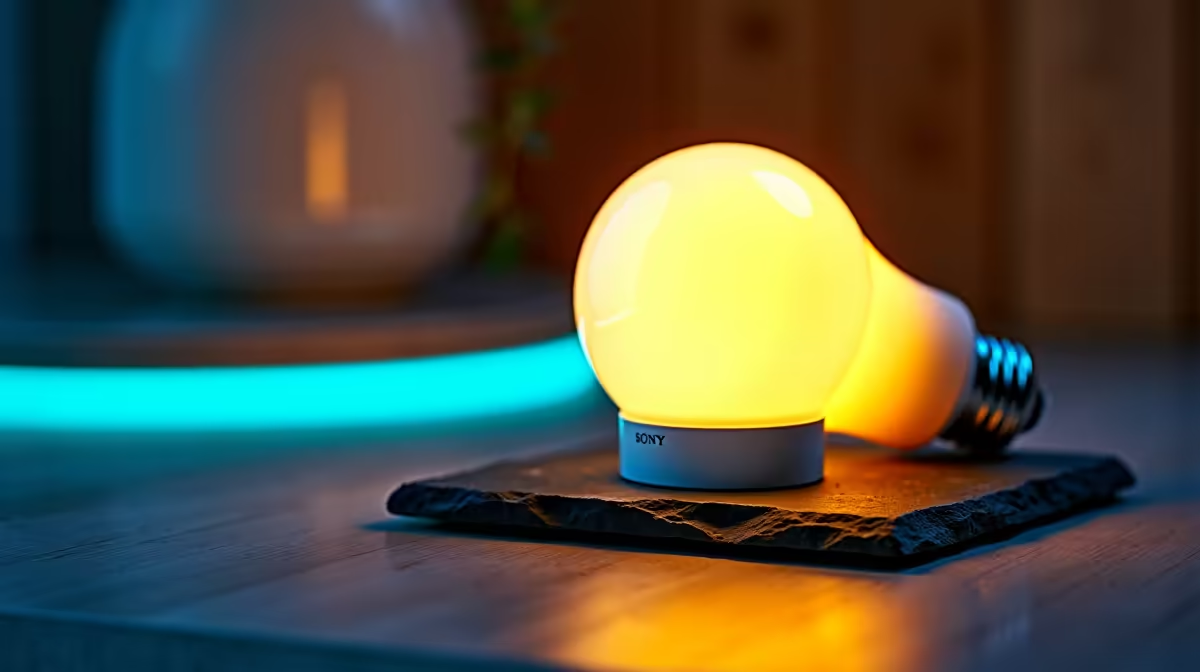
For premium E27 locally-controlled lighting, a Philips Hue White Ambiance (2025 generation) runs Zigbee, Bluetooth, and Matter over Thread simultaneously. That means it works with a Hue Bridge, directly via ZHA or Zigbee2MQTT without any bridge, or through a Matter controller. The 2025 update improved energy efficiency and added fine 0.2% dimming for sleep automations. The white spectrum runs from 2000K warm candlelight to 6500K daylight. It is the premium pick, and it costs accordingly.
For a budget entry into proper local control, the IKEA TRADFI E27 806lm Zigbee 3.0 bulb pairs directly with ZHA or Zigbee2MQTT and requires no IKEA gateway. It also acts as a Zigbee router, contributing to your mesh. The colour temperature range is 2200K to 4000K, covering warm and neutral white. At a fraction of the Philips Hue price, it is an excellent starting point for rooms where full-colour is not needed.
For rooms with wall switches that get regularly flicked, a Sengled Element Classic E27 is worth noting: it handles being power-cycled cleanly and rejoins the Zigbee mesh after being switched off at the wall, rather than losing its connection and dropping out of automations.
Picking by colour, white, and budget
Decide whether you need full colour or just adjustable white. Tunable white bulbs that shift from warm to cool cover most living and working spaces and usually cost less than full-colour bulbs. Full colour is worth it for feature lighting, gaming rooms, and mood scenes, but it is overkill for a kitchen or study.
Budget ranges from inexpensive white-only Zigbee bulbs up to premium bulbs that run Zigbee, Bluetooth, and Matter over Thread at once with very fine dimming. For rooms where a wall switch gets flicked off regularly, prefer a bulb known to rejoin the mesh cleanly so it does not drop off the network. To check fittings, protocols, and current stock in one place, browse the smart home range at Evetech, and a Zigbee coordinator or USB stick from the accessories best sellers is the small piece that ties the whole local setup together.
Frequently Asked Questions
Do I need a hub for local smart bulbs?
For Zigbee, yes, a coordinator such as a small USB stick that Home Assistant talks to through ZHA or Zigbee2MQTT. Matter-over-Thread needs a Thread border router. Either way the hub keeps control local instead of routing through the cloud.
What is the difference between E27 and B22 in SA?
E27 is a screw fitting with a threaded base, while B22 is a bayonet fitting with two pins that push and twist to lock. South African homes use both, so check each fixture before buying a bulb to make sure it physically fits.
Why pair through Zigbee2MQTT instead of the maker's app?
Pairing through the manufacturer's app often keeps the bulb tied to their cloud, adding lag and a point of failure. Adding it directly through ZHA or Zigbee2MQTT gives you true local control, faster response, and reliable automations with no cloud dependency.
Are Zigbee or Matter bulbs better for Home Assistant?
Both work locally and well. Zigbee is mature, widely supported, and many bulbs extend the mesh. Matter over Thread is newer and cross-platform. Choose based on the coordinator or hub you already run rather than the protocol alone.
Do I need colour bulbs or is white enough?
Tunable white, which shifts from warm to cool, suits most everyday rooms and costs less. Save full-colour bulbs for feature lighting and mood scenes where the extra ability genuinely adds something.
Will smart bulbs still work if the internet goes down?
Zigbee and Matter-over-Thread bulbs controlled through Home Assistant respond locally, so a dropped internet connection does not affect them. Cloud-dependent Wi-Fi bulbs will fail in an outage, which is a key reason to choose a local protocol for any bulb you rely on for daily automations.
Building a cloud-free smart lighting setup? Browse the smart home range at Evetech to match Zigbee or Matter bulbs to your E27 or B22 fittings, and grab a Zigbee coordinator from the accessories best sellers to run it all locally through Home Assistant.