A spool of filament and a weekend of tinkering can feel like the start of a workshop, but the maths behind owning a 3D printer versus paying a print service in South Africa is colder than that. The honest answer hinges almost entirely on how often you actually print, not on how badly you want the machine on your desk. Volume decides it.
Quick Answer
Owning pays off once you print regularly. An entry FDM printer starts around R5,499, and a service typically charges per part plus material. Print a handful of small parts a year and the service wins easily. Print weekly, or batch large jobs, and the printer clears its cost inside a few months and keeps saving after that.
The Two Cost Models Are Not Comparable At First Glance
A print service has near zero entry cost. You upload a file, pay a per part fee that bundles material, machine time and labour, and the finished item arrives. Nothing to maintain, no failed prints to eat, no filament going brittle in a humid Durban cupboard.
Owning flips that. You pay the machine up front, then a much lower running cost per part: filament works out to a few rand for a small model, plus electricity and the occasional nozzle or build plate. The catch is that everything in between, calibration, failed first layers, bed levelling, clogs, lands on you.
So the comparison is not "printer price versus part price". It is a fixed cost with cheap parts against zero fixed cost with expensive parts. They cross over at a specific volume, and that crossover is the whole decision.
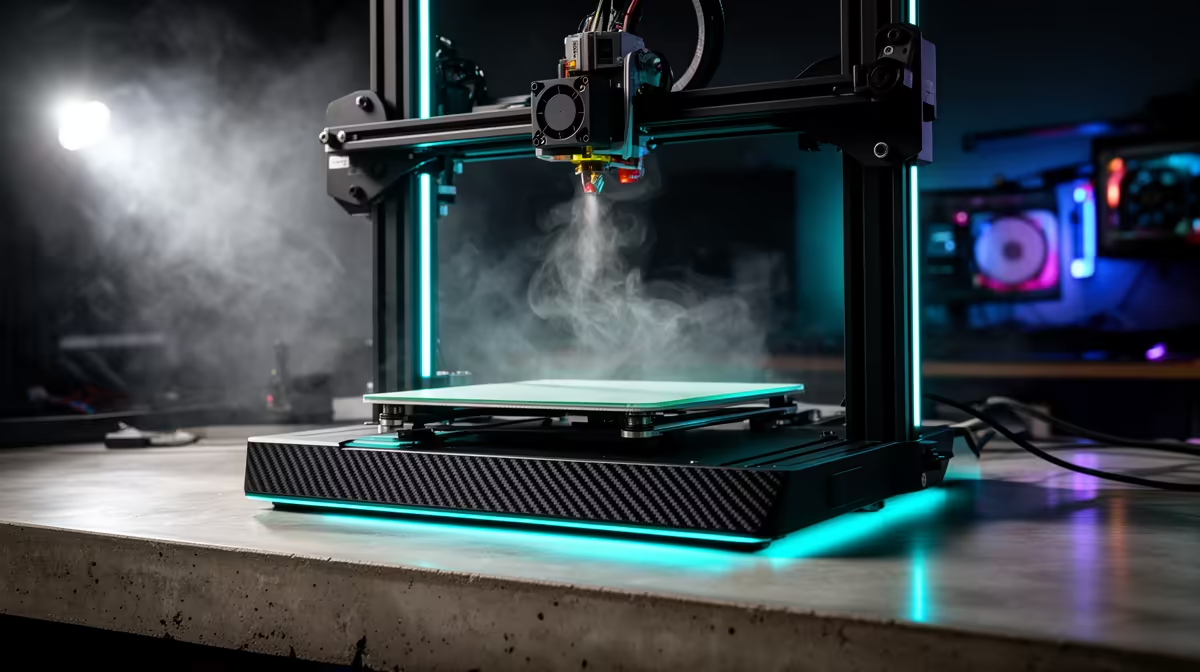
If you want to see where the entry hardware actually sits today, the current 3D printer range at Evetech gives you the real starting prices to plug into your own sums rather than a guess.
Working Out Your Break-Even
Treat it as a simple split. Take the printer outlay, say R5,499, and divide it by the per part saving you get from printing at home instead of outsourcing.
A Worked Example
Imagine a service charges roughly R120 for a part that costs you about R20 in filament to print yourself. That is a R100 saving per part. Divide R5,499 by R100 and you reach break-even at around 55 parts. After that, every print is almost pure saving.
If you only need 55 parts over five years, the service was the smarter call. If you hit 55 parts in three months because you print enclosures, brackets, miniatures or replacement clips constantly, the printer paid for itself before the warranty cooled off.
Why Bigger And Functional Parts Tilt It Faster
Service pricing scales hard with size and print time. A large functional part, a tool holder, a drone frame, a custom mount, can cost several hundred rand to outsource but only tens of rand in filament at home. Heavy, frequent, sizeable prints push your break-even point closer with every job. Small decorative one-offs push it away.
The Hidden Costs People Forget On Both Sides
Owning is not just the printer. Budget for spare nozzles, a roll or two of spare filament, adhesion aids, and storage that keeps filament dry, since damp filament prints badly. There is also time: your first weeks involve real learning, and a few prints will fail.
The service hides costs too. Shipping or collection adds rand and days to each job. Iterating a design through a service is slow and expensive because every revision is a new paid print. At home you can fail, tweak and reprint the same evening for the price of a little plastic. For makers who design as they go, that iteration speed is often worth more than the per part maths alone.
Material And Quality Differences Worth Pricing In
Volume is the headline, but the kind of part you need quietly shapes the maths too. A home FDM machine prints common materials like PLA and PETG cheaply and well, which covers most hobby and functional jobs. Step up to engineering filaments, flexible materials or very fine resin detail and the picture shifts, since some of those need a different machine type or careful tuning you may not want to learn for a single job.
A service earns its keep precisely here. If you need one part in a material your printer cannot run, or at a surface finish beyond an entry FDM machine, paying per part for that single item is far cheaper than buying a second printer to chase it. The smart owners often run a printer for the bulk of their work and still outsource the rare specialist job, treating the two options as partners rather than rivals.
Quality consistency matters as well. A service delivers a predictable result because the operator has already dialled in their machine. At home, your first prints will not match that until you have learned bed levelling, temperatures and adhesion. Factor that learning period into the early cost, because it is real even though it does not show on an invoice.
Who Should Buy And Who Should Outsource
Buy if you print at least a couple of times a month, if you iterate designs, if you make functional parts or run a small product side-line, or if waiting on a service breaks your workflow. The machine earns its keep and the learning curve becomes a skill you keep.
Outsource if your needs are occasional, if you want a single high-quality showpiece in a material you cannot run at home, or if you simply have no space and no appetite for maintenance. Paying per part to skip the hassle is a perfectly rational choice for light users.
A printer rarely sits alone either. Once it is running you will reach for cutting tools, finishing kit and storage, and the accessories that frequent makers tend to stock up on cover most of those follow-on buys without overspending.
Frequently Asked Questions
How many parts do I need to print before a printer pays off?
It depends on your saving per part, but a common range lands between 40 and 70 parts for an entry machine. Work out what a service charges for your typical part, subtract your filament cost, and divide the printer price by that figure to get your personal number.
Is an entry 3D printer good enough for real use?
Yes for the vast majority of hobby and functional jobs. Entry FDM machines from around R5,499 handle brackets, enclosures, models and prototypes well. You only need to step up for very large builds, exotic materials or fine production-grade detail.
What ongoing costs come with owning a 3D printer?
Filament is the main one, at a few rand per small part, plus electricity, occasional nozzles, a build surface over time, and adhesion or storage supplies. Factor in the odd failed print while you learn, since those eat material too.
When is a print service genuinely the better choice?
When your volume is low, when you need a material or build size your home machine cannot manage, or when you would rather avoid maintenance entirely. For a one-off showpiece a few times a year, paying per part beats owning a machine that sits idle.
Does printing at home save time as well as money?
For frequent and iterative work, yes. You skip shipping and collection delays and can reprint a tweaked design the same day. For a single occasional part, a service may actually be faster since you avoid setup and calibration.
Run your own numbers first: tally how many parts you realistically print in a year, then compare against the live entry prices in the Evetech 3D printer range. If the volume is there, owning pays off fast.