A used UPS can look healthy until an aged battery collapses under load. Before buying a second-hand UPS, verify battery date, self-test, output type, capacity, alarms and replacement options with safe supported testing.
Quick Answer
A second-hand UPS is worth considering only when you can identify the exact model, inspect it safely, verify battery and service history, run a supported self-test, and measure runtime under a controlled load. A passing self-test does not prove full battery capacity or suitability for your electronics.
Use current named products in the UPS range as a new-condition baseline, then compare the required cables or supporting items among accessories best sellers. Read exact written terms; do not assume every new UPS has the same local cover.
Identify the unit before powering it
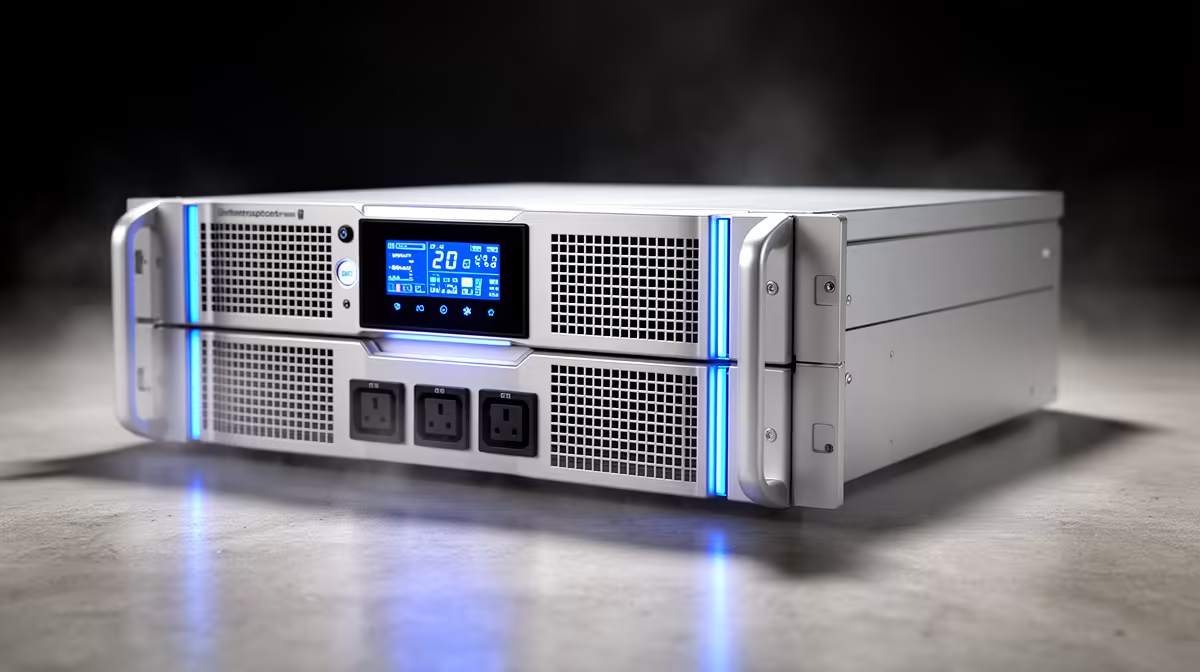
Record the brand, model, VA, watt capacity, input and output voltage, frequency, topology, outlet type, waveform description, battery type, communication ports, and serial or manufacture information where available.
Find the official manual and current support page. Check whether replacement batteries, software, USB drivers, network cards, and approved cables remain available. An old enterprise UPS can be cheap and demand costly battery cartridges or a dedicated input circuit.
Inspect the enclosure, sockets, plug, cable, ventilation, display, battery door, and screws. Burn marks, cracks, corrosion, liquid residue, swollen panels, missing earth pins, exposed conductors, or a chemical smell are reasons to stop.
Do not open electrical sections. Battery compartments designated for user access still require the maker's isolation and handling procedure.
Treat the battery as an unknown consumable
Ask for purchase date, battery replacement date, model of installed battery, storage conditions, typical load, outage history, and self-test logs. Treat verbal history as context rather than proof.
Sealed lead-acid batteries lose capacity with age, heat, storage at low charge, and repeated cycling. Lithium-based units have their own battery-management and ageing considerations. Calendar age alone does not determine remaining runtime.
Check for swelling, leakage, corrosion, heat, and loose terminals through the approved inspection route. Never short a battery or test it with an improvised load.
Price an approved complete battery replacement into the used purchase even when the current pack appears to work. Include recycling of the old battery through an appropriate route.
Run the built-in diagnostics
Power the UPS from a safe earthed supply without sensitive equipment attached. Follow the manual's startup and charge procedure. Check display, alarms, fan, error codes, input reading, battery state, and self-test.
A failed self-test ends the bargain until a qualified assessment establishes the cause. A passed test confirms only what that model checks under its conditions.
Connect supported management software or USB signalling when included in the plan. Confirm the exact computer or NAS detects line state, battery state, load, and alarms. Proprietary software support can end before the hardware does.
Never bypass an alarm, earth, battery interlock, or failed fan to complete a sale test.
Measure runtime with a safe load
Use a non-critical test load within the UPS's VA and watt limits. A suitable lamp or equipment load must also be compatible with the UPS output and test environment. Follow the maker's procedure.
Charge fully, record load, simulate input loss safely, and time the run to a conservative threshold rather than deep discharge. Watch output state, voltage indication, alarms, fan, temperature, and battery decline.
Compare measured runtime with reputable model data at a similar load and battery condition. A battery that collapses from half charge or shows severe voltage drop needs replacement.
Repeat after installing an approved new pack. Update the battery date in software if the model requires it and test shutdown signalling.
Match waveform and transfer to the load
Line-interactive, standby, and online topologies can produce different battery-mode waveforms and transfer behaviour. Read the exact specification and confirm suitability with the PC, console, NAS, audio, or network equipment makers.
A device that runs on mains pass-through may buzz, restart, or overheat on battery output. Test every intended load before depending on the UPS.
Online units can provide continuous conversion and may have fans, higher idle use, and complex bypass states. A cheap used online UPS can be a poor home fit when it needs expensive batteries and constant ventilation.
Calculate the complete used cost
Add the purchase price, approved battery pack, cables, software or management card, transport, assessment, installation, and expected conversion losses. Use current July 2026 named new models for comparison.
Heavy UPS units need safe transport. Do not lift beyond your ability or carry a battery unit by its cable. Large installed systems may need professional isolation and relocation.
Ask for proof of purchase and any transferable support information. Private-sale and retailer remedies differ by the transaction. Use current authoritative South African consumer guidance when rights are unclear.
Keep a maintenance record
Label battery replacement date, test load, runtime, firmware, alarms, and connected equipment. Perform self-tests and controlled runtime checks at the supported interval.
Keep vents clear and the unit dry, cool, and accessible. Do not hide it in a sealed cupboard. Replace batteries and fans only through procedures designated for the exact model.
Stop using the unit after smoke, burning smell, swelling, leakage, unsafe heat, cracked sockets, or repeated unexplained transfers. A bargain UPS should reduce risk, not become another electrical fault.
Check the seller's test environment
Ask to see the UPS cold-start, accept mains input, charge, report load, enter battery mode, and return to line operation. Run the test at a safe location with a known earthed supply and non-critical compatible load.
Listen for a fan that grinds, a relay that chatters, or an alarm the seller dismisses without documentation. Check whether the display buttons work and whether the unit retains settings after power removal.
Confirm that the supplied input lead, output leads, USB cable, rack ears, battery door, and network card belong to the exact model. Missing mounting or proprietary communication parts can erase the saving.
Do not accept a demonstration that bypasses a failed battery, earth, fuse, or interlock. Walk away from any unit modified outside its approved service route.
FAQ
Is a passed self-test enough for a used UPS?
No. It does not prove full runtime, output suitability, battery history, communication support, or behaviour with your load. Run a controlled measured test.
Should I replace the used battery at once?
Budget for an approved replacement. Decide from age, condition, logs, runtime test, and manufacturer guidance. Never reuse a swollen or leaking pack.
Does a used online UPS suit a gaming PC?
It can when capacity, input, output, waveform, noise, ventilation, batteries, and maintenance fit the room. Compare its complete cost with a current new line-interactive option.
Identify the used UPS, price an approved battery, and prove runtime, signalling, and load compatibility before connecting valuable equipment.