Quick Answer
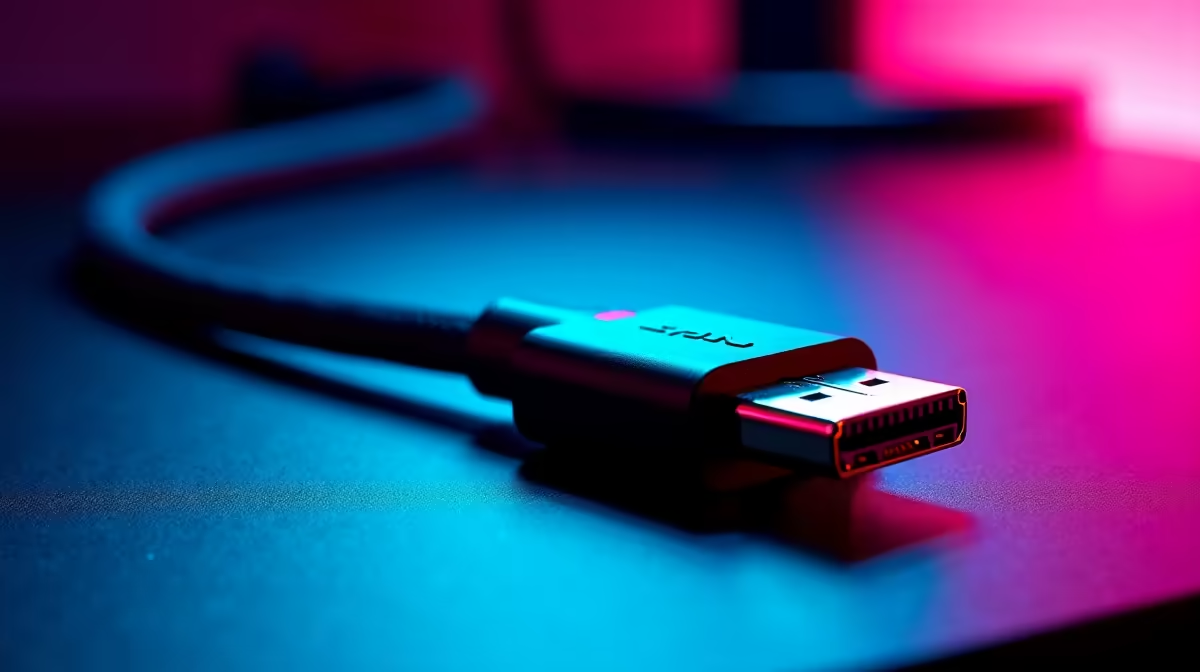
For South African esports and high-resolution gaming, a certified DisplayPort 1.4 cable (32.4Gbps) is the right investment in 2026. It supports 4K@120Hz with DSC and 1440p@165Hz uncompressed, covering every competitive and cinematic gaming scenario that current SA hardware supports, with zero bandwidth headaches.
What SA Esports Players Actually Need From a Cable 🎮
South Africa's competitive scene competes in titles including Valorant, CS2, and Apex Legends through the VS Gaming and Mettlestate circuits. Pro-level players typically prioritise refresh rate over resolution: 1080p@240Hz or 1440p@165Hz is far more common at tournament level than 4K@60Hz because lower resolution reduces GPU load and keeps frames above the 144Hz threshold where input-latency advantages are measurable. A DisplayPort 1.4 cable at 32.4Gbps handles 1440p@240Hz without compression and 1080p@360Hz without breaking a sweat, covering today's esports monitors entirely. Current-gen GPUs like the RTX 5070 and RX 9070 output DP 2.1, making them future-compatible with higher-resolution displays as well.
Reliability Over Specs: What Competitive Players Must Prioritise 🔧
A cable that works 99.9% of the time is not good enough for esports. Signal dropouts and link resets in Valorant or CS2, where one lost frame at the wrong moment costs a round, are functionally catastrophic. Triple-layer electromagnetic shielding prevents interference from PC fans, the PSU cable bundle, and nearby networking hardware that operates in close proximity in a competitive gaming setup. Gold-plated connectors maintain consistent contact resistance through hundreds of plug cycles, which matters for players who transport gear to LAN events run by VS Gaming or EGX South Africa. Budget R250 to R450 for a quality certified cable rather than R80 for an unbranded alternative that risks link instability.
Cable Length and Desk Management for Gaming Setups ✨
For a standard South African gaming desk, a 1.5m cable is the sweet spot: long enough to reach from a tower under the desk to a monitor on the surface, short enough to route cleanly without slack pooling. A 2m cable suits corner desk configurations or setups where the tower sits on a separate shelf. Avoid passive cables beyond 3m for DP 1.4 signals, as passive cables can experience signal degradation at those runs; you would need an active cable instead, which costs significantly more. Velcro cable ties available at SA hardware stores for under R50 keep gaming desks tidy without pinching cable jackets.
Pack a Backup Cable for LAN Events ⚡
Carry a second certified DisplayPort 1.4 cable in your LAN bag alongside your keyboard and mouse. Cable failures at tournaments happen more often than hardware failures, and event organisers rarely stock certified replacements. A spare at R200 to R300 is cheap insurance against a missed match.
FAQ
What DisplayPort version handles 1440p@165Hz for competitive play?
DisplayPort 1.2 at 21.6Gbps comfortably covers 1440p@144Hz. For 1440p@165Hz, DP 1.2 carries it within its headroom in most certified cables. For 1440p@240Hz, step up to a DP 1.4 cable to avoid any compression overhead.
Can a bad cable cause frame drops or added latency in games?
A defective cable causes link resets that appear as dropped frames or brief black screens. Input latency is processed at the GPU level, not the cable level, so a stable certified cable eliminates signal-induced drops without affecting the underlying input pipeline.
Are locally available certified DisplayPort cables easy to find in SA?
Yes. Evetech stocks certified DisplayPort cables in multiple lengths and DP versions. Buying locally means warranty support without import duty delays, and you get cables stocked specifically for SA voltage and climate conditions.
Competing in SA esports or upgrading to 4K gaming?
Evetech stocks certified DisplayPort 1.4 cables chosen for competitive durability and full-bandwidth reliability.