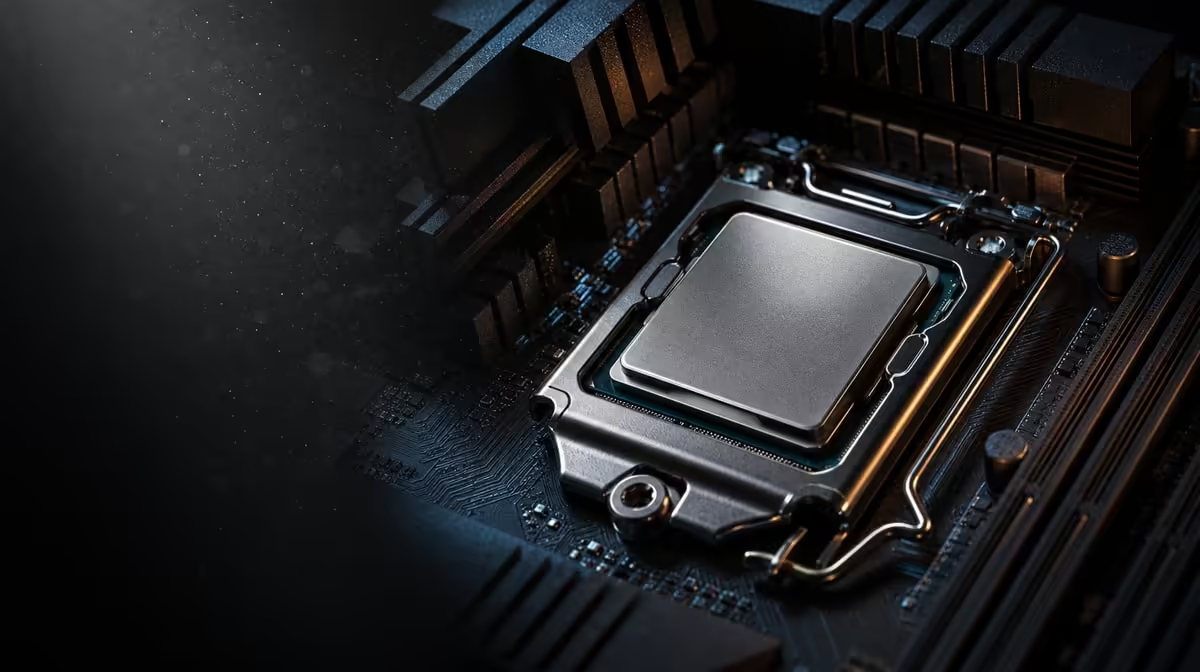
Gaming processors do not work from core count and clock speed alone. Data has to reach those cores in time, which is why AMD 3D V-Cache for gaming deserves to be understood as part of a complete CPU design rather than a magic FPS switch. The R7,199 Ryzen 7 5800X3D combines 100MB cache with eight Zen 3 cores and 16 threads.
Quick Answer
3D V-Cache increases the amount of fast data storage available close to the processor cores. It can help games that reuse working data effectively, but the gain depends on the engine, scene, settings and whether the GPU is already the limit. The Ryzen 7 5800X3D provides a concrete example at R7,199 with 100MB cache, eight cores and 16 threads.
🧠 See where cache fits in the data path
Processor cores continually request instructions and data. On-chip cache gives them a fast place to find information that may be needed again, reducing some journeys to slower system memory. Expanding that nearby capacity can matter when a game's working set contains frequently reused data and the processor would otherwise spend more time waiting.
The 5800X3D states 100MB cache. That number describes capacity, not a direct quantity of frames. It works alongside the Zen 3 core design, the 3.5GHz base clock and maximum boost of up to 4.5GHz. Cache, architecture and frequency address different parts of processor behaviour, so none should be used as the sole prediction for every game.
System memory still has a separate job. A larger CPU cache does not replace adequate RAM capacity, a stable memory configuration or sensible software use. Cache stores a comparatively small, fast working set; system memory holds the wider active data required by the game and operating system. Storage remains another layer again.
The AMD CPU section lets buyers compare large-cache and conventional processor options without treating the cache figure in isolation.
🎮 Know which gaming situations can respond
Cache-sensitive games are those in which faster access to reused data removes a meaningful processor delay. Strategy simulations, busy game worlds or high-frame-rate scenarios may create such work, but a genre label is not proof. Two titles that look similar can use their processors very differently, and even two scenes in one game can shift the constraint.
The GPU can conceal CPU improvement. At a demanding resolution and visual preset, the graphics card may take long enough to render each frame that faster processor preparation makes little visible difference. Reducing graphics pressure can expose the processor side, but that test answers a diagnostic question rather than prescribing the settings everyone should play.
Game patches, background processes and memory configuration can also alter results. That is why a reliable comparison controls the game version, scene, resolution, settings, graphics card, memory arrangement and operating conditions. Run the sequence more than once and watch for abnormal variation.
Average FPS is only part of the experience. Frame-time behaviour shows whether frames arrive evenly, and low-percentile results can reveal pauses hidden by the average. A cache change may influence consistency differently from the headline rate, so both forms of evidence deserve attention.
Evetech's broader processor catalogue offers context for comparing these design trade-offs across the available CPU field.
📊 Turn benchmarks into a buying decision
Begin with the buyer's actual library. Give more weight to tests of games that will be played, using a graphics card and resolution reasonably close to the intended system. A dramatic result from an unrelated title is less useful than a modest, repeatable result in a daily workload.
Look at the comparison method before accepting the percentage. Both processors should use appropriate, stable platforms; the same graphics card and test route should be retained; and frame caps should not conceal the difference. One uncontrolled video clip cannot isolate the effect of cache from frequency, memory or background activity.
At R7,199, the 5800X3D must also be assessed as an AM4 upgrade. A supported motherboard and reusable memory can reduce the total cost, while a new build may need more components. This processor has no included cooler, is rated at 105W and requires discrete graphics for display output. Those conditions belong beside the benchmark result on the decision sheet.
Cooling choices can be priced through Evetech's CPU cooler range. Verify AM4 mounting, heat-handling capability, case clearance and airflow rather than selecting on appearance alone.
🧩 Understand the 5800X3D as a complete CPU
Eight cores and 16 threads give the processor resources for game work and parallel tasks. The Zen 3 architecture describes the design those cores use. Its operating-frequency figures are 3.5GHz at base and as much as 4.5GHz on boost, while 100MB states cache capacity. The 105W figure informs the cooling plan.
Platform support is not inferred from those performance features. The exact AM4 motherboard and its required BIOS must explicitly support the Ryzen 7 5800X3D. A physical socket match cannot make unsupported firmware recognise the CPU.
Display output is similarly independent of cache. The build needs a discrete GPU, with the screen attached directly to the card. The processor may help prepare game frames, but the graphics hardware renders them and drives the display.
3D V-Cache is therefore best understood as one purposeful resource within a balanced machine. It can reduce a real processor constraint in suitable games. It cannot guarantee one FPS uplift, correct weak graphics performance, replace RAM, create display output or compensate for an incompatible motherboard.
There is also a difference between explaining why a result is plausible and proving that result for a buyer. Cache theory can explain why one measured game improves, but a representative benchmark is still needed to establish the size of the change. Look for repeated runs, disclosed settings and a comparable graphics configuration. If the test route or supporting hardware changes between CPUs, the apparent cache advantage may contain other differences.
For an owner upgrading an existing AM4 PC, a before-and-after capture can be especially useful. Record the current processor, memory configuration, graphics driver, game build and test scene. Repeat that same route after the 5800X3D installation once temperatures and firmware are stable. This gives the buyer evidence from the exact system in which the R7,199 purchase must earn its place.
Frequently Asked Questions
Why can on-chip cache affect game performance?
It keeps some repeatedly used data close to the CPU cores, which can reduce slower memory access. A benefit appears only when that access pattern matters to the game's processor workload.
Which workloads tend to respond to a larger CPU cache?
Workloads with a useful, repeatedly accessed data set can respond. The game engine and scene determine this more reliably than a broad genre label.
What does the Ryzen 7 5800X3D provide for this role?
It provides 100MB cache together with eight Zen 3 cores and 16 threads. AMD specifies a 3.5GHz base clock and a boost ceiling of 4.5GHz.
Can a cache figure be converted directly into FPS?
There is no fixed conversion. Graphics load, engine behaviour, memory, settings and the rest of the processor design affect the frame-rate result.
How should two gaming CPUs be benchmarked fairly?
Keep the GPU, game version, test scene, resolution and settings constant. Repeat the runs and review frame-time consistency as well as average FPS.
Does a larger cache replace the need for adequate system memory?
It does not replace RAM. Cache and system memory hold data at different scales and serve different parts of the processing path.
Why can average FPS hide part of the experience?
An average can look strong even when individual frames arrive unevenly. Frame-time and low-percentile measurements add evidence about smoothness and repeated slow moments.
Ready to judge 3D V-Cache in the games and system you actually use?
Compare Evetech's AMD processor choices, then weigh the R7,199 5800X3D against controlled benchmarks and the complete AM4 build cost.