


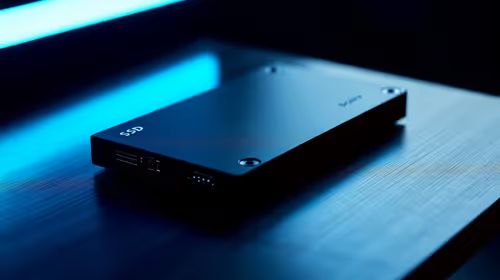
PCIe 5.0 vs PCIe 4.0 for Strategy and Sim Games in SA
PCIe 5.0 and PCIe 4.0 differ most in lane support, compatibility, and upgrade value for strategy and sim games. SA buyers should match the choice to their actual hardware and games.
Read moreto BIOS Updates for Beginners. Everything you need to know with SA pricing, step-by-step instructions & expert recommendations.
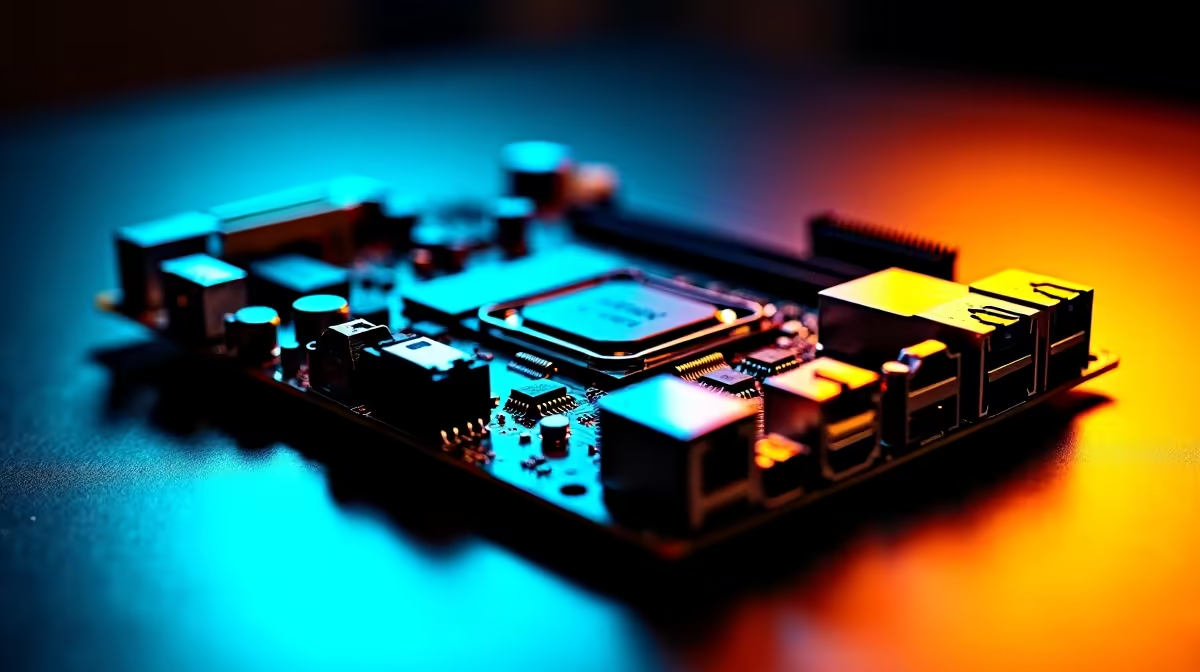
A BIOS update replaces your motherboard''s firmware to fix bugs, improve stability, and add support for newer hardware. In South Africa, where power fluctuations and loadshedding are real risks, updating BIOS safely requires a stable power source and a clear process.
Updating your BIOS sounds intimidating, but it is a straightforward process once you understand the steps. For South African PC builders and gamers, BIOS updates can unlock support for newer CPUs, fix compatibility issues, and improve system stability - especially important when running hardware under the stress of an unreliable power grid.
BIOS (Basic Input/Output System) is the firmware that controls how your motherboard communicates with all connected hardware. Manufacturers release BIOS updates to fix bugs, add support for new CPU generations, improve RAM compatibility, and patch security vulnerabilities. You should update your BIOS if you are installing a new CPU that requires it, experiencing random crashes or POST failures, or if your motherboard manufacturer has released a critical stability patch. However, if your system is running perfectly, a BIOS update is not always necessary - the rule of thumb is: if it is not broken, do not fix it.
The first step is identifying your current BIOS version. Press Windows + R, type msinfo32, and look for the BIOS Version/Date entry. Next, visit your motherboard manufacturer''s official website, navigate to your specific model''s support page, and download the latest BIOS file. Most modern motherboards support USB BIOS flashing - you copy the BIOS file to a FAT32-formatted USB drive and use the motherboard''s built-in flash utility (often accessed by holding a dedicated button). Critical SA-specific warning: never start a BIOS update during loadshedding or if your area has been experiencing voltage fluctuations. Use a UPS (Uninterruptible Power Supply) if you have one. A power loss mid-flash can brick your motherboard.
There are three main methods: in-OS update tools (provided by manufacturers like ASUS AI Suite or MSI Dragon Center), USB flash without a CPU (useful when installing a new CPU that the board does not yet support), and BIOS-level flash utilities accessed through the UEFI interface itself. The USB without CPU method is the safest for beginners because it bypasses the operating system entirely. Always use the exact BIOS file for your specific motherboard model - using a file meant for a similar but different revision can cause permanent damage.
Q: Is it safe to update BIOS in South Africa given loadshedding? A: It is safe as long as you pick a time when loadshedding is not scheduled and your power supply is stable. A UPS adds an important safety layer during the flash process.
Q: What happens if a BIOS update fails? A: If the flash is interrupted, the board may not POST. Many modern motherboards have a dual-BIOS feature that lets you recover automatically. Check your motherboard manual for the recovery procedure.
Q: Do I need to update my BIOS for a new CPU? A: Yes, often. A new CPU generation typically requires a BIOS update even on a compatible socket. Always check the CPU support list on your motherboard manufacturer''s website before buying.
Ready to Find Your Perfect Match? Shop at Evetech.
Complete Guide to BIOS Updates for Begin available at Evetech.co.za with local warranty and fast delivery.
Complete Guide to BIOS Updates for Begin - check Evetech for latest stock and SA pricing.
Depends on your use case. Complete Guide to BIOS Updates offers good value at current Rand pricing.
PCIe 5.0 and PCIe 4.0 differ most in lane support, compatibility, and upgrade value for strategy and sim games. SA buyers should match the choice to their actual hardware and games.
Read more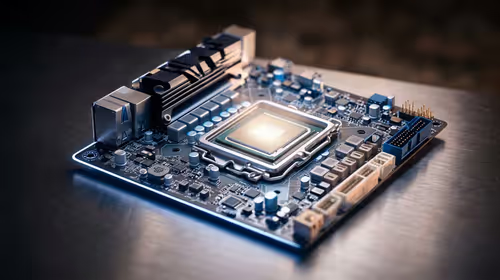
AM5 vs AM4 for video editing in 4K Difference explained is mostly about compatibility, budget, upgrade path, and setup fit. SA buyers should check device support and real needs before expecting a clear win from either option.
Read more
OLED vs QD-OLED for strategy and sim games buyers - what changes is mostly about compatibility, budget, upgrade path, and setup fit. SA buyers should check device support and real needs before expecting a clear win from either option.
Read more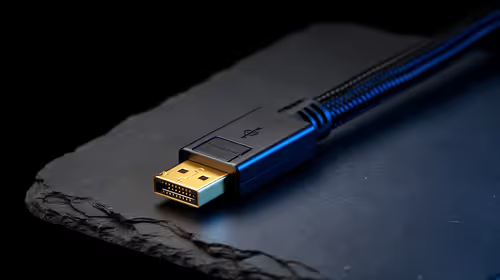
DisplayPort 2.1 and 1.4 differences matter when SA PC builders match GPUs, monitors, and refresh targets. Use this difference between displayport 2 1 and displayport 1 4 explained pc builders guide to avoid mismatched parts.
Read more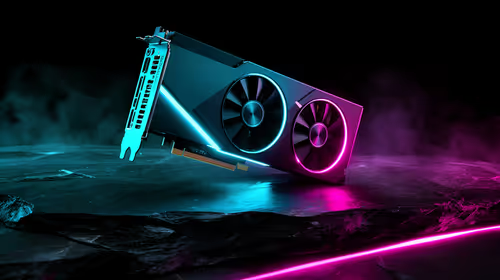
Ray tracing vs Path tracing depends on Strategy and sim games needs, platform limits, and budget fit. Compare compatibility, latency, upgrade path, and real setup constraints before choosing for an SA build.
Read more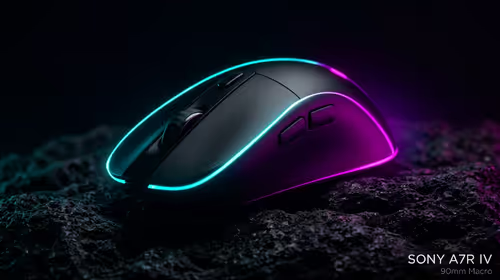
wireless mouse guide for Gqeberha gamers should be shortlisted around the job it must do. South African buyers should compare sensor, shape, weight, and wireless latency, warranty path, and upgrade room before treating any pick as best.
Read more
From 1 October 2026, WhatsApp Business Platform service replies in South Africa are expected to cost about $0.0076, or 12 cents, per delivered message.
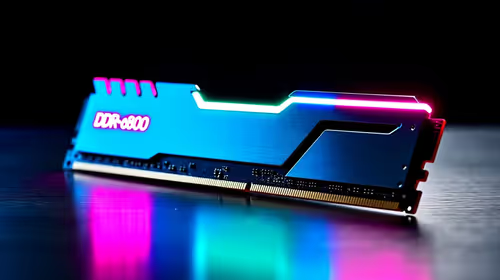
DDR5-8000 RAM Kits pros and cons depend on the build, budget, and workload. Weigh gaming needs, platform fit, power, cooling, warranty support, and South African pricing context before shortlisting it.
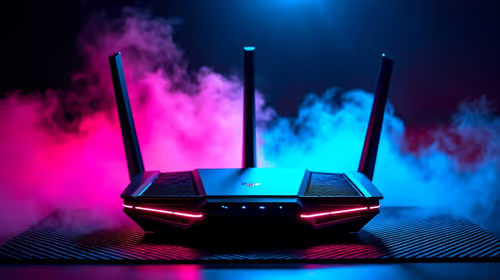
Wi-Fi 6E vs Wi-Fi 6 depends on AAA single-player gaming needs, platform limits, and budget fit. Compare compatibility, latency, upgrade path, and real setup constraints before choosing for an SA build.
Ryzen 9 9950X3D dead pixel checks should isolate the panel first. Run colour fills, inspect the monitor menu, test another cable or input, and capture proof before linking it to the SA CPU upgrade.

YouTube will count public views from the first frame across video formats from 24 August, while earnings and eligibility remain tied to engaged viewing.
Canonical expects Ubuntu on WSL users to outnumber native Ubuntu desktop users before the end of 2026. The software is open source and runs inside supported Windows PCs.
Telkom's daily bundles pair WhatsApp access with 10 all-network voice minutes. The R15 option includes 300MB, while the R17 option uses a fair-use threshold.

A 10,000-hour test found similar image retention across older and newer OLED TVs, while newer panels were brighter and more efficient. Local OLED monitors started at R9,999.

Windows 11 update KB5121003 is linked to crashes in several multiplayer games on versions 24H2 and 25H2. Check the build, report the fault and avoid risky file or update changes unless the problem is confirmed on your PC.

Comsol's standalone 5G network covers about one million Gauteng homes and starts commercial ISP service in September. Early packages range from R275 to R875 a month, but coverage and fair-use rules still decide the real value.

Sennheiser's Momentum True Wireless 5 adds user-replaceable batteries, 12-hour playback and a $299.95 launch price. There is no confirmed South African date, so compare longevity with live earbuds from R199 to R2,999.

AVerMedia's GC531 and GC535 are professional HDMI capture devices for continuous streaming, with RGB24 capture up to 2K30 and 4K30. South African creators should compare them with live 4K capture cards from R2,099.