Quick Answer
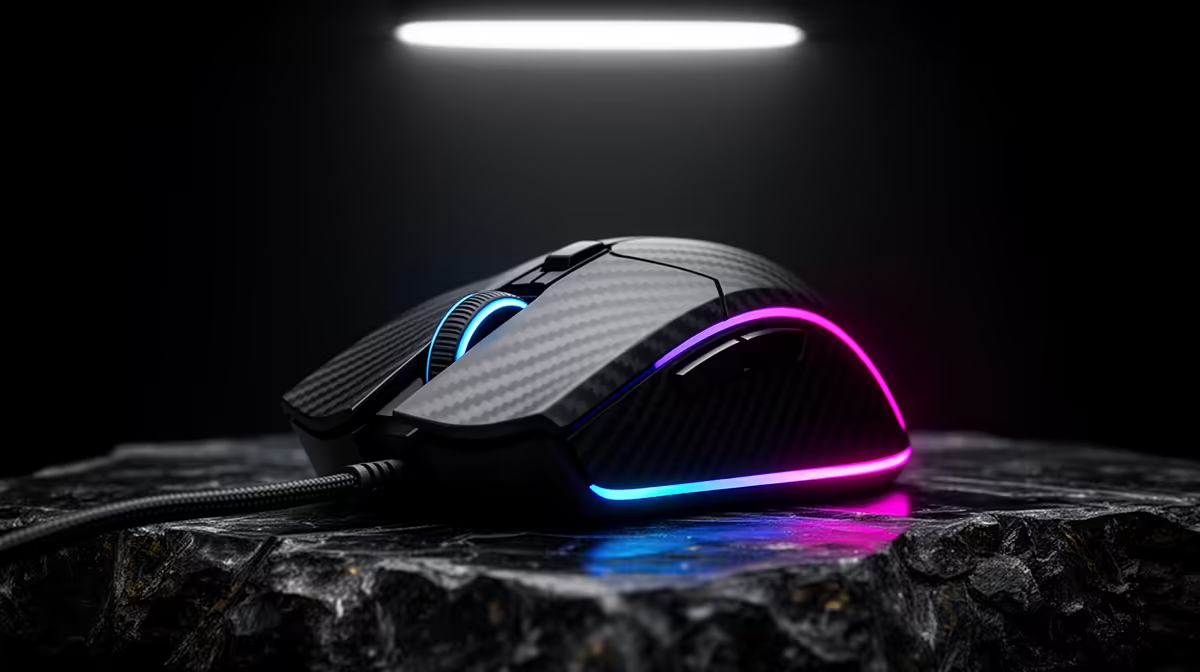
50K DPI in gaming mice refers to the maximum resolution at which the optical sensor can theoretically report cursor movement. In practice, no competitive player uses DPI above 3,200, but a sensor capable of 50K DPI uses a higher-quality imaging array and signal processor that improves tracking accuracy, low-speed precision, and jitter reduction even when set to 400 or 800 DPI.
DPI Explained: What It Measures and Why It Matters 🔬
DPI stands for dots per inch. A mouse set to 800 DPI reports 800 cursor position counts for every inch of physical mouse movement. At 1,600 DPI it reports 1,600 counts per inch, making the cursor travel twice as far on screen. The DPI ceiling (50K in this case) describes the maximum resolution the sensor's imaging array can achieve, not the setting you would use.
The imaging array in a 50K DPI sensor captures a higher-resolution snapshot of the mousepad surface per reading than a lower-ceiling sensor. This finer surface sampling gives the onboard DSP more data to calculate displacement precisely, translating to lower sub-pixel jitter and more accurate tracking at normal DPI settings.
Native vs Interpolated DPI: The Critical Distinction 📊
Sensors have a native optical DPI ceiling set by their physical imaging array. Beyond this ceiling, firmware achieves additional DPI through interpolation, which carries increased jitter without improving cursor precision. The PixArt PAW3950 has a confirmed native resolution around 30,000 DPI; figures above this, including the 50K maximum listed by some manufacturers, are interpolated.
Setting a 50K DPI sensor to 800 DPI (well within native range) gives genuinely superior tracking to a 12,000 DPI sensor at the same setting, because the imaging pipeline is higher quality throughout.
Practical DPI Settings for Gaming in SA 🎮
Most South African competitive gamers in FPS titles use between 400 and 1,600 DPI combined with in-game sensitivity to reach a total eDPI of 200 to 1,600. At these settings, a 50K DPI sensor's quality advantage over a 12,000 DPI sensor is real but subtle: less micro-jitter during slow aim adjustments, cleaner straight-line tracking, and more consistent lift-off behaviour across different surfaces.
For RTS, MOBA, or desktop productivity, 1,600 to 3,200 DPI is common. In South Africa, 50K DPI-class sensors arrive in mice priced from around R1,500 for wired options to R3,000 for wireless flagships.
Use the CPI Tester Tool ⚡
Download the free Mousetester or CPI Analyzer tool and run a straight-line tracking test at your chosen DPI setting. If the plotted path shows regular lateral drift, your sensor is exhibiting angle snapping or jitter. A quality 50K DPI sensor produces a near-perfect straight line at any speed below 250 IPS.
FAQ
What DPI should I actually set my mouse to for gaming?
Start at 800 DPI for FPS and adjust your in-game sensitivity until a full 360-degree turn requires 30 to 45 cm of physical mousepad movement. For desktop use between gaming sessions, 1,600 to 2,400 DPI is more comfortable for navigating large screens.
Does the DPI setting affect battery life in wireless mice?
No. DPI setting has negligible effect on wireless mouse power consumption. Polling rate is the dominant battery variable. A mouse at 50,000 DPI and 1,000 Hz uses essentially the same power as the same mouse at 400 DPI and 1,000 Hz.
Can I trust DPI ratings from budget gaming mouse manufacturers?
Be sceptical of DPI ratings above 6,000 on mice priced below R500. Budget sensors apply heavy interpolation to achieve high DPI numbers that are marketing figures rather than real optical resolution. The sensor model name is a more reliable quality indicator than the DPI ceiling.
Find a high-spec sensor that delivers at any DPI setting.
Evetech stocks gaming mice built around flagship optical sensors with genuine high-resolution imaging pipelines. Browse the full mouse range at Evetech and choose a sensor that performs where it counts.