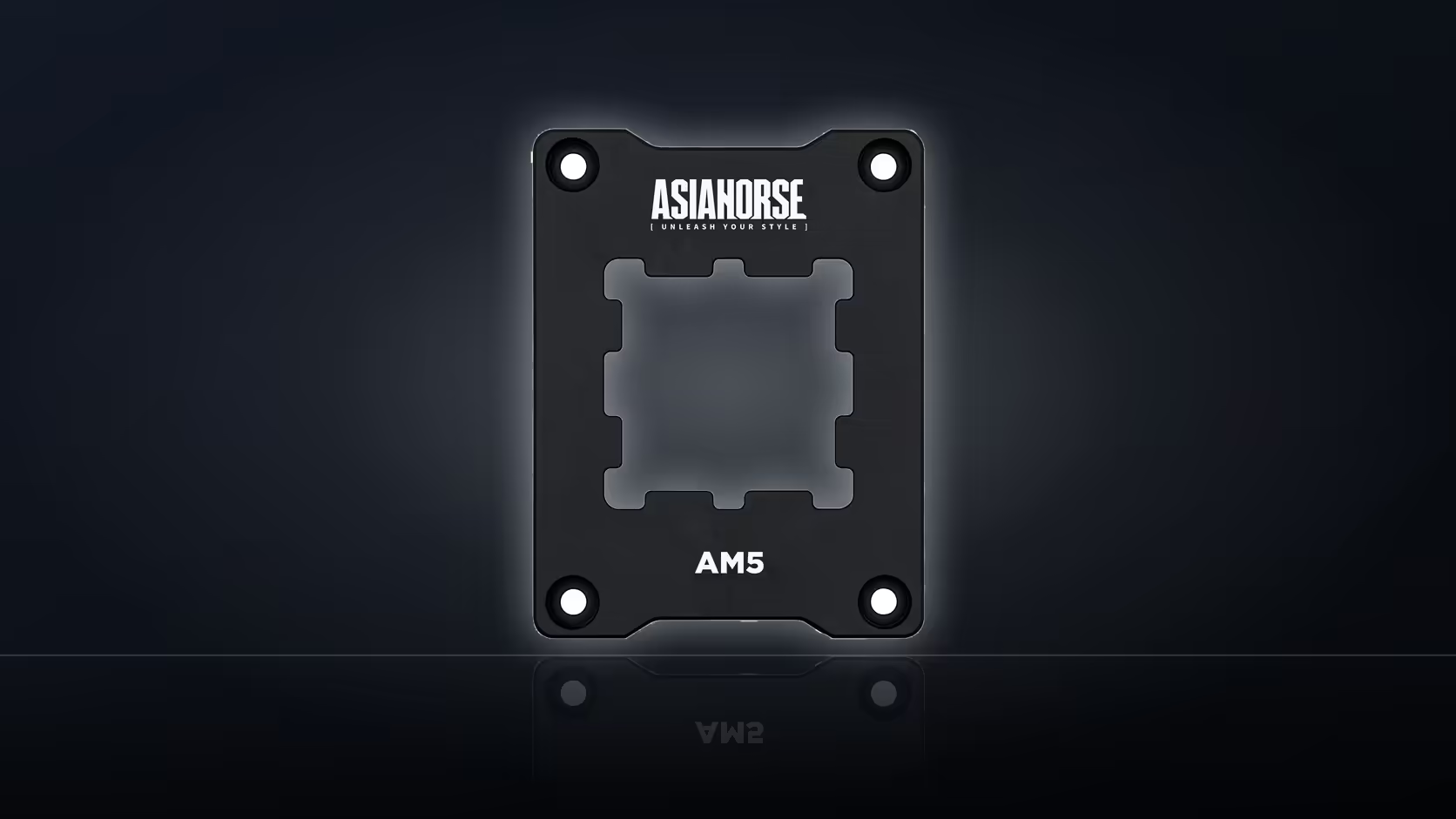
Two temperature-related problems get lumped together far too often in casual PC-building conversation: whether a cooler is fundamentally big enough for the job, and whether it is making full, even contact with the processor it's sitting on. A contact frame speaks to only one of those, and knowing which one matters before spending anything on either.
Quick Answer
The AsiaHorse Pulsar contact frame, R299, changes how evenly a cooler presses onto the processor - it does not add cooling capacity the way a bigger cooler or an extra radiator does. If temperatures run high across the board regardless of workload, that points to capacity. If results look uneven, worse than expected on an otherwise-adequate cooler, or inconsistent between reseats, that points toward contact.
⚖️ Two different questions dressed up as one
Contact pressure is about the interface: how well the two flat surfaces of the processor lid and the cooler base actually meet across their full area. Heat only moves efficiently between surfaces that are in genuine, even contact, with a thin, consistent layer of thermal paste filling whatever microscopic gaps remain. Poor contact means parts of that surface are effectively insulated rather than conducting.
Cooling capacity is a different problem altogether: once heat has successfully moved into the cooler, how much of it can the cooler actually shed into the surrounding air. That comes down to the cooler's physical size, the surface area of its fins or radiator, the number and speed of its fans, and how well the case around it moves air. A cooler can have flawless contact and still be too small for a demanding processor under sustained load.
Reading which one you actually have
Symptoms line up differently for each. A processor that runs hot no matter what load is thrown at it, with temperatures that track predictably upward as demand increases, usually points to a cooler that's simply undersized for the chip. Contact problems tend to look different: a temperature reading that seems worse than the cooler's specifications suggest it should be, or results that shift noticeably between one mounting attempt and the next with nothing else in the build changed.
🧊 What a frame like this actually claims
The description is specific on this point: the frame spreads mounting pressure across the processor for the purpose of more consistent cooler contact. That is a mechanical, design-level claim about even pressure distribution, not a quoted temperature figure or a guaranteed number of degrees. It addresses the interface question, not the capacity one, and nothing in the listing suggests otherwise.
Anyone reading a frame like this as a fix for an undersized cooler will end up disappointed, not because the frame failed, but because it was never built to solve that particular problem. The CPU coolers category is where capacity actually gets addressed - a larger air tower, more radiator surface area, or additional fans.
🔍 Isolating the variable that matters
Where both a capacity concern and a contact concern seem plausible, testing one change at a time is the only reliable way to know which one actually moved the needle. Swapping the cooler and the mounting hardware in the same sitting makes it impossible to say afterward which change did the work, which matters if a future decision depends on knowing that.
A clean paste reapplication with thermal solutions alongside a fresh frame fit is also worth doing as its own controlled step, given that any cooler removal disturbs the existing paste layer regardless of what else changes.
🧪 Why uneven contact happens in the first place
Modern processor lids and cooler bases are both machined to be as flat as manufacturing tolerances allow, but "as flat as tolerances allow" isn't the same as perfectly flat. Small variations in either surface, combined with mounting pressure that isn't distributed evenly across the four corners of the socket, can leave one side of the interface pressing harder than the other. Where that happens, thermal paste has to bridge a wider gap on the under-pressured side, and paste is a far worse conductor than direct metal-to-metal contact.
Retention hardware plays directly into this. The stock arms on any AM5 board are designed to a general specification that has to work across a wide range of coolers, and the pressure they apply is a compromise rather than something tuned to any single cooler and processor pairing. A frame built specifically around spreading that pressure more evenly is addressing exactly this compromise, without changing anything about the processor or the cooler themselves.
What makes contact pressure and cooling capacity easy to conflate is that both eventually show up as the same number: a temperature reading. A build with genuinely poor contact and a build with a genuinely undersized cooler can post similar idle-to-load temperature curves on paper, even though the underlying cause and the correct fix are completely different.
One useful way to hold these apart is to think of contact pressure as a fixed cost paid once at mounting time, and cooling capacity as an ongoing cost paid continuously under load. Contact quality is set the moment the cooler is torqued down and doesn't change again until the next removal. Capacity is drawn on constantly under sustained workload, which is why capacity problems tend to scale with how hard the chip is being pushed, while contact problems tend to show up as a consistent offset regardless of load.
A processor that idles fine but climbs steeply and predictably under sustained load, tracking with how demanding the workload is, points toward the cooler running out of headroom. A processor that runs warmer than expected even at idle, or shows an offset that doesn't track cleanly with load, is more consistent with something at the interface.
🔬 A practical way to test the difference
Where the two explanations both seem plausible, the cleanest way to separate them is a controlled before-and-after comparison that changes only one variable at a time. Record idle and a fixed load-test temperature with the current setup as a baseline, then make one change, whether that's fitting the frame or swapping to a larger cooler, and repeat the same test under the same conditions before drawing any conclusion.
Changing both the mounting hardware and the cooler in the same session, however tempting when the board is already open, removes the ability to say afterward which change actually produced the result. That might not matter for a one-off build chasing lower temperatures by any means. It matters more if the outcome will inform a future decision, such as whether a frame is worth fitting to a second build.
🧵 Where the frame fits into that bigger picture
None of this is an argument against fitting a contact frame. It's an argument for being precise about what problem it's solving. A frame that genuinely improves pressure distribution on a board where the stock arms were applying uneven force is doing real, useful work, and R299 is a modest outlay against the cost of a full cooler upgrade if contact turns out to be the actual issue. The mistake to avoid is reaching for it as a first response to any high temperature reading without first asking whether the cooler itself was ever going to be adequate for the processor sitting under it.
Frequently Asked Questions
What does contact pressure affect?
How well heat moves from the processor into the cooler base, which depends on the two surfaces meeting evenly.
And cooling capacity?
How much heat the cooler can shed once it has it, which depends on the cooler's size, fans and airflow.
Which one is my problem?
If temperatures are high across the board, capacity is the likelier issue. Uneven or unexpectedly poor contact points the other way.
Can a frame fix an undersized cooler?
No. If the cooler cannot shed the heat, improving contact does not change what it is capable of dissipating.
What does the description claim?
That the frame spreads mounting pressure across the processor for consistent cooler contact, without quoting a temperature figure.
Should I upgrade the cooler instead?
Where the cooler is clearly undersized for the processor, that addresses the actual constraint rather than the interface.
Could both be worth doing?
They can be, though testing one change at a time is the only way to know which produced the result.
Weighing up contact versus capacity?
Explore Evetech's CPU cooler lineup to find something with the headroom your processor actually needs.