Quick Answer
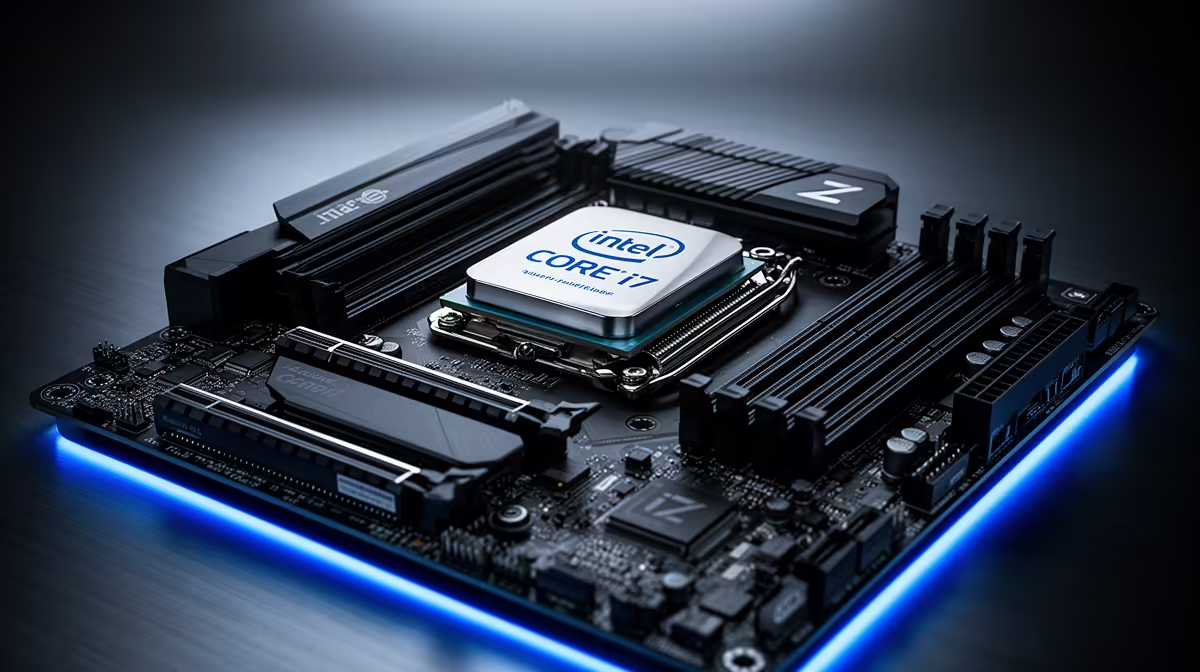
The best motherboard for content creation on the Core i7-14700K is the MSI MAG Z790 TOMAHAWK WIFI DDR4 (R4,500 at Evetech) — four M.2 PCIe 4.0 slots handle dedicated OS, project, cache, and export NVMe drives; 16-phase VRM sustains the 253 W Turbo draw during Blender renders; and 2.5GbE enables 295 MB/s NAS transfers for 4K footage ingestion. Pair with 32 GB DDR4-3600 dual channel (R1,700) and an RTX 3080 (~R10,000) for a capable 4K production workstation.
Why the i7-14700K is the Content Creation Sweet Spot
The Core i7-14700K (20 cores: 8P+12E, unlocked, LGA 1700) hits the performance-per-rand sweet spot for SA content creators:
- ~20% faster Blender CPU renders than the i5-14600K
- ~10% slower than the i9-14900K at substantially lower cost
- 12 efficiency cores handle background encoding (OBS, HandBrake) while P-cores focus on the active application
- Supports DDR4-3600 or DDR5-6000 depending on board variant
For DaVinci Resolve, Premiere Pro, After Effects, and Blender — the i7-14700K delivers pro-grade speed at a realistic budget for a SA creator.
Board Features Critical for Content Creation
Four M.2 PCIe 4.0 slots: Allocate separately — OS on one Samsung 990 Pro 1 TB (R1,400), active project on a WD SN850X 2 TB (R2,500), and export/cache on two additional drives. No storage I/O competition during renders.
USB 3.2 Gen2x2 (20 Gbps): Ingests camera SSD footage at 2,000 MB/s — a 50 GB memory card in under 30 seconds.
DDR4-3600 support + XMP: DaVinci Resolve Fusion and After Effects benefit from higher memory bandwidth — DDR4-3600 CL16 dual channel delivers approximately 10% faster cache-heavy operations than DDR4-3200.
Note on 13th/14th-gen voltage issue: Apply the 0x12B Intel microcode BIOS update before sustained production workloads. This protects the i7-14700K from the voltage degradation issue affecting prolonged high-power sustained loads. Check board BIOS changelog — updates from late 2024 include it. DDR5 speed guidance: DDR5-6000 CL30 is the sweet spot for content workloads on DDR5 boards.
FAQ
How much RAM should a content creation i7-14700K build have?
32 GB DDR4-3600 dual channel is the production minimum — handles 4K H.265 multi-cam editing without paging. 64 GB is the step-up for 4K RAW (Blackmagic RAW, ProRes 4444) multi-cam with effects or After Effects compositions with many 4K layers. 128 GB makes sense only for 8K RAW workflows or ML model training. Always buy matching dual-channel sticks for best memory bandwidth on LGA 1700.
Does Thunderbolt 4 matter for a content creation i7-14700K build?
Thunderbolt 4 provides 40 Gbps bandwidth to external NVMe enclosures — faster than USB 3.2 Gen2x2 (20 Gbps). If you connect external NVMe RAID enclosures for field backup workflows, Thunderbolt 4 is worth seeking in a Z790 board. The ASUS ProArt Z790-CREATOR WIFI (~R6,500) includes Thunderbolt 4 alongside 2.5GbE and content-creation-optimised features. For most SA creators, USB 3.2 Gen2x2 is adequate.
Is the i7-14700K significantly better than the i5-14600K for Adobe Premiere Pro?
Yes — the i7-14700K's additional cores provide approximately 25–35% faster Premiere Pro CPU-based renders (effects processing, export encoding when not using GPU). For GPU-accelerated workflows (most modern Premiere workflows use GPU), the difference narrows to 10–15%. For SA video creators who render 1080p–4K YouTube content daily, the i7-14700K's time savings add up meaningfully over a month of production.
Premiere Pro, go to File → Project Settings → General and set Renderer to GPU Acceleration (CUDA for Nvidia, OpenCL for AMD) — this single setting routes timeline effects through the GPU instead of the CPU, freeing the i7-14700K's cores for background tasks and reducing real-time playback stutters on 4K timelines.