Quick Answer
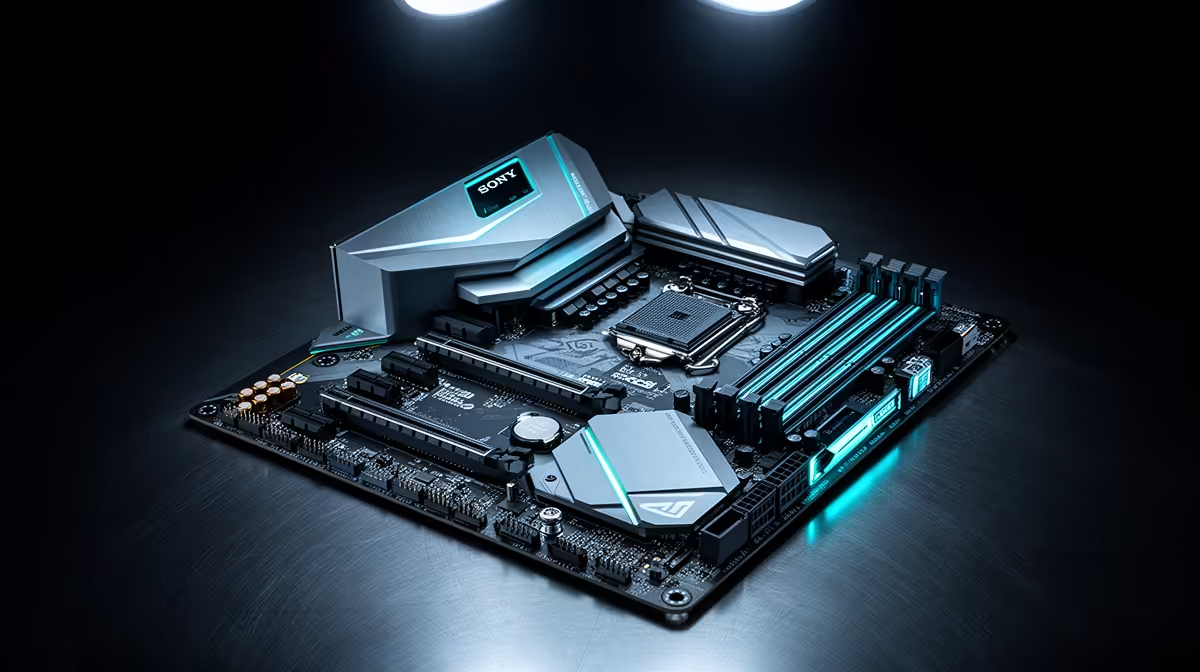
The best motherboard for overclocking the Core i7-14700K is the ASUS ROG STRIX Z790-F GAMING WIFI (R6,000 at Evetech) — its 18-phase 90 A DrMOS VRM sustains the i7-14700K at 5.6–5.7 GHz P-core with a 360 mm AIO. Named Z790 boards shortlisted for SA buyers: MSI MAG Z790 Tomahawk (R4,500) for 5.5 GHz; ASUS Z790-F for 5.7 GHz; ASUS ROG MAXIMUS Z790 APEX (~R9,500) for extreme 5.8+ GHz attempts. DDR5-6000 CL30 on DDR5 boards, DDR4-3800 CL16 on DDR4 variants, are the memory OC sweet spots.
Core i7-14700K OC Targets by VRM Tier
| OC target |
VRM phases needed |
Board recommendation |
AIO needed |
Power draw |
| 5.3 GHz all-core |
12-phase |
Gigabyte Z790 UD (~R3,200) |
240 mm |
~160 W |
| 5.5 GHz all-core |
16-phase |
MSI Z790 Tomahawk (~R4,500) |
240 mm |
~195 W |
| 5.7 GHz all-core |
18-phase |
ASUS Z790-F (~R6,000) |
360 mm |
~230 W |
| 5.8+ GHz |
24-phase |
ROG MAXIMUS Apex (~R9,500) |
360 mm / custom |
~280 W |
VRM and BIOS Quality for i7-14700K OC
MSI Z790 Tomahawk: 16-phase 75 A MOSFETs; excellent MTI (Memory Try It) function for RAM OC; solid OC Genie auto-profile starting point. Best value for 5.5 GHz daily use.
ASUS ROG STRIX Z790-F: 18-phase 90 A DrMOS; AI Overclocking profiles calibrated to individual chip; Extreme Tweaker BIOS section for fine voltage control. Best for 5.6–5.7 GHz stable daily OC.
ASUS ROG MAXIMUS Z790 APEX: 24-phase, ProbeIt voltage measurement points, OC Socket for exposed CPU pads. Extreme tool for record attempts.
Critical Pre-OC Step: 0x12B Microcode
Apply the 0x12B Intel microcode BIOS update before starting any overclock on the i7-14700K. Post-microcode, some chips require 0.04–0.06 V higher Vcore for the same target frequency — start voltage tuning after applying the update, not before, or risk instability misdiagnosed as a board issue.
FAQ
What is a realistic daily-use overclock for the i7-14700K on the MSI Z790 Tomahawk?
Most i7-14700K chips achieve 5.5 GHz P-core all-core at 1.27–1.32 V on the MSI Tomahawk, running under 78°C on a 240 mm AIO during gaming loads. Blender AVX-512 renders push temperatures higher (85–88°C at 5.5 GHz) — this is within Intel's thermal design and acceptable for occasional render work. Set E-cores to a flat 4.3 GHz multiplier to reduce heat from the efficiency cluster while maintaining gaming FPS.
Does the i7-14700K OC benefit SA gamers at 1440p with an RTX 4080?
At 1440p with an RTX 4080, the GPU is the primary FPS bottleneck in most AAA titles — OC provides 5–10% gains. In CPU-limited titles (CS2 at 1080p, AoE IV, Starcraft II above 200 fps), OC gains reach 15–22%. The biggest benefit for SA gamers is 1% low FPS improvement — reducing stutter spikes from ~140 to ~170 fps in CS2 makes the game feel noticeably smoother. For pure 1440p AAA gaming, GPU investment beats CPU OC for FPS.
What DDR5 speed works best for an overclocked i7-14700K on a Z790 DDR5 board?
DDR5-6000 CL30 is the proven gaming sweet spot — it runs in Gear 1 mode on most Z790 boards (lower latency than Gear 2) and pushes close to the memory bandwidth ceiling the i7-14700K's controller handles efficiently. DDR5-7200+ provides diminishing returns (under 3% additional FPS in most games) and requires careful QVL compatibility checking. The Corsair Dominator Titanium DDR5-6000 kit has excellent Z790 compatibility with the i7-14700K across multiple boards.
the i7-14700K, set the P-core ring bus (CPU Cache Ratio) to at least 47–49 in BIOS — the P-core ring frequency affects latency-sensitive calculations in gaming, and running the ring bus too far below the P-core frequency (more than 8× lower) creates a latency gap that costs 5–8% gaming FPS in CPU-limited scenarios.