Quick Answer
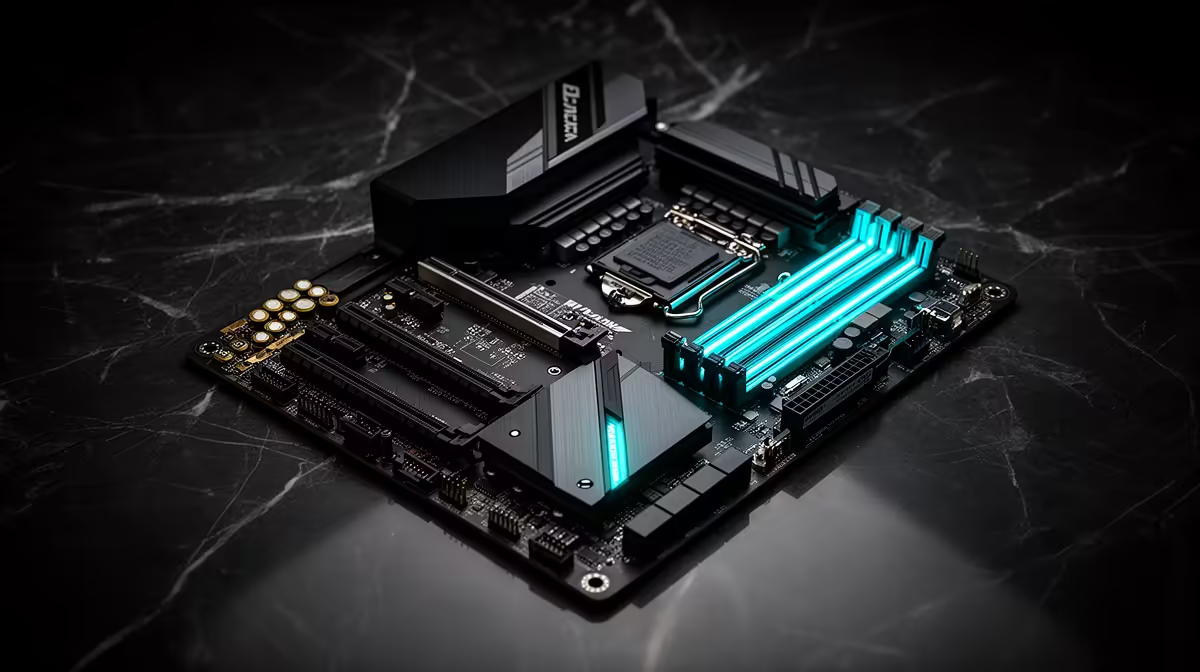
For stock operation, the best motherboard for the Core i7-14700K is the MSI MAG Z790 TOMAHAWK WIFI DDR4 (R4,500 at Evetech) — a 16-phase VRM handles stock Turbo bursts to 253 W without throttling, 2.5GbE and Wi-Fi 6E are included, and four M.2 PCIe 4.0 slots support comprehensive NVMe storage. If overclocking is never planned, the Gigabyte Z790 UD DDR4 (R3,200) is an adequate stock Z790 option that saves R1,300.
Why Z790 Even for Stock i7-14700K Operation
The i7-14700K on Z790 at stock settings runs with Intel's Turbo profiles enabled — up to 253 W in brief Turbo bursts during gaming and 125 W sustained (PL1). A B760 board technically runs the CPU at stock speed, but B760's VRM may struggle with 253 W Turbo bursts on the lower-end boards, causing micro-throttle events. Z790 boards are designed for the full Turbo envelope:
- Z790 UD DDR4 (~R3,200): 12-phase VRM handles stock with Turbo burst. Conservative choice.
- MSI Z790 Tomahawk WIFI DDR4 (~R4,500): 16-phase — handles full 253 W burst cleanly plus sustained gaming load. Recommended.
- ASUS Z790-F GAMING WIFI (~R6,000): 18-phase — significant overkill for stock but adds Wi-Fi 7 and premium build quality.
Stock Performance at 1080p and 1440p Gaming
At stock, the i7-14700K with an RTX 4070 (~R11,000) on DDR4-3600 XMP:
- CS2 at 1440p: 190–260 fps
- Valorant at 1440p: 280–350 fps
- Cyberpunk 2077 at 1440p Ultra: 80–95 fps (GPU-limited)
- Apex Legends at 1440p: 160–200 fps
The stock i7-14700K is non-bottlenecking for the RTX 4070 and RTX 4080 in virtually all current titles at 1440p.
Must-Do Before First Extended Use
Apply the 0x12B Intel microcode BIOS update before running the i7-14700K for extended periods — this addresses the voltage management issue in 13th/14th-gen Intel CPUs. Flash the latest BIOS from the manufacturer website before installing the OS. Then enable XMP in BIOS and confirm RAM runs at DDR4-3600 (or your kit's rated speed) in Task Manager.
FAQ
Can the i7-14700K run on a B760 board for stock gaming?
Yes — the i7-14700K is LGA 1700 and operates on B760 boards with a BIOS update. B760 locks the CPU multiplier to stock and caps overclocking. For stock gaming builds where OC is never planned, a B760 board with a 10+ phase VRM (MSI PRO B760-A WiFi at ~R2,700) handles the i7-14700K's 125 W PL1 without issue. Set PL1 = 125 W explicitly in BIOS to prevent the board from running unlimited Turbo bursts that stress weaker B760 VRMs.
What's the difference in gaming FPS between a stock and overclocked i7-14700K at 1440p?
At 1440p, GPU-limited scenarios (most AAA titles) show 3–8% FPS difference between stock and 5.5 GHz OC. In CPU-limited scenarios (CS2 above 250 fps, AoE IV, high-refresh competitive gaming), the difference is 12–20%. For SA buyers planning a stock build, the stock i7-14700K with an RTX 4080 delivers excellent 1440p performance without the thermal and stability management overhead of overclocking.
Is the i7-14700K worth the premium over the i7-13700K for stock gaming builds?
For stock gaming, the i7-14700K and i7-13700K perform within 5% of each other — both have the same P-core and E-core architecture. The i7-14700K has slightly higher max Turbo clocks (5.6 GHz vs. 5.4 GHz) and 4 additional E-cores (20 total vs. 16). At current Evetech pricing, buy whichever is cheaper — they're essentially interchangeable for gaming at stock.
up a stock i7-14700K on any Z790 board, open HWiNFO64 during your first gaming session and check the CPU Package Power reading — a stock build should show 125–150 W during sustained gaming, not 250 W+. If you see 250 W sustained, the board has MCE or unlimited power limit enabled; set PL1 = 125 W in BIOS.