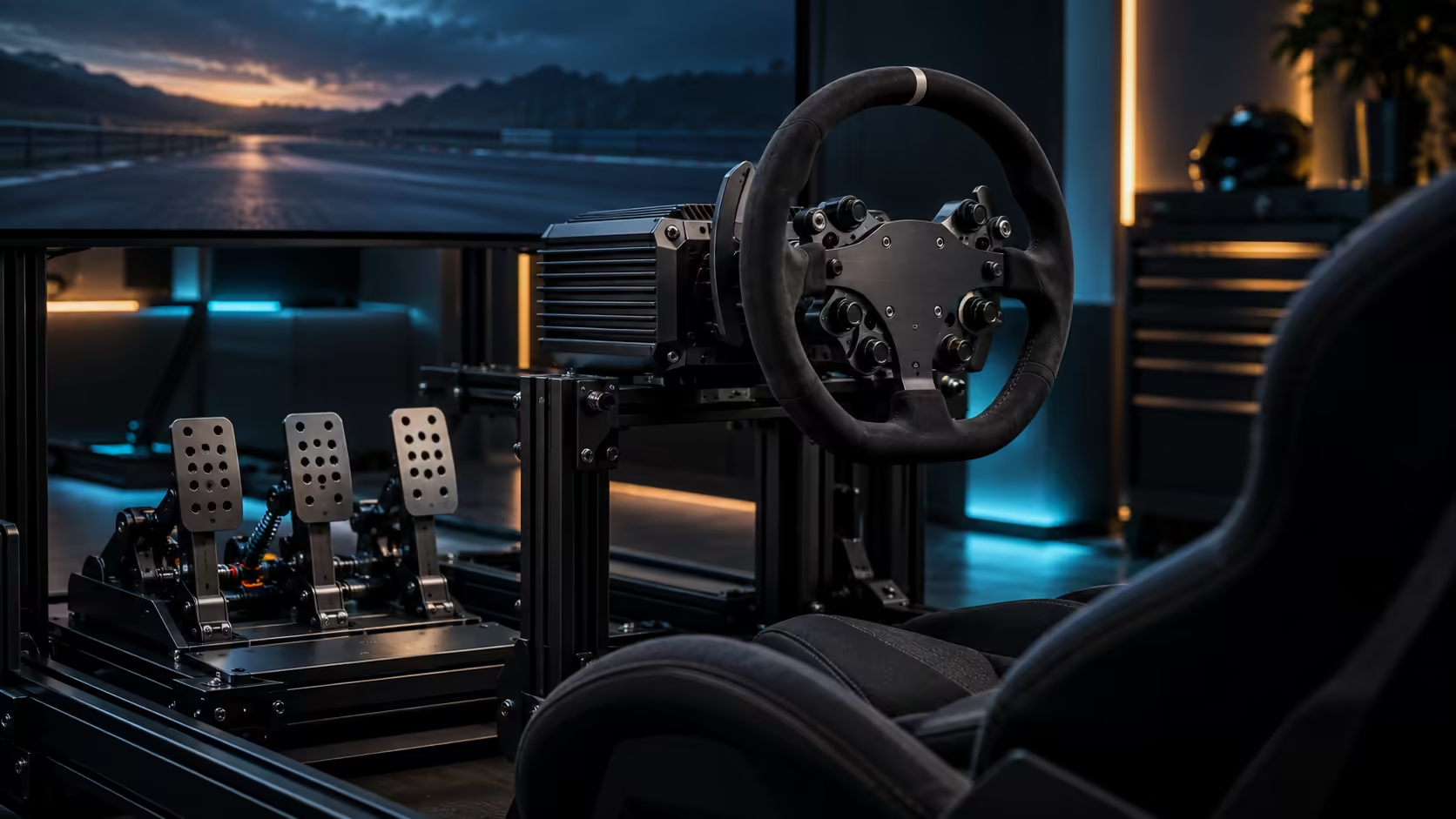
Every gear-driven wheel on the market has to solve the same problem: a motor spinning fast enough to be useful needs its speed traded for torque through a reduction stage, and that reduction stage is where the honesty of the force feedback signal starts to erode. A direct drive racing wheel skips the trade entirely by coupling the motor straight to the shaft, which is a mechanical difference with a very specific effect on what you actually feel through the rim.
Quick Answer
A direct drive wheel connects the motor straight to the steering shaft with no belt, gear or pulley in between, while a gear-driven wheel passes force through a reduction mechanism that adds friction, play and a slight delay. The Alpha EVO base in the R14,999 Green Flag bundle reaches 9Nm through direct coupling alone, which is why fine detail like a tyre losing grip arrives cleanly rather than smoothed over.
⚙️ What the reduction stage actually costs you
A belt or gear system exists because small motors spin fast but produce little torque, so a reduction stage trades rotational speed for strength, the same principle as a bicycle's lowest gear. That trade works, but nothing in mechanical engineering is free: gears mesh with a small amount of backlash, and belts stretch slightly under load, both of which introduce a tiny delay and a small amount of play between what the game sends and what the rim does.
That delay measures somewhere around 2 to 8ms on a well-built gear-driven wheel, which sounds trivial until you consider that the events force feedback exists to communicate, a tyre stepping out, a kerb strike, the exact moment a car starts to slide, happen in exactly that timeframe. Direct drive removes the mechanism causing the delay rather than making a faster version of it, because there is no reduction stage for backlash or belt stretch to occur in.
🔬 Where the difference actually shows up while driving
The gap is easiest to feel at the extremes rather than in the middle of a corner. Small, fast corrections, the kind you make catching a snap of oversteer, are where a gear-driven wheel's mechanical play shows as a slight vagueness right at centre, a dead zone of roughly 1 to 2 degrees where the wheel is not quite reporting what the tyres are doing. Direct drive has effectively none of that, because there is nothing mechanical to take up slack in.
At the other extreme, sustained high loads, like a heavy car cornering hard for several seconds, both types can deliver strong resistance, but a gear-driven wheel under sustained torque often develops audible whine or heat as the reduction stage works harder, while a direct drive base simply holds the output the motor is rated for.
💰 The cost the spec sheet does not mention
None of this makes gear-driven wheels obsolete. A well-built belt-driven wheel remains a legitimate step up from a basic gamepad's rumble motors and costs meaningfully less than a direct drive base of comparable torque, because a reduction stage lets a smaller, cheaper motor produce usable force. For a driver getting into sim racing for the first time, that lower cost of entry matters more than the last percentage point of detail.
The 9Nm Alpha EVO base sits at the point where the mechanical simplicity of direct drive and a torque figure that covers serious driving both arrive at once, which is why bundles built around it, like the R14,999 Green Flag package, are priced as a step above entry-level gear-driven wheels rather than beside them. That price difference is also easier to justify once local warranty support is part of the comparison, since a fault on a precision direct drive motor is a straightforward local repair rather than an overseas shipping problem.
There is also a maintenance cost most buyers never budget for. A belt-driven wheel's belt needs periodic re-tensioning as it stretches with use, and a gear-driven wheel's gears benefit from an occasional check for wear or grease depletion, neither of which a direct drive base requires since there is no mechanical stage to service. Over several years of regular use that difference is a real, if small, running cost saved rather than a one-time purchase advantage.
🎮 Controller comparisons, and why they undersell both options
It is worth being honest about the baseline most drivers are actually coming from. A standard gaming controller communicates force feedback through a pair of rumble motors that vibrate rather than resist, which cannot represent directional information like a wheel losing grip on one side versus the other at all. Anyone weighing a gaming controller against even an entry-level wheel is comparing two different categories of feedback, not two points on the same scale, since a controller has no steering resistance to compare in the first place.
Once you have decided a wheel is worth the investment, the direct drive versus gear-driven question becomes the real comparison, and it is one best made against your budget and how seriously you plan to race rather than against what a controller could do. The racing simulation shelf and the dedicated sim racing range both list torque and drive type against price, which is the pair of numbers worth comparing directly.
Frequently Asked Questions
Is direct drive always better than a gear-driven wheel?
For detail and response, yes, because there is no mechanism to introduce backlash or delay. For value at entry-level torque figures, a gear-driven wheel can still be the sensible buy.
Why do gear-driven wheels sometimes whine under load?
The reduction stage, whether belt or gear, works harder as torque demand rises, and that mechanical effort can produce audible noise that a direct-coupled motor does not generate in the same way.
Does the reduction stage in a gear-driven wheel wear out over time?
Belts can stretch and gears can develop additional play with heavy use over years, which is a maintenance consideration direct drive avoids by having no such stage to wear.
Is a controller close enough to a wheel for sim racing?
No. A controller's rumble motors vibrate rather than resist, so they cannot communicate directional steering forces the way even an entry-level wheel can.
Ready to feel the difference direct coupling makes?
Compare torque and drive type side by side on the Racing Simulation shelf before deciding where to spend.