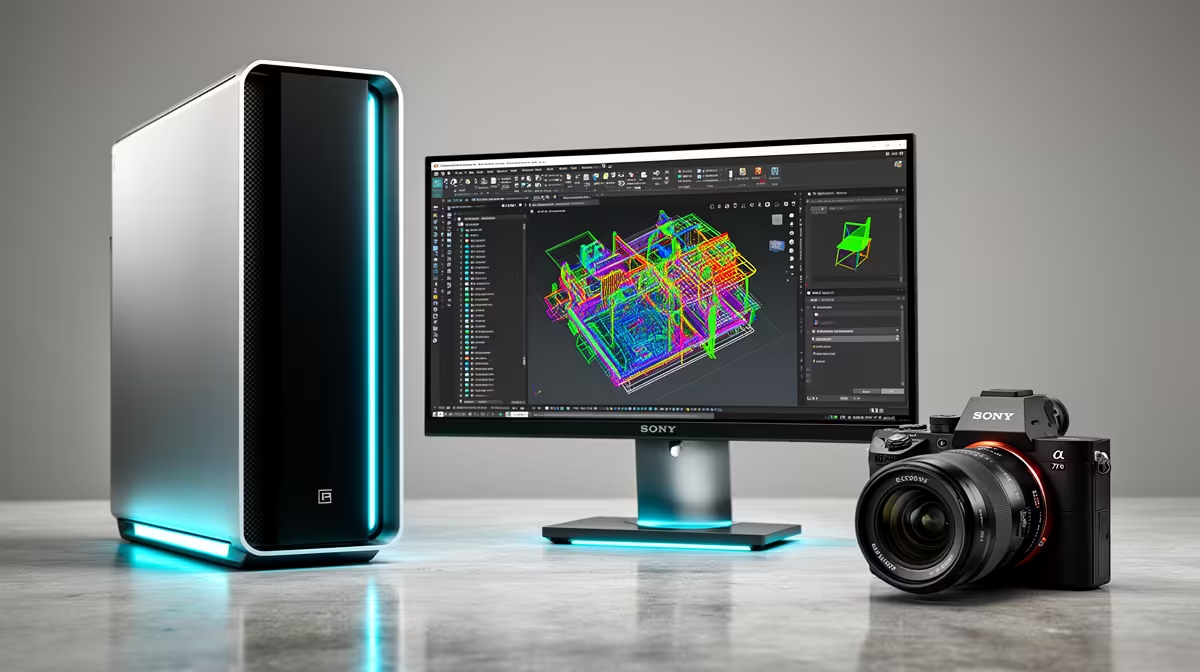
You can run Tinkercad smoothly on a laptop that cost R10,000, and you do not need a dedicated graphics card to do it. Browser-based CAD tools render entirely inside the browser using WebGL, which means the heavy lifting happens through a standardised graphics layer that integrated chips handle comfortably. The question of whether you need a powerful PC for this kind of work has a refreshingly simple answer, and understanding why it works that way helps you avoid overspending.
Quick Answer
No, you do not need a powerful PC for browser-based CAD like Tinkercad. Any modern laptop from roughly R8,000 upward, with a current version of Chrome, Edge, or Firefox and standard integrated graphics, runs these tools without lag. A dedicated GPU and a high-end CPU make no meaningful difference for browser CAD.
Why Browser CAD Is So Light
Tinkercad, and tools like it, run inside a sandboxed web page. They use WebGL, a graphics interface that lets a browser draw 3D content using whatever GPU the machine already has, including the integrated graphics built into nearly every CPU sold today. There is no installation, no driver pack, and no separate rendering engine to maintain.
That design choice keeps the system requirements low by intention. The 3D models you build in Tinkercad are simple compared to professional engineering assemblies. A few hundred shapes, basic boolean operations, and a viewport you rotate with the mouse do not stress modern hardware. The browser tab does the work, and the operating system supplies the WebGL bridge.
What Integrated Graphics Already Handles
Integrated graphics has a poor reputation among gamers, and for demanding titles that reputation is earned. Browser CAD is a completely different workload. Rotating a model, extruding a shape, and previewing a design are lightweight operations that an Intel or AMD integrated GPU manages without breaking a sweat.
The CPU Matters More Than the GPU Here
If anything slows browser CAD down, it is rarely the graphics. It is the browser itself juggling many open tabs, or a machine with very little memory swapping to disk. A current dual or quad-core processor with enough RAM keeps the interface responsive. The GPU is barely a factor for the kind of geometry Tinkercad produces.
Memory Is the Real Comfort Factor
Browsers are memory-hungry, and a student running Tinkercad alongside research tabs, a music stream, and a word processor benefits more from extra RAM than from any graphics upgrade. A machine with a comfortable amount of memory keeps everything snappy, which is where your money is better spent if you are choosing between specs.
When You Would Actually Need More Power
There is a real line where light CAD ends and heavy CAD begins. Professional desktop applications such as full-feature parametric modellers, simulation suites, or rendering tools with millions of polygons genuinely want a dedicated GPU and a strong CPU. If your studies or work will eventually move to that software, buying ahead makes sense.
For browser CAD specifically, though, that power sits idle. A student learning 3D design, a hobbyist sketching parts for a printer, or anyone working in Tinkercad is well served by an everyday laptop. If your next step is hardware that turns those designs into physical objects, the 3D printers stocked at Evetech pair naturally with browser CAD without demanding a workstation to drive them.
Choosing the Right Laptop Anyway
Even though browser CAD is undemanding, a few specs make the overall experience better. A screen with decent resolution gives you room to see your model and the tool panels. A comfortable amount of RAM keeps tabs responsive. A solid-state drive makes the whole machine feel quick. None of these require a premium price.
If you want accessories that round out a CAD-and-print setup, from spare cables to storage, the accessories Evetech keeps in stock cover the extras without pushing you toward a more expensive base machine. The core message holds: spend on memory, screen, and storage before you spend on a graphics card you will not use for this work.
How Browser CAD Compares to Installed CAD
It helps to understand exactly where Tinkercad sits in the wider CAD landscape, because the gap explains why the hardware demands are so different. Tinkercad is a beginner-friendly, block-based modeller built for learning and quick designs. It works with relatively simple geometry, runs entirely online, and saves your projects to the cloud rather than churning your local processor and storage.
Installed professional packages operate on a different scale entirely. They hold huge assemblies in memory, recalculate complex parametric relationships in real time, and render photorealistic previews using the dedicated graphics card directly. That is the work that justifies an expensive machine. A browser tab drawing a few shapes simply never touches that ceiling, which is the whole reason a budget laptop keeps up.
What This Means for a Student Buying Their First Machine
For a student or a newcomer, the practical advice is to buy for everyday life and let browser CAD ride along for free. A laptop chosen for note-taking, research, video calls, and general study already exceeds what Tinkercad asks of it. There is no separate CAD-grade purchase to make at this stage.
The smarter move is to put your budget into the things you will feel daily: a comfortable amount of RAM so tabs stay responsive, a solid-state drive for quick boot and load times, and a screen that is pleasant to look at for hours. Those choices improve every task you do, browser CAD included, far more than a graphics card you would never exercise.
Frequently Asked Questions
Can a R8,000 laptop run Tinkercad?
Yes. An entry-level laptop around R8,000 with integrated graphics and a current browser runs Tinkercad comfortably. The tool is designed to work on modest hardware, including school and student machines.
Do I need a graphics card for browser-based CAD?
No. Browser CAD uses WebGL, which runs on the integrated graphics already built into virtually every modern CPU. A dedicated graphics card adds no useful benefit for tools like Tinkercad.
Will more RAM help with Tinkercad?
More than a faster GPU would. Browsers use a lot of memory, especially with several tabs open, so extra RAM keeps the interface smooth and prevents slowdowns far more effectively than graphics upgrades.
Is a Chromebook good enough for Tinkercad?
For basic Tinkercad use, a capable Chromebook with a current browser can work, since the tool runs in the browser. A Windows laptop offers more flexibility if you later move to installed CAD software.
When would I need a more powerful PC?
Only when you graduate to professional desktop CAD, simulation, or high-polygon rendering. Those installed applications genuinely benefit from a dedicated GPU and stronger CPU. Browser CAD never reaches that threshold.
You do not need to overspend to start designing in the browser, and once your designs are ready to become real objects, the right machine is waiting. Explore the 3D printers at Evetech to turn your browser CAD projects into physical prints without needing a workstation to drive them.