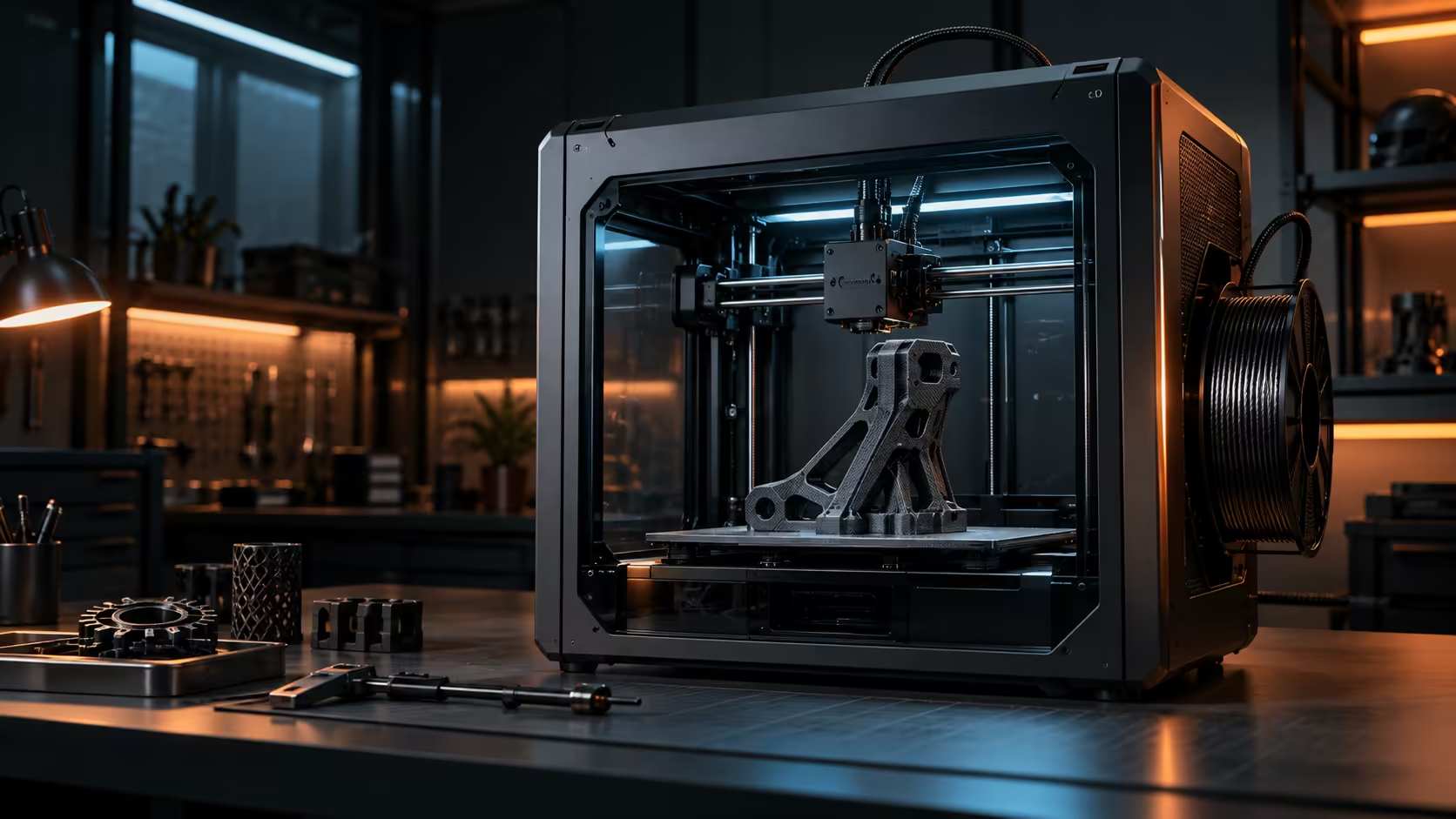
A print left running in the open shares its heat, its fumes and its noise with the whole surrounding room, and none of those three things are usually welcome together all at once. Enclosed versus open-frame 3D printers comes down to which of those three you are actually trying to control.
Quick Answer
An enclosure holds firmly on to the heat the bed and hotend already generate, which is precisely what stops large ABS and ASA parts curling off the plate as they cool unevenly out in open air. It also genuinely contains fumes and noticeably dampens noise, which is why the Creality K1C pairs its closed chamber with a built-in air filter rather than leaving either problem to the room around it. It costs R12,599.
🌡️ Temperature: why closed beats open for certain materials
PLA, printing at 190 to 220C, tolerates open-frame printing without much real trouble at all, since it does not shrink or warp dramatically as it fully cools down. ABS and ASA, printing at 230 to 260C, behave differently: uncontrolled airflow across a cooling part causes uneven shrinkage, and that shows up as curling corners or cracked layers on larger prints specifically.
An enclosure keeps ambient temperature around the part far more stable than an open frame ever can, since it is not competing against whatever draught or air conditioning happens to be active in the room at the time.
🌬️ Filtration: containing what the material gives off
Materials that need enclosure heat also tend to be the ones that give off more while printing, and an open frame lets that spread through the room rather than staying contained. The K1C's built-in air filter addresses this directly, dealing with what an enclosed chamber traps rather than releasing it the moment the door would otherwise be open.
🔇 Noise: the quieter side of the same wall
An enclosure doubles as a sound barrier, since the same panels holding heat in also dampen the fan and motor noise coming out. This matters more than people expect once a printer is running for eight or ten hours in a shared living space, where the difference between audible in the next room and barely noticeable comes down almost entirely to whether there is a chamber wall in between.
Weigh all three factors against your actual space and materials before choosing, since an open-frame machine still has its place for PLA-only work in a well-ventilated area. Browse filament suited to whichever printing style you settle on, and consider a case fan upgrade for the room itself if ambient heat buildup around an enclosed machine becomes a problem in summer.
🔬 What actually happens when an open-frame machine prints ABS
An open frame does not stop ABS from printing entirely, it simply changes the odds of a given print actually succeeding, since ABS typically wants a bed somewhere between 90C and 110C and shrinks noticeably as it cools away from that temperature. A small, squat part with short vertical walls can print successfully in open air on a good day with no draughts, while a tall part with a wide base almost always curls at the corners the moment ambient airflow is uneven for even part of the job. The failure is probabilistic rather than absolute, which is exactly why some open-frame ABS prints succeed and others fail for no obvious reason, when the real cause was a draught that came and went partway through.
This unpredictability is the real, practical argument for an enclosure with ABS, not that open-frame printing is somehow impossible, but that it turns an otherwise straightforward material choice into a genuine gamble dependent entirely on room conditions on any given day of the week.
🧯 A safety note on running enclosed prints unattended
An enclosed printer holding in heat and fumes also holds in the consequences of anything going wrong mechanically, so keep the machine on a genuinely heat-resistant surface, well clear of anything flammable nearby, and within reach of a working smoke detector regardless of how reliable the printer has been so far in day-to-day use. This is not specific to any one brand or model, it applies to any enclosed heating appliance left running for hours unattended, and it costs nothing beyond a moment's thought about where the machine actually sits. Check safety and build quality notes across the 3D printer range before choosing where a new machine will live long-term.
Frequently Asked Questions
Is an enclosure necessary for printing PLA?
Not generally, since PLA tolerates open-air cooling reasonably well on most jobs; enclosures matter most for ABS, ASA and other similar higher-temperature materials.
Does an enclosure make a printer significantly quieter?
Yes, the very same panels that retain heat inside also dampen fan and motor noise coming out, which becomes noticeable in a shared living space over a long print.
Can an open-frame printer be enclosed afterwards with an aftermarket cover?
Some can, though results vary and a purpose-built enclosure usually manages temperature and filtration more reliably than an add-on cover.
Does filtration only matter for smell?
No, it also affects what actually stays in the room versus what disperses through it, which matters for indoor air quality during longer prints.
Can ABS ever print successfully on an open-frame machine?
Sometimes, on small, squat parts printed in a genuinely draught-free room, but the result stays inconsistent from one print to the next, which is exactly the unpredictability a proper enclosure removes entirely.
Is it safe to leave an enclosed printer running overnight unattended?
Generally yes on a well-built machine, provided it sits on a heat-resistant surface, away from anything flammable, with a working smoke detector nearby regardless of the printer's own reliability record.
Does an enclosure need active heating, or is trapped heat enough?
Trapped heat from the bed and hotend alone is often enough for materials like PETG and mild ABS use; an actively heated chamber adds more consistency for demanding materials and genuinely larger parts specifically, where uneven passive heat retention starts to matter more.
Does the type of enclosure material affect how well heat is retained?
Yes, a fully panelled enclosure with a door retains heat far more evenly than a partial or mesh cover, which matters most on larger, taller prints where even a small gap lets heat escape unevenly from one side.
Deciding between an open-frame and enclosed printer?
Match the choice to your materials, your space and how much noise you can live with.