Ever watched a pro Valorant player snap to a target with impossible speed and wondered, "How?" While raw skill is king, their gear is the unsung hero. We’re diving into the world of esports gaming laptops for 2025, unpacking the specific hardware that gives the pros their competitive edge. It’s not about flashy RGB… it’s about raw performance that translates directly to victory. Ready to see what separates the champs from the contenders? 🏆
The Screen: Why Refresh Rate is Everything
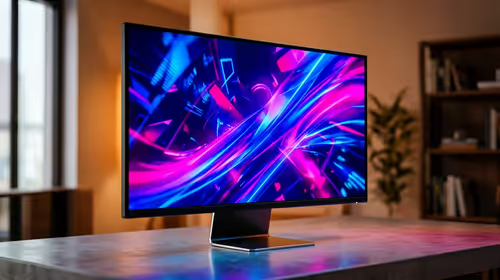
Forget 4K resolution. In the competitive scene, speed is the only metric that matters. The single most important feature of esports gaming laptops in 2025 is a high-refresh-rate display. A standard 60Hz screen updates the image 60 times per second. A pro-grade 144Hz, 240Hz, or even 360Hz panel updates it 144, 240, or 360 times per second.
What does this mean for you? A buttery-smooth image where enemies appear on screen fractions of a second sooner. It allows for cleaner tracking of fast-moving targets and a more direct, responsive feel between your mouse movement and what you see. Once you experience 144Hz or higher, going back to 60Hz feels like playing in slow motion. This is the foundation of any serious competitive setup, and many of the best gaming laptop deals now feature these high-speed panels as standard.
CPU Showdown: The Brains Behind the Frames
Many popular esports titles like CS:GO, Valorant, and League of Legends are surprisingly CPU-intensive. These games rely on the processor for physics calculations, player location data, and preparing frames for the graphics card. A weak CPU can create a bottleneck, holding back your powerful GPU and causing inconsistent frame rates... the ultimate enemy in a clutch situation.
This is why the hardware pros use always features a high-performance processor. For 2025, the debate continues between Team Blue and Team Red.
- Intel: Known for exceptional single-core performance, which is critical for high FPS in many esports titles. A laptop with a modern Core i7 or i9 is a formidable weapon. You can find some seriously powerful Intel laptops on special that are perfect for competitive play.
- AMD: Ryzen processors offer incredible multi-core performance and efficiency, making them excellent not just for gaming, but for streaming and content creation too. The latest Ryzen 7 and Ryzen 9 chips are powerhouses that chew through any task you throw at them. Check out the latest Ryzen laptop deals to see their competitive pricing.
Ultimately, you can't go wrong with either, but make sure your chosen CPU has high clock speeds to feed your screen those crucial frames per second.
Pro Gamer's Secret ⚡
Many pros lower their in-game graphical settings, even on powerful hardware. Why? To maximise frame rates and reduce visual clutter. Disabling shadows or lowering texture quality can push your FPS well over 300, giving you the smoothest possible image and the fastest on-screen response. It's all about competitive advantage, not just pretty visuals.
The GPU: Consistent Power for Flawless Performance
While the CPU is critical, the Graphics Processing Unit (GPU) is what renders the final image. You might think you need the most powerful GPU on the market, but for esports, consistency is more important than raw power. The goal isn't to run Cyberpunk 2077 with path tracing at 4K; it's to maintain a rock-solid 240+ FPS at 1080p in Apex Legends during a chaotic final-circle fight.
This is where NVIDIA's GeForce RTX series shines. A laptop with an RTX 4050 or 4060 provides more than enough horsepower for any esports title, ensuring your frame rate never dips when it matters most. These GPUs also support features like NVIDIA Reflex, which reduces system latency for an even more responsive feel. Exploring the current range of GeForce RTX gaming laptops on special is the best way to find that sweet spot of performance and price.
Beyond the Cores: Keyboard, Cooling, and Budget
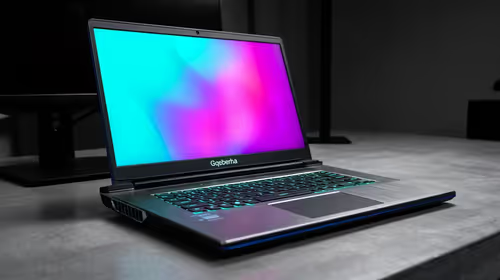
A top-tier CPU and GPU mean nothing if the rest of the machine can't keep up. The design of a pro gaming laptop is just as important. Pros look for laptops with highly responsive keyboards (sometimes with mechanical switches), robust cooling systems to prevent thermal throttling during long tournaments, and fast connectivity options like Wi-Fi 6E and a 2.5G Ethernet port. 🔧
You don't need a R50,000 budget to get a machine with these core features. The market for esports gaming laptops has become incredibly competitive, and it's now possible to find tournament-ready machines that deliver incredible value. You can find excellent options with 144Hz screens and powerful components when you buy gaming laptops under R20k, proving that you can get on the ladder without emptying your wallet.
Ready to Level Up Your Gear?
Getting a pro-spec machine doesn't mean breaking the bank. The secret to the perfect esports gaming laptop for 2025 is balancing a high-refresh screen with a powerful CPU and GPU. Explore our massive range of laptop specials and find the perfect machine to start your climb up the ranks.