An RTX 5070 laptop can spend the morning in a backpack and the evening driving a full gaming desk. The monitor has to suit both the GPU and the particular chassis wrapped around it. A slim model and a thick performance laptop can carry the same badge while sustaining different frame rates. Start the RTX 5070 laptop monitor shortlist at 27-inch 1440p and 165Hz to 180Hz, then let your measured performance move it.
Quick Answer
Choose a 27-inch QHD monitor with a 165Hz or 180Hz refresh rate, Adaptive-Sync and good response through the VRR range. A 240Hz panel fits competitive games when the laptop holds high real frame rates. A 32-inch 4K screen makes sense for mixed creative work and gaming, with DLSS and tuned effects carrying the heavier titles. Evetech's in-stock gaming-monitor sample reached a R4,499 median in July 2026, so use that dated middle point to judge how much the faster or sharper panel adds.
🖥️ Build the shortlist around 1440p
QHD on 27 inches looks crisp from a normal desk distance and gives Windows enough room for useful side-by-side work. The RTX 5070 laptop tier has a practical route to high-refresh play at that resolution, though an ambitious ray-tracing preset can still pull frame rate well below the panel's ceiling.
Begin at High rather than Ultra. Run the most demanding game you own through a busy route and record one-percent lows after the laptop has warmed up. If the result moves between 105fps and 155fps, a 165Hz VRR monitor can show that delivery cleanly without forcing the machine to chase a fixed number.
Evetech's gaming-monitor selection gives you current QHD sizes and refresh rates once the target is clear.
⚡ Move to 240Hz when your games earn it
Competitive shooters and racing games can make the extra refresh visible. The jump is easiest to appreciate when the laptop also supplies fast, steady base frames. Check a full match, including the crowded moments that drag down performance.
Processor limits matter here. Lowering resolution may stop helping once the CPU or game engine controls the result. If 1080p Low and 1440p Medium produce similar one-percent lows, a larger GPU number will not unlock the missing refresh by itself.
Panel behaviour deserves equal weight. A nominal 240Hz display with visible overshoot can look worse than a well-tuned 180Hz panel. Look for response measurements across the VRR range rather than one best-case setting.
4️⃣ Choose 4K for a wider life than gaming
At 32 inches, 4K gives photos, text and video space to shine. The RTX 5070 laptop can run the desktop and lighter games at native resolution. New demanding releases will lean more heavily on DLSS and selective settings cuts.
Keep the monitor at native 4K when using an upscaler so the interface and output remain sharp. Test fine detail in motion from your chair. A quality mode that looks good during play is more valuable than a performance label chosen from a menu.
🔌 Make the cable follow the laptop manual
The GPU family does not tell you which port carries the fastest display mode. Check the exact laptop specification for HDMI bandwidth, DisplayPort over USB-C and the output wired directly to the NVIDIA GPU. A USB-C socket can support video, charging, both or neither; its shape is not the specification.
Use a certified cable short enough for the desk. After connecting, open Windows Advanced display and select the native resolution plus the intended refresh. If 240Hz or 4K high refresh is absent, try the documented output before touching game settings.
🔄 Keep changing laptop performance inside VRR
Laptop clocks move with heat and power. Variable refresh lets the display follow those changes without turning each dip into a harsh stutter or tear. Enable the monitor's sync option and confirm compatible VRR in the NVIDIA control panel.
Then repeat the game after twenty minutes. A cooling pad or raised rear edge may help a chassis breathe, but it cannot replace clear intakes and a sensible power profile. Choose the monitor from the performance the laptop can sustain, not its first cool minute.
📐 Pick curved or flat from distance and use
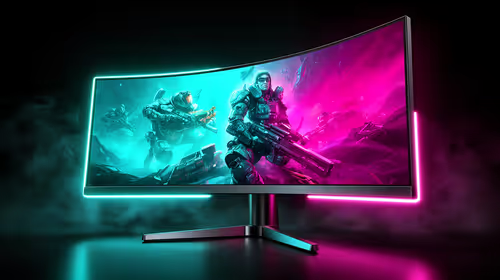
A flat 27-inch panel works naturally for mixed tasks and takes up little visual space. Curvature becomes more noticeable on 32-inch screens and ultrawides, where it can keep the edges feeling closer. Neither shape raises frame rate.
Sit at the intended distance and open the applications you use for work. Straight design lines and spreadsheets may favour flat. A curved screen can feel inviting in games, especially when it fills more of your view. The desk decides this one better than the GPU.
🎒 Compare the complete laptop station
Leave space for the laptop's exhaust and charger brick. If the built-in display stays open, place it where the two screens do not force constant neck movement. An arm can reclaim desk depth, subject to the monitor's mount support and the desk's strength.
Evetech's monitor best-seller list is useful for comparing current stand footprints and connection layouts. The RTX 5070 graphics-card category shows the wider desktop tier separately; desktop cards and laptop GPUs are different performance classes despite the shared family name.
Frequently Asked Questions
Can an RTX 5070 laptop push past 165Hz at 1440p?
Yes in lighter and competitive games. Sustained results depend on the laptop's power limit, cooling and processor as well as the GPU.
Is 4K a realistic option for an RTX 5070 laptop?
Yes for the desktop, creative work and lighter games. Demanding play will often require DLSS and restrained effects.
Does the RTX 5070 laptop need a specific cable for high Hz?
It needs a cable and output that support the chosen resolution and refresh. Follow the laptop and monitor specifications rather than the connector shape alone.
Should an RTX 5070 laptop monitor be curved or flat?
Flat suits a typical 27-inch mixed-use desk. Curved becomes more compelling on larger or wider screens, subject to personal comfort.
How does the RTX 5070 compare to the 5060 for monitor choice?
It offers more room for high refresh and demanding settings, while differences between individual laptop designs can narrow or widen that gap.
Will an RTX 5070 laptop bottleneck a 240Hz monitor?
Some games will run below 240fps. That does not make the monitor unusable, provided VRR works and your competitive titles reach the higher range.
Is VRR essential for an RTX 5070 laptop external monitor?
It is one of the most useful features because laptop frame rates change with scene load, heat and power.
Building a desk that lets the RTX 5070 laptop stretch out?
Compare high-refresh 1440p monitors at Evetech, then verify the laptop's output and sustained game results before choosing 180Hz or 240Hz.