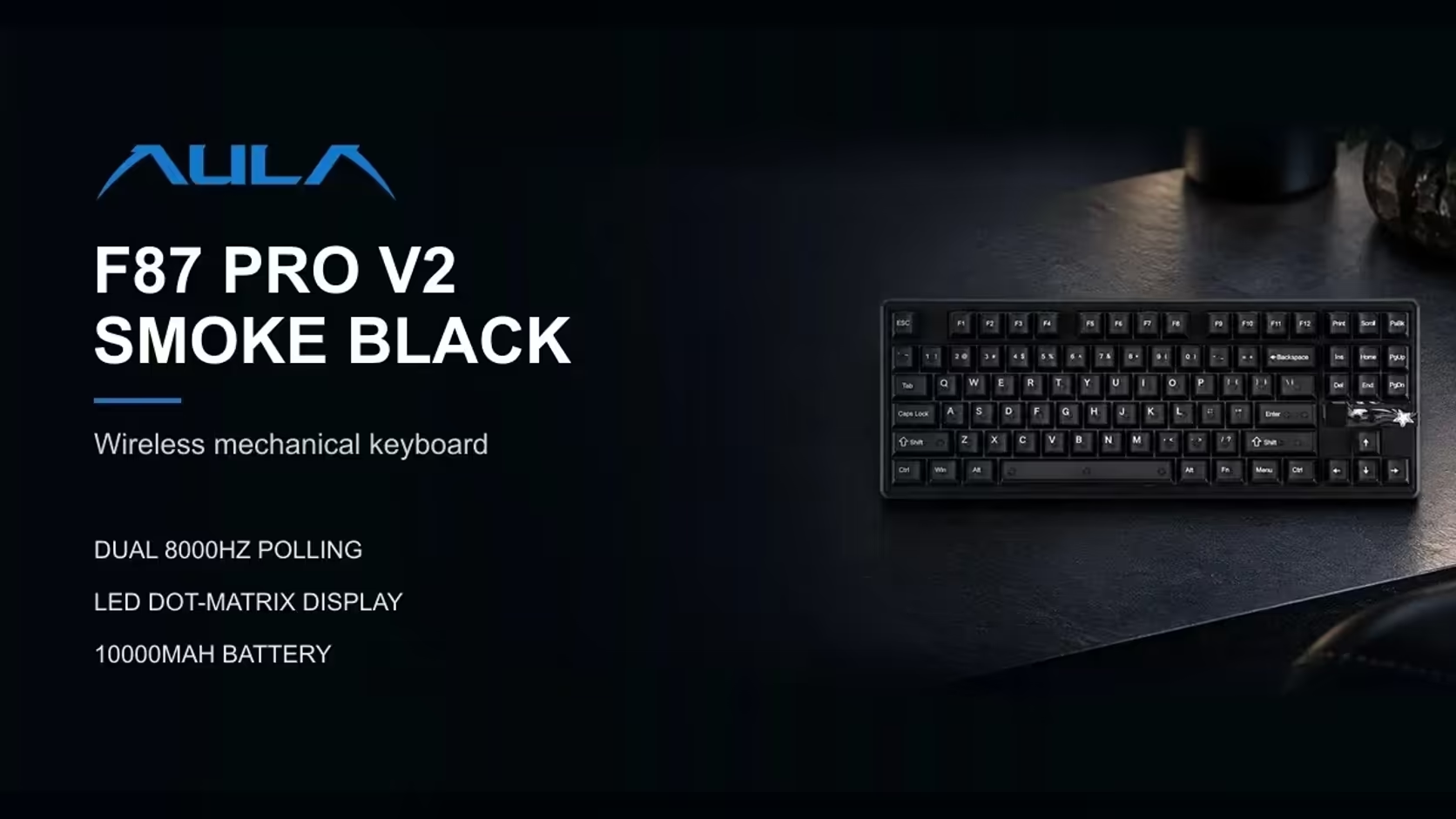
On a spec sheet, the AULA F87 Pro V2 and HERO 75 HE look like near neighbours: both wireless, both tri-mode, both reporting at 8000Hz. Under the keycaps they are built on different ideas. One is a mechanical tenkeyless board with a light-up display; the other is a magnetic Rapid Trigger keyboard in a 75% layout. Knowing what magnetic switches actually change is the key to picking between them.
Quick Answer
Choose the F87 Pro V2 for a mechanical TKL with a 49-LED audio display, SOCD and a 10000mAh battery. Choose the HERO 75 HE for magnetic switches with Rapid Trigger and actuation you can set from 0.1mm to 3.4mm in 0.005mm steps. Both poll at 8000Hz and connect by cable, 2.4GHz or Bluetooth. At Evetech both sell for R899, with the HERO 75 HE carrying 2 Years Local Warranty and the F87 Pro V2 carrying 1 Year Local Warranty.
🧲 What magnetic switches add
A mechanical switch, the kind fitted to the F87, registers a press when two metal contacts meet at a fixed point in the key's travel. That point is set at the factory and does not change.
Hall effect switches swap the contacts for magnetism: the board senses the field as the key descends and so knows the key's depth continuously, not just at one trigger point. That opens up two things mechanical switches cannot do.
Adjustable actuation
On the HERO 75 HE, each key can be told to fire at its own depth, picked from a 0.1mm to 3.4mm window and tuned in 0.005mm increments. A very shallow point makes movement keys respond almost as soon as you touch them; a deeper one protects against accidental presses while typing.
Rapid Trigger
Rapid Trigger resets a key the instant it starts moving back up, rather than waiting for it to pass a fixed reset point. In practice, you can stop, strafe and re-press faster, because the key is ready again sooner. The HERO 75 HE also offers a zero dead zone setting, and its driver shows live key travel and supports switch calibration.
Switch names differ by colour: Stormrise sits in the black HERO, Spiritcloud in the Orange and Green editions.
Where mechanical still holds its own
None of that makes a mechanical board obsolete. A fixed actuation point is predictable, needs no tuning and behaves the same on every machine you plug into. If you mostly type, play story games or simply do not want to spend an evening in a driver setting per-key depths, the F87's approach is the simpler one. Mechanical sockets also open up a far wider choice of replacement switches, since the hot-swap sockets take standard mechanical parts rather than magnetic ones.
⚡ Where the two boards match
Both keyboards poll at 8000Hz, a 0.125ms reporting interval. On the HERO 75 HE that applies wired and over its 2.4GHz receiver, with Bluetooth at 125Hz. For the F87, AULA quotes dual 8000Hz. Cable, dongle and Bluetooth are on offer with each, and each will hold three devices.
Both support SOCD, so the question of which one handles opposing strafe keys cleanly is settled either way. The HERO 75 HE's key-mode list is longer, adding DKS, Multi-Point Trigger and END to Mod-Tap and Toggle. The F87 stops at SOCD, Mod-Tap and Toggle.
Both boards are hot-swappable. The F87 takes mechanical switches in every socket. The HERO 75 HE swaps keycaps and magnetic switches and supports mixed setups, but it takes magnetic switches, not mechanical ones.
📐 Layout, build and lighting
Size and layout
The F87 is a tenkeyless board: only the number pad goes, and Insert, Home, Page Up and the rest stay. The HERO 75 HE is a 75% layout with 84 keys, keeping the function row and arrows in a tighter body, 313mm wide and about 980g.
How they are built
The F87 hangs its internals on gaskets and stacks seven layers of damping for a cushioned landing. The HERO takes another route, a boat-style chassis, and pairs its aluminium plate with five damping layers and double-shot PBT caps.
Lighting
This is where the F87 leans into show. Its 49-dot LED grid dances to whatever audio is playing or loops a GIF you set in AULA's software, and lighting wraps the whole case in a 360-degree zone. The HERO 75 HE has south-facing per-key RGB and a 36-LED light box along the top.
🔋 Batteries and cover
Battery sizes are 10000mAh in the F87, labelled true capacity by AULA, and 8000mAh in the HERO. AULA rates neither in hours, so the larger cell is simply a bigger reserve rather than a guaranteed runtime.
Warranty is where the two differ most on paper. The HERO 75 HE belongs to AULA's group of magnetic keyboards, which Evetech covers for twice as long as the display boards like the F87. Either way, a claim is dealt with locally rather than overseas.
✅ Which one to buy
Choose the F87 Pro V2 if
- You want a display that reacts to your music and games.
- You rely on the navigation keys of a TKL.
- You want the larger battery and mechanical switches you can swap freely.
Choose the HERO 75 HE if
- You play fast competitive games where Rapid Trigger and adjustable actuation make a real difference.
- You prefer a compact 75% layout.
- The longer warranty matters to you.
Put both next to the rest of Evetech's gaming keyboards before deciding; the keyboard best sellers page adds a view of which layouts buyers keep returning to.
Frequently Asked Questions
What is the practical benefit of magnetic switches?
They let you set where each key registers and reset keys instantly with Rapid Trigger, which helps fast movement in competitive games.
Do both boards support SOCD?
Yes. It appears in the key-mode list of each board.
Which layout is more compact?
The HERO, at 313mm wide in a 75% arrangement. The F87 trades that compactness for a complete navigation block.
Which has the bigger battery?
The F87, at 10000mAh to the HERO's 8000mAh, though AULA quotes no hours for either.
How do the lighting features compare?
The F87 adds an audio-reactive display and all-round case lighting; the HERO relies on south-facing key lighting and a 36-LED light box on top.
Why is the warranty longer on the HERO 75 HE?
Evetech gives AULA's magnetic boards the longer term, and the F87 is a mechanical display board rather than a magnetic one.
Does Bluetooth run at 8000Hz on the HERO 75 HE?
No. It reaches 8000Hz wired and on the 2.4GHz receiver; Bluetooth runs at 125Hz.
Ready to choose between magnetic speed and a mechanical light show?
Compare the F87 Pro V2 and the HERO 75 HE alongside Evetech's full gaming keyboard range and pick the board that matches how you play.