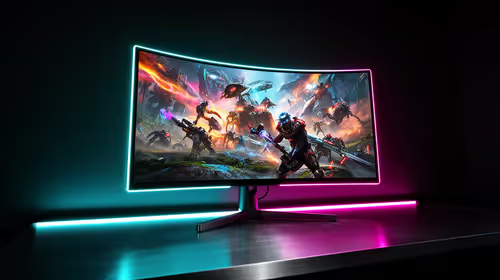
You're in the final circle in Apex Legends. The tension is thick. You line up the perfect shot... and your screen glitches, tearing into a jagged mess for a split second. It's enough to make you miss. That frustrating visual artifact is called screen tearing, and it's the enemy of smooth gameplay. Luckily, we have powerful allies in the FreeSync vs G-Sync battle, two incredible technologies designed to eliminate tearing and give you the buttery-smooth experience you deserve.
So, What is This Gaming Sync Tech Anyway?
At its core, screen tearing happens when your graphics card (GPU) sends out frames at a different rate than your monitor can display them. Your monitor has a fixed refresh rate (like 60Hz, 144Hz, or 240Hz), while your GPU's output fluctuates wildly depending on how intense the game is. When they're out of sync, you see a horrible horizontal line across the screen.
Variable Refresh Rate (VRR) technology solves this. Instead of a fixed rate, VRR allows the monitor to dynamically adjust its refresh rate to match the frame rate of your GPU in real-time. The two dominant types of VRR are AMD's FreeSync and NVIDIA's G-Sync.
FreeSync vs G-Sync: The Two Champions 🎯
While both aim for the same goal—flawless, tear-free gaming—they take different paths. Understanding the G-Sync vs FreeSync debate is key to choosing the right display for your rig and budget.
AMD FreeSync: The People's Champion
FreeSync is AMD's answer to screen tearing. It's built on an open standard called VESA Adaptive-Sync, which means monitor manufacturers can implement it without paying licensing fees to AMD. This generally makes FreeSync monitors more affordable.
There are three tiers to look for:
- FreeSync: The base level, eliminating tearing.
- FreeSync Premium: Adds mandatory Low Framerate Compensation (LFC) and at least a 120Hz refresh rate at 1080p resolution.
- FreeSync Premium Pro: Includes everything from Premium plus HDR (High Dynamic Range) support.
Because it's so accessible, you can often find some of the best PC monitor deals on displays sporting FreeSync technology.
NVIDIA G-Sync: The Premium Contender
G-Sync is NVIDIA's proprietary solution. For years, "true" G-Sync required a special hardware module built directly into the monitor. This dedicated chip handles the sync process, ensuring a highly consistent and premium experience with features like variable overdrive to reduce ghosting.
This hardware requirement and a strict certification process mean G-Sync monitors typically carry a higher price tag. The tiers are:
- G-Sync Compatible: These are actually FreeSync monitors that NVIDIA has tested and certified to provide a good baseline G-Sync experience.
- G-Sync: Features the dedicated NVIDIA processor for a full feature set and superior performance.
- G-Sync Ultimate: The best of the best, with the dedicated processor plus advanced HDR support (HDR1000) and ultra-low latency.
You'll find these technologies across our entire range of gaming monitors, from entry-level to professional-grade.
Pro Tip: Unlocking G-Sync on a FreeSync Monitor ⚡
If you have an NVIDIA graphics card (10-series or newer) and a "G-Sync Compatible" FreeSync monitor, you can enable G-Sync! Just connect via DisplayPort, go to the NVIDIA Control Panel, find "Set up G-SYNC," and enable it for your display. It's a great way to get VRR benefits without paying the full G-Sync premium.
Key Differences for South African Gamers 🤔
So, how do you choose? It comes down to your GPU, your budget, and what you value most.
- GPU Compatibility: This is the big one. Traditionally, you needed an AMD Radeon GPU for FreeSync and an NVIDIA GeForce GPU for G-Sync. While NVIDIA cards can now run on many FreeSync monitors (as "G-Sync Compatible"), an AMD card still can't use G-Sync.
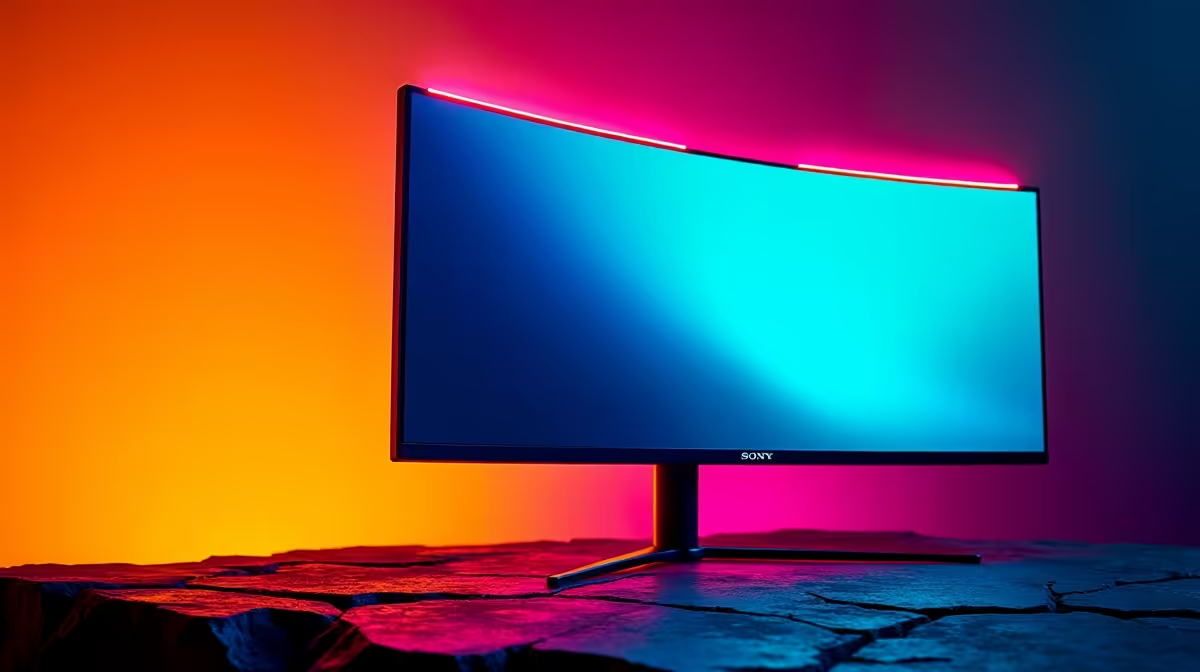
- Price: FreeSync's open standard makes it the clear winner on price. You'll find it on a huge variety of displays, including many fantastic immersive curved monitors that won't break the bank.
- Performance & Quality: Historically, the dedicated G-Sync hardware module provided a more reliable and consistent experience across the entire refresh rate range. However, the gap has closed significantly. A top-tier FreeSync Premium Pro monitor can easily rival a G-Sync display, especially on high-end rigs pushing pixels on stunning high-resolution 4K and 5K monitors.
The Final Verdict: Which Sync Tech is for You? ✨
Choosing between FreeSync and G-Sync is simpler than it seems. Here's the bottom line for Saffas building or upgrading their setup:
- If you have an AMD GPU: Your choice is made. Go for a FreeSync monitor that matches your budget and desired features (like Premium or Premium Pro).
- If you have an NVIDIA GPU: You have options. For a guaranteed, top-tier experience with all the bells and whistles, a true G-Sync or G-Sync Ultimate monitor is a fantastic investment. For excellent value, a certified G-Sync Compatible FreeSync monitor is an incredibly smart choice that delivers smooth gameplay for less.
Ultimately, both technologies are a massive upgrade over a standard display. The right choice depends on your specific hardware and budget. Remember that sync tech is just one piece of the puzzle; panel type, resolution, and size are also crucial factors when browsing all the different PC monitors available. From on-the-go portable monitors to the stands and cables you'll find in our monitor accessories section, building the perfect setup is about getting all the details right.
Ready to Banish Screen Tearing for Good?
The FreeSync vs G-Sync debate shows there's a perfect sync solution for every gamer. Explore our massive range of gaming hardware and find the perfect monitor to unlock flawlessly smooth gameplay.