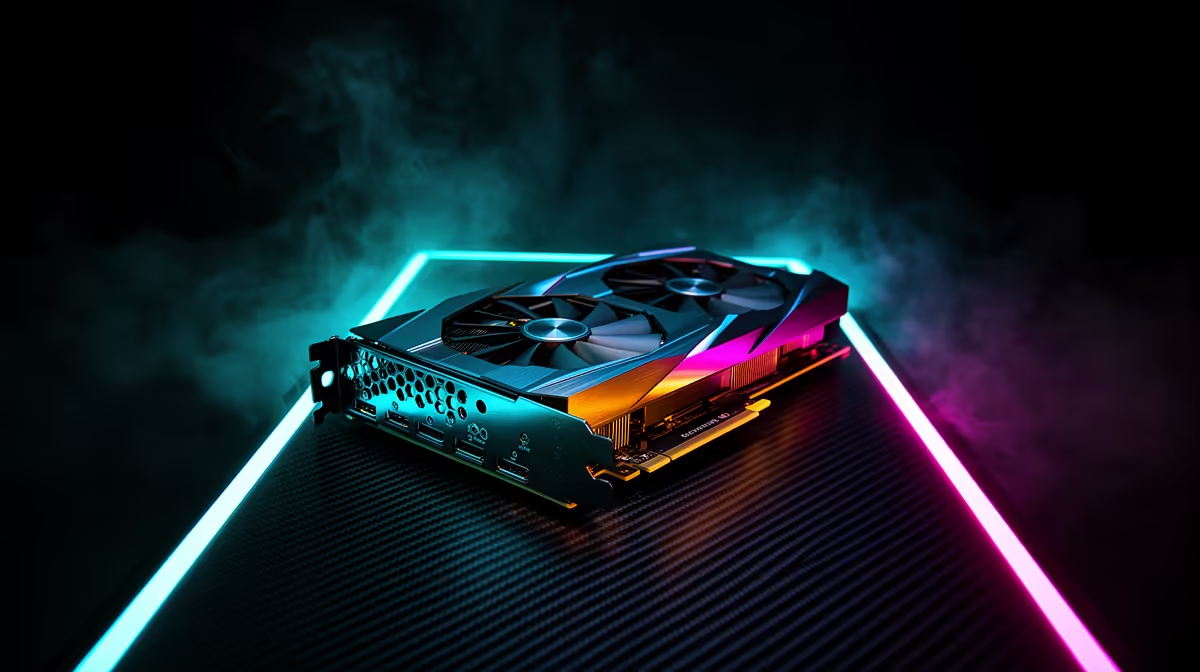
Buying a new graphics card in South Africa feels like a boss battle. Between confusing specs and prices that make your wallet weep, how do you choose the right one? Forget the jargon. This guide cuts through the noise. We're breaking down the essential gaming GPU features you actually need to know, helping you find the perfect card for your rig and your budget, right here in Mzansi. Let’s get you ready for max settings. 🚀
Core GPU Features: The Foundation of Your Framerate
Before we get to the flashy new tech, let's talk about the fundamentals. The core specifications of a graphics card are the engine that drives your gaming experience. Understanding these helps you see why one card costs R8,000 and another costs R28,000.
VRAM: Your GPU's Workspace
Video RAM, or VRAM, is your GPU's dedicated high-speed memory. Think of it as a workbench. The bigger and more complex your game's textures and assets are, the more space they need. If you run out of VRAM, your system has to fetch data from slower system RAM, causing horrible stuttering.
For 1080p gaming in 2024, 8GB of VRAM is the comfortable minimum. For 1440p or ultra-detailed simulators, you'll want 12GB or more. Games with massive, detailed worlds like Microsoft Flight Simulator demand powerful PCs with plenty of VRAM to render the world smoothly.
Cores and Clock Speeds
You'll see terms like CUDA Cores (NVIDIA) and Stream Processors (AMD). In simple terms, these are tiny processors inside the GPU that handle graphics calculations. More cores generally mean more power. Clock Speed, measured in MHz, is how fast those cores run. While a higher number is better, the GPU's overall architecture is what truly defines its performance. A modern card with fewer cores can often outperform an older card with more, thanks to smarter design.
The "Magic" Features: Ray Tracing & AI Upscaling
This is where modern gaming GPU features really shine. These technologies use dedicated hardware and AI to create stunning visuals and boost performance in ways that were impossible just a few years ago.
Ray Tracing: Next-Level Realism
Ray Tracing is a rendering technique that simulates how light behaves in the real world. It creates incredibly realistic reflections, shadows, and lighting that can transform a game's atmosphere. The visual payoff is immense, turning a game world into a breathtakingly immersive place. It's a demanding feature, but for cinematic experiences in titles like Cyberpunk 2077, a capable gaming PC makes the neon-drenched streets truly come alive.
DLSS & FSR: The Free FPS Boost ✨
This is arguably the most important feature for South African gamers. NVIDIA's DLSS and AMD's FSR are AI upscaling technologies. They render your game at a lower internal resolution and then use sophisticated AI algorithms to intelligently upscale the image to your monitor's native resolution. The result? A massive frame rate boost with minimal, often unnoticeable, loss in visual quality. For fast-paced shooters, this is a must-have, ensuring you get the smoothest gameplay on a PC built for Call of Duty: Warzone.
Check Your VRAM Usage 🔧
Not sure if you need a VRAM upgrade? Use a tool like MSI Afterburner's on-screen display while playing your most demanding game. If your VRAM usage is consistently hitting its maximum limit (e.g., 7900MB on an 8GB card), you're likely experiencing performance bottlenecks and would benefit from a card with more memory.
GPU Features for Competitive Gaming
When victory is decided in milliseconds, you need a GPU that prioritises raw speed and responsiveness over cinematic visuals. The goal is simple: maximum frames per second (FPS) and minimum input lag.
High refresh rates are key. A GPU that can consistently push 144 FPS or more gives you a tangible advantage, as you see enemy movements sooner. This is non-negotiable for esports titles. Whether you're building structures in Fortnite on a custom gaming PC or landing headshots, more frames equal more data for you to react to. This is just as true for team-based shooters, where a PC optimised for Overwatch 2 can help you climb the ranks. Even in classic battle royales, a powerful GPU ensures you're not dropping frames during a crucial firefight on a rig designed for PUBG.
Finding the Right Balance for Your Budget
Not everyone needs a top-of-the-line card. The best gaming GPU features are the ones that fit your needs and your wallet. A solid mid-range card today can offer a fantastic experience in a huge variety of games. It can run sprawling open worlds smoothly, like the ones found on a PC ready for GTA V, and can even make simpler-looking games look spectacular. For instance, adding ray tracing shaders to Minecraft with a good PC completely transforms its blocky world into a visual masterpiece.
The key is to identify which features matter most to you. Are you a competitive FPS player? Prioritise raw performance. Love single-player cinematic games? Look for a card with strong ray tracing capabilities.
Ready to Upgrade Your Visuals?
Understanding gaming GPU features is the first step. The next is finding the card that fits your rig and budget. Whether you're chasing photorealistic worlds or pure competitive FPS, the right GPU makes all the difference. Explore our massive range of gaming graphics cards and find the perfect engine for your next adventure.