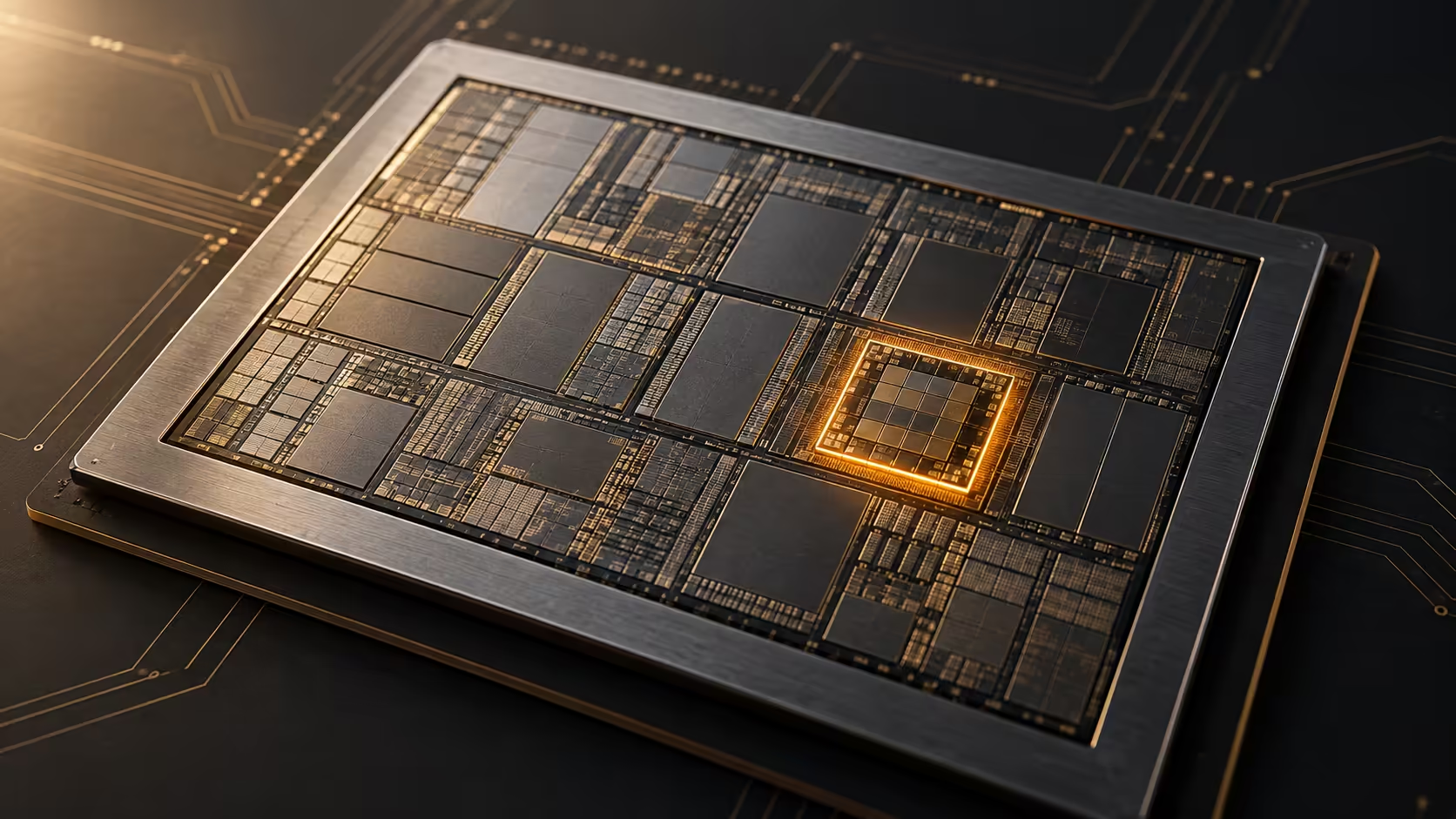
A bigger AI number is easy to compare and easy to misunderstand. Googlebook NPU TOPS describes a particular kind of computational throughput. It does not directly tell you how quickly a laptop will open a document, render a game or return an answer from an online assistant. To make the number useful, first identify the work that could use the accelerator.
Quick Answer
TOPS means trillions of operations per second under specified arithmetic conditions. It is a theoretical throughput metric, not a universal application benchmark. The Google launch comparison lists up to 49 NPU TOPS for Acer and ASUS, 45 for XPS and HP, and 47 for Lenovo. Compare those figures alongside precision, software support and whether the feature actually uses the accelerator.
🧮 Know what is being counted
An NPU is a neural processing unit designed to handle patterns of computation used by AI workloads. TOPS reports how many arithmetic operations it can theoretically process in a second under the stated assumptions. The unit sounds broad, but those assumptions are essential to interpreting it.
Different numerical representations require different amounts of work. An accelerator may process many compact, low-precision values more quickly than larger, higher-precision values. Therefore two numbers calculated using different precision are not automatically equivalent measures of capability.
The counting method matters too. Hardware can be described using conditions that do not occur continuously in a real application. A peak figure represents a ceiling for the defined operation pattern, not a promise that ordinary software will keep every part of the accelerator busy.
A simple analogy is the capacity of a workbench. It tells you something about the amount of work that can be arranged, but not how quickly materials arrive or whether the tools fit the job. The NPU still needs appropriate software and data. Without those, a higher arithmetic ceiling may change little for the user.
🧩 Follow the application through the hardware
An AI feature does more than arithmetic. It may load a model, prepare input, move data through memory, perform calculations and convert the result into an interface response. Different stages can run on different parts of a system. Improving one stage only helps as much as that stage limits the whole task.
Suppose a hypothetical workflow spends most of its time loading data and a smaller share doing accelerated computation. Doubling the peak compute rate would not halve the total waiting time, because the loading work remains. This is a general performance principle, not a measured Googlebook example.
Software support is equally important. The application needs a route that can use the available accelerator for the intended model and operations. The mere presence of an NPU does not establish that a particular Android app uses it, or that a desktop AI package can be installed on Googlebook.
This is why the AI laptop finder should begin with an actual task. Describe the app, model or feature you need before comparing processor specifications. A workload that depends on an unsupported program has a compatibility problem, not a shortage of TOPS.
🌐 Local and online processing have different limits
An online assistant can involve a remote service. Its response time may depend on the connection, service processing and the amount of information exchanged. A larger local NPU number does not establish a proportional improvement in that remote path.
Conversely, an on-device workload can benefit from local acceleration when the software uses it effectively. That possibility still needs feature-specific evidence. It would be incorrect to infer that every Googlebook AI function runs locally simply because the laptop contains an NPU.
The processing location also cannot be inferred from how quickly an answer appears. A fast response may still involve a service, while a slower local task may be performing substantial work on the machine. Use the relevant feature documentation to understand its route rather than treating perceived speed as a privacy or architecture test.
Separate those questions when reading launch material. One question is what the processor can theoretically calculate. Another is which software makes use of it. A third is where the data is processed. A single number cannot answer all three, and combining them produces misleading buying advice.
🎮 Do not turn AI throughput into a universal ranking
Gaming performance depends heavily on graphics work, processor behaviour, memory, software compatibility and the game itself. NPU TOPS is not a substitute for frame-rate measurements. It also cannot establish that a Windows game installs natively on Googlebook.
Total platform TOPS needs particular care. A combined figure can include CPU and GPU contributions as well as the neural accelerator. Comparing that total with another machine''s NPU-only figure mixes categories. Look for the exact component and conditions behind each number before drawing a conclusion.
The useful independent test would define the model, input size, app version, power setting and result being measured. It might report completion time, sustained throughput, energy use or responsiveness, depending on the task. Without a common method, even two apparently similar results can answer different questions.
For ordinary purchasing, current laptop listings should therefore be assessed as complete systems. Screen comfort, supported applications, memory and portability can matter more than a small difference in an AI arithmetic ceiling. If the desired NPU-dependent feature has not been established, give that number less weight rather than inventing a benefit.
TOPS remains a useful technical specification when kept within its scope. It identifies an aspect of accelerator capability and can help shortlist hardware for a known workload. The mistake is letting it stand in for the workload itself. Choose the job first, confirm the software route, and then ask whether the hardware measurement is relevant to the time or energy that job consumes.
Frequently Asked Questions
What does TOPS stand for in an NPU specification?
Trillions of operations per second, a theoretical throughput measure for specified arithmetic conditions.
Does twice the TOPS mean twice the Gemini response speed?
No. Service latency, model execution and memory transfer can dominate the response time.
Can NPU TOPS predict gaming frame rates?
No. Game performance depends heavily on graphics, CPU work, software compatibility and the actual game workload.
Why does numeric precision matter?
An accelerator may execute more low-precision operations than higher-precision ones, so unlike figures are not equivalent.
Is total platform TOPS the same as NPU TOPS?
No. A platform total can include CPU and GPU contributions rather than only the neural accelerator.
Start with the AI task, then choose the laptop
Explore Evetech laptop options by supported applications and real workload needs before using NPU figures to refine the shortlist.