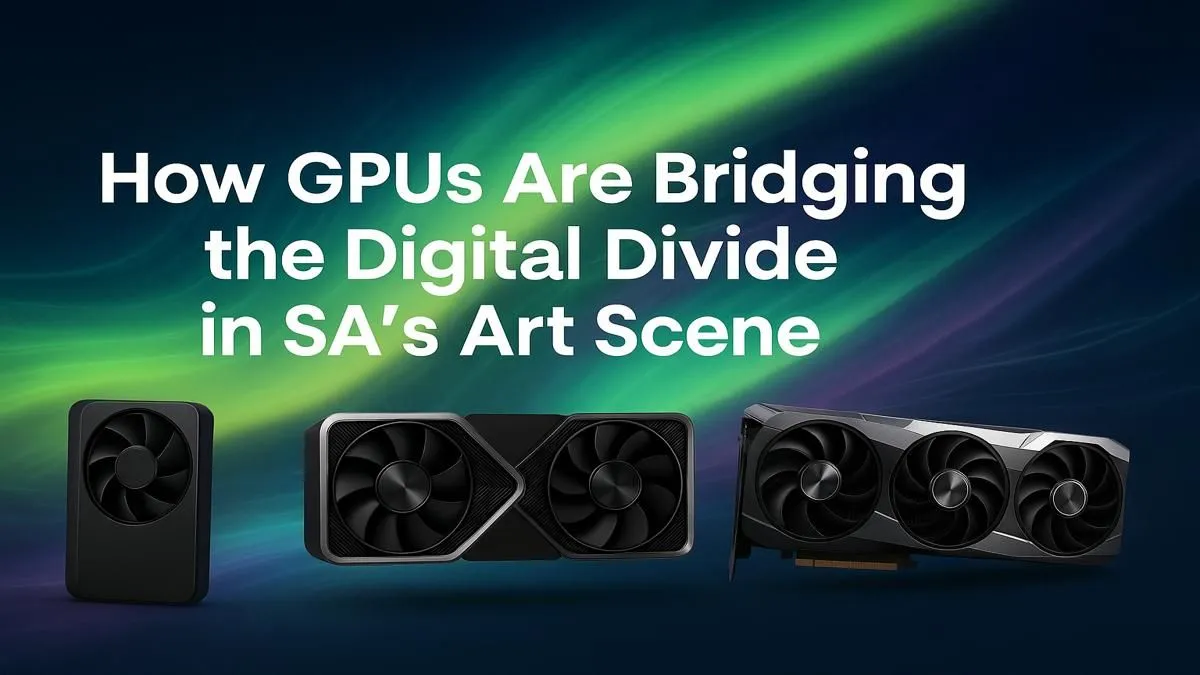
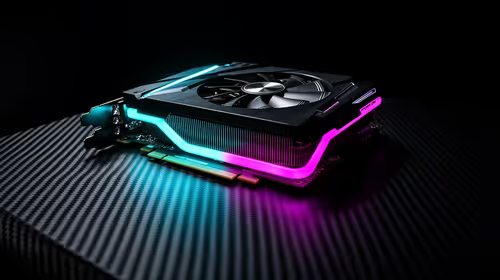
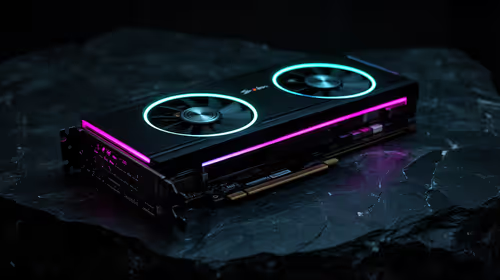
Is there anything more frustrating than a lagging brush stroke in Photoshop or a Blender render that takes longer than an unexpected outage? For South African creators, the digital canvas is our playground, but a weak GPU can feel like a creative prison. Choosing the right graphics card isn't just for gamers; it's the key to unlocking a smooth, efficient workflow. This guide will help you find the best GPUs for digital art in South Africa, bridging the divide between your vision and your final masterpiece. ✨
Why Your GPU is a Digital Artist's Best Friend
While your CPU (Central Processing Unit) handles general tasks, the GPU (Graphics Processing Unit) is a specialised powerhouse designed for parallel processing. Think of it as an army of workers ready to handle thousands of visual tasks at once. For digital artists, this means:
- Smoother Canvas Interaction: Panning, zooming, and rotating large files in applications like Photoshop or Clip Studio Paint becomes fluid and responsive.
- Real-time Previews: See the effects of complex filters, 3D lighting, and textures instantly instead of waiting for a progress bar.
- Faster Rendering: This is the big one for 3D artists and video editors. A powerful GPU can slash render times from hours to minutes, accelerating your entire project pipeline.
The two key specs to watch are VRAM (Video RAM), which determines the size and complexity of the files you can work on smoothly, and the number of processing units (like NVIDIA's CUDA Cores or AMD's Stream Processors), which dictates raw rendering power.
Choosing the Right GPU for Your Creative Workflow
The ideal GPU depends entirely on what you create. There’s no single "best" option, but we can pinpoint the perfect choice for your specific needs. Finding the right balance of performance and price is crucial when looking at GPUs for digital art in South Africa.
For the 2D Illustrator & Photographer 🎨
If your world revolves around Photoshop, Lightroom, or Illustrator, you don't need the most powerful card on the market. Your priority is stability and enough VRAM (8GB is a great starting point) to handle high-resolution images and many layers without stuttering. Both NVIDIA and AMD graphics cards offer excellent options in the entry-level to mid-range that deliver fantastic performance for 2D work. The key is a card with solid driver support for Adobe Creative Cloud.
For the 3D Modeller & Animator 🚀
Welcome to the deep end. Applications like Blender, Maya, and Cinema 4D are incredibly demanding and benefit directly from a GPU's raw power. For rendering, NVIDIA's CUDA cores have historically held an advantage in many popular render engines like Cycles and Redshift. A card from the NVIDIA GeForce series with at least 12GB of VRAM is a wise investment, allowing you to work with complex scenes and high-resolution textures without hitting a memory ceiling.
Check Your Software's Engine 🔧
Before buying, always check which render engines your primary 3D software supports best. While NVIDIA's CUDA is widespread, some engines (like AMD's ProRender) are optimised for specific hardware. A quick Google search for "Blender Cycles GPU support" or "V-Ray GPU requirements" can save you a lot of ZAR and future headaches.
For the Video Editor & VFX Artist 🎬
Video editing in DaVinci Resolve or Adobe Premiere Pro hammers a GPU, especially when working with 4K footage, colour grading, and visual effects. Both VRAM and processing speed are critical. DaVinci Resolve, in particular, is known for its incredible GPU acceleration. While NVIDIA is a strong contender, modern AMD Radeon graphics cards offer incredible price-to-performance in this space, often packing generous amounts of VRAM that are perfect for high-resolution timelines.
Gaming vs. Workstation GPUs: The South African Reality
You’ll often see two categories of cards: "Gaming" (like GeForce/Radeon) and "Workstation" (like NVIDIA RTX Ada/AMD Radeon Pro). Workstation cards are built for extreme precision and stability, with certified drivers for professional CAD and scientific software. However, they come at a significant price premium.
For the vast majority of digital artists in South Africa—from freelancers to small studios—a high-end gaming GPU offers far better value. You get incredible performance for creative applications at a fraction of the cost. Unless your work requires 10-bit colour precision in the viewport or specific driver certifications, a powerful gaming card is the smarter financial choice. However, for specialised engineering or architectural visualisation, dedicated workstation graphics cards remain the industry standard for a reason.
Ready to Create Without Limits?
The right GPU is more than a component; it's an investment in your creativity. Stop letting lag dictate your workflow. Explore our massive range of graphics cards and find the perfect engine for your digital art.