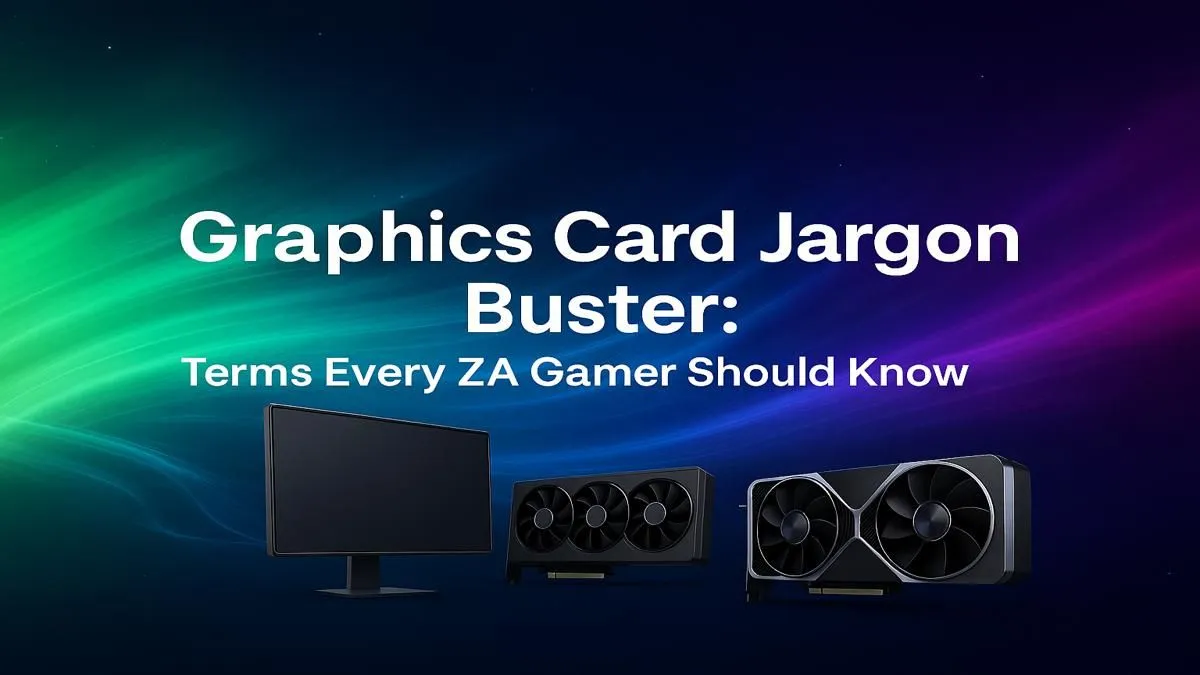
Staring at a wall of GPU specs? VRAM, CUDA Cores, Boost Clock… it can feel like learning a new language. You just want to know if a card will run the latest titles on ultra settings without your PC sounding like a jet engine taking off from OR Tambo. We get it. This gamer's guide to GPUs decodes the most important graphics card terms explained in plain English, so you can shop smart and game harder. 🚀
Understanding the Core GPU Specs
Before you can pick the right card, you need to know what the numbers on the box actually mean. This section on key graphics card terms explained covers the absolute fundamentals that determine a GPU's raw power.
VRAM (Video RAM)
Think of VRAM as your graphics card's dedicated, ultra-fast short-term memory. It stores all the high-resolution textures, models, and other visual data your game needs to display the next frame. The more VRAM you have (measured in gigabytes or GB), the higher the resolution and texture quality you can run smoothly. For 1080p gaming, 8GB is a good starting point, but for 1440p or 4K, you'll want to aim for 12GB or more.
Clock Speed (Base & Boost)
Measured in megahertz (MHz), clock speed is essentially how fast the GPU's processor can run. You'll often see two numbers:
- Base Clock: The standard operating speed.
- Boost Clock: The maximum speed the card can achieve automatically under load, as long as temperature and power allow.
While a higher clock speed is generally better, it's not the only factor. A card with more processing cores at a slightly lower speed can still outperform one with fewer cores at a higher speed.
Processing Cores (CUDA / Stream Processors)
These are the workhorses of the GPU. They are tiny, individual processors that handle all the complex calculations needed to render a 3D scene. Different brands have different names for them:
- NVIDIA: CUDA Cores
- AMD: Stream Processors
- Intel: Xe-cores
Generally, the more cores a GPU has within the same generation, the more powerful it is. They are the engine that drives performance, especially when you're looking at the impressive architecture behind NVIDIA's powerful GeForce graphics cards.
Key Features for Modern Gaming Explained
Beyond the core specs, modern GPUs come packed with specialised technology designed to make your games look better and run faster. Understanding these features is crucial for making a future-proof choice.
Ray Tracing & DLSS / FSR 💡
Ray Tracing is a rendering technique that simulates the physical behaviour of light, creating incredibly realistic shadows, reflections, and lighting. It makes games look stunning, but it's very demanding on performance.
That's where upscaling tech comes in. DLSS (Deep Learning Super Sampling) from NVIDIA and FSR (FidelityFX™ Super Resolution) from AMD use AI to render your game at a lower resolution and then intelligently upscale it to your target resolution. The result? You get the beautiful visuals of ray tracing with a massive performance boost. It's a must-have feature, and you can see it in action across the latest AMD Radeon graphics cards.
Check Your Bottlenecks! 🔧
A powerful new GPU is fantastic, but it won't reach its full potential if your CPU is too old or slow to keep up. This is called a "bottleneck." Before you buy, use an online bottleneck calculator to quickly check if your current CPU is a good match for the graphics card you're considering. It could save you from a disappointing upgrade.
TDP (Thermal Design Power)
TDP, measured in watts (W), tells you the maximum amount of heat a GPU will generate under a typical workload. More importantly for a PC builder, it gives you a clear idea of two things:
- Power: How powerful your Power Supply Unit (PSU) needs to be.
- Cooling: How much heat your PC case needs to be able to exhaust.
Always make sure your PSU can comfortably handle your GPU's TDP, with some headroom to spare.
Putting It All Together for Your Next Upgrade
So, what does this all mean when you're staring at two different cards? It's about balance. A card with tons of VRAM but slow clock speeds might struggle, just as a super-fast card with too little VRAM will hit a wall at high resolutions. The goal is to find a GPU where the specs work together to match your gaming goals and budget. By understanding these GPU terms, you're now equipped to compare cards intelligently and find the perfect fit among the best graphics card deals in South Africa. ✨
Ready to Upgrade Your Rig?
Understanding these graphics card terms is the first step to building a better gaming experience. Now it's time to put that knowledge to use. Explore our massive range of graphics cards and find the perfect GPU to power your gameplay.