



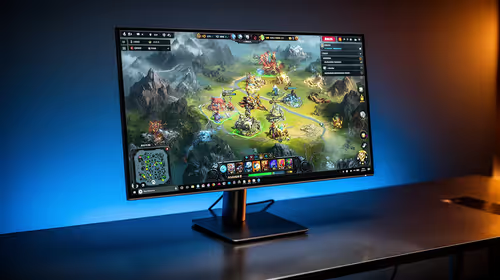
IPS vs VA for Strategy and Sim Games in SA
IPS vs VA for strategy and sim games should be judged by fit, not a single winner. Compare compatibility, latency, capacity, upgrade path, cost planning, and South African setup needs.
Read moreEver wondered how gaming mice are made? 🖱️ This guide takes you behind the scenes of the manufacturing process, from initial design and ergonomic testing to the final assembly of sensors and switches. Discover the tech and precision that go into creating the perfect tool for your setup. ⚙️

Ever flicked your wrist for a pixel-perfect headshot and felt that satisfying click? That split-second victory isn't just skill… it's the result of incredible engineering packed into the device under your palm. But have you ever wondered how gaming mice are made? Forget dusty factories; this is a high-tech process of precision and passion. From initial sketch to the final product in your hands, let's lift the shell and see what makes a gaming mouse tick. 🚀
The journey of a gaming mouse begins not on an assembly line, but in the minds of designers and ergonomists. They spend hundreds of hours studying how we hold and move a mouse, catering to different grip styles like palm, claw, and fingertip. This research informs the shape, weight, and button placement.
Early designs are modelled in 3D CAD software before being brought to life as 3D-printed prototypes. These models are tested by pro gamers and engineers, who provide crucial feedback. Is the thumb rest comfortable? Is the weight balanced for swift movements? This iterative process of refinement ensures the final design feels like a natural extension of your hand.
Understanding how gaming mice are made means looking at their core parts. A mouse is more than its plastic shell; it's a collection of highly specialised gaming mouse components that determine its performance.
The optical or laser sensor is the soul of the mouse. It's a tiny, high-speed camera that takes thousands of pictures of the surface beneath it every second. Top-tier sensors, like those from PixArt, are favoured for their flawless tracking, ensuring no spin-outs or jitters during intense gameplay. Key specs like DPI (Dots Per Inch) and Polling Rate (how often the mouse reports its position to the PC) are born from this tiny, powerful component.
Those satisfying clicks come from mechanical or optical switches located under the main buttons. Brands like Omron and Kailh are famous for creating switches rated for millions of clicks, guaranteeing durability. The choice of switch affects the click's feel, sound, and response time. For competitive players who demand instantaneous feedback and reliability, a solid wired gaming mouse with proven mechanical switches is often the go-to weapon of choice.
The Printed Circuit Board (PCB) is the mouse's central nervous system, connecting the sensor, switches, scroll wheel, and lighting. The design of the PCB is critical, especially for creating lightweight mice. This is also where the choice between wired and wireless tech comes into play. Modern wireless gaming mice now feature low-latency technology that makes them just as fast and reliable as their cabled cousins, offering freedom without compromise. ✨
grip style heavily influences which mouse will feel best. Palm Grip: Your entire hand rests on the mouse. Look for larger, ergonomic mice. Claw Grip: Your palm rests on the back, but your fingers are arched. Ambidextrous, smaller mice work well. Fingertip Grip: Only your fingertips touch the mouse. Ultra-lightweight and small mice are ideal here.
Once the design is finalised and components are sourced, mass production begins. The outer shell is typically created using injection moulding, where molten plastic is forced into a precise mould. This process allows for complex shapes and durable, lightweight construction.
Inside the factory, skilled technicians and automated robots work in harmony. Components are carefully soldered onto the PCB, which is then fitted into the shell. Mouse feet (usually made of low-friction PTFE), buttons, and the scroll wheel are added before the top and bottom halves of the shell are screwed or snapped together. The quality of materials used here often separates a budget-friendly mouse under R1000 from a more premium model. Often, the sweet spot for performance and build quality can be found in the mid-range up to R2000, offering excellent value.
Before a mouse can be boxed up, it faces a gauntlet of tests. Specialised machines repeatedly click the buttons millions of times to test switch durability. The sensor is tested on various surfaces—from cloth mousepads to wood desks—to ensure tracking accuracy. Drop tests, cable stress tests, and environmental checks are also standard procedure.
This rigorous quality control is what you pay for in a premium product. The meticulous testing behind a high-end gaming mouse over R2000 ensures it can withstand years of intense gaming sessions. But understanding the tech doesn't mean you have to break the bank. With the right knowledge, you can spot the best gaming mouse deals that offer incredible performance for the price.
So, the next time you're dominating a lobby, give a little nod to the incredible journey that powerful tool in your hand has been on.
Ready to Find Your Perfect Match? A gaming mouse is a complex piece of precision engineering. Now that you know how they're made, you can choose the one that's perfect for your grip, your games, and your budget. Explore our massive range of gaming mouse deals and find the perfect peripheral to conquer your world.
Gaming mice are primarily constructed from durable ABS plastic for the shell, with PTFE (Teflon) feet for smooth gliding and rubber or silicone side grips for enhanced control.
Gaming mouse sensors are complex components made in sterile cleanrooms. They use photolithography to etch circuits onto silicon wafers, creating a tiny camera that tracks movement.
The optical sensor is crucial for tracking accuracy (DPI) and speed. However, the microswitches are also vital, as the gaming mouse components explained in our guide determine click feel and durability.
Manufacturers perform rigorous gaming mouse quality control, including click durability tests (millions of clicks), sensor tracking accuracy tests, and drop tests to ensure reliability.
An ergonomic design comes from studying hand shapes and grip styles (palm, claw, fingertip) to create a mouse that minimizes strain and maximizes comfort during long gaming sessions.
Some gaming mice include adjustable weights to allow users to customize the mouse's balance and feel, tailoring it to their personal preference for faster movements or more stable aiming.
IPS vs VA for strategy and sim games should be judged by fit, not a single winner. Compare compatibility, latency, capacity, upgrade path, cost planning, and South African setup needs.
Read more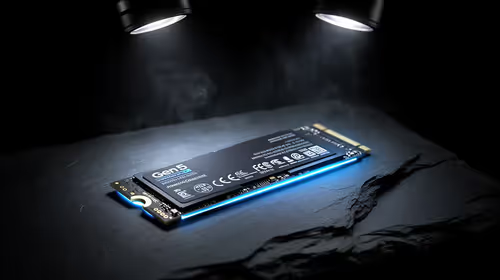
Gen 5 NVMe SSD guide for Bloemfontein gamers should be shortlisted around the job it must do. South African buyers should compare capacity, speed, thermals, and motherboard support, warranty path, and upgrade room before treating any pick as best.
Read more
Skip the RTX 5070 if your first-time builder budget needs better balance. Better SA picks can free room for the right CPU, PSU, case, monitor, storage, and cooling while still giving a strong first gaming PC experience this year in South Africa.
Read more
RTX 5080: weighing the pros and cons for SA should be shortlisted around the job it must do. South African buyers should compare GPU tier, VRAM, cooling, and PSU headroom, warranty path, and upgrade room before treating any pick as best.
Read more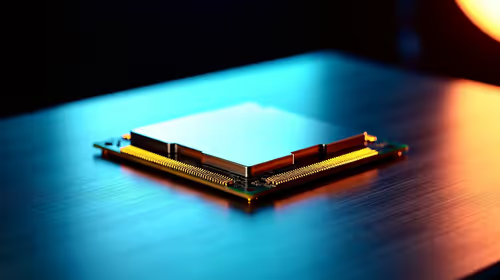
Core i5-13400F gives South African PC builders a capable mid-range CPU choice with clear limits. Check its gaming fit, discrete GPU requirement, LGA1700 platform costs, and upgrade path before locking in your parts list.
Read more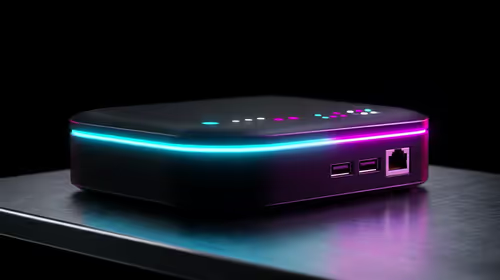
Pros and cons of the Wi-Fi 7 routers for SA should be shortlisted around the job it must do. South African buyers should compare WiFi standard, coverage, latency, and device support, warranty path, and upgrade room before treating any pick as best.
Read more
Steam content servers unreachable needs a download-path check, not an immediate reinstall of every game. Restart the client, inspect download settings and compare another connection when practical. Clearing the download cache is separate from deleting installed games.

Keychron G6 HE has built-in and swappable battery versions with different weights. The product brief lists 42g and 46g respectively, each with a 3g tolerance. Choose by grip and battery preference before treating one headline weight as universal.

Corsair HS80 v2 MAX supports 2.4GHz wireless and Bluetooth. Its maximum battery figures use RGB-off conditions and differ by connection. Check microphone routing, comfort and the exact device support before assuming every wireless mode behaves alike.

Windows taskbar notification badges can be shown or hidden in Taskbar behaviours. This changes the small app indicators, not the underlying messages. Choose a calmer desktop while keeping a deliberate routine for checking important conversations and app updates.

Windows title bar window shake can minimise other open windows when you shake the active window by its title bar. Inspect the Multitasking setting and switch it off if that gesture interrupts your work. The preference costs R0 and does not require new hardware.

Windows Print Screen opens Snipping Tool when its keyboard preference is enabled. Change the option under Accessibility, Keyboard to choose another workflow. Test whether you need a clipboard image or a saved file.

Windows desktop icons missing may be a visibility setting. Right-click the desktop, choose View and inspect Show desktop icons. If only system icons are absent, use Desktop icon settings. Check the Desktop folder before assuming files were deleted.

Windows set time zone automatically greyed out calls for a location and device-policy check. Automatic time-zone selection relies on location services. A manual time-zone choice is separate from synchronising the clock; check both before replacing hardware.
Windows title bar window shake can minimise other open windows when you shake the active window by its title bar. Inspect the Multitasking setting and switch it off if that gesture interrupts your work. The preference costs R0 and does not require new hardware.
Windows Print Screen opens Snipping Tool when its keyboard preference is enabled. Change the option under Accessibility, Keyboard to choose another workflow. Test whether you need a clipboard image or a saved file.
Windows desktop icons missing may be a visibility setting. Right-click the desktop, choose View and inspect Show desktop icons. If only system icons are absent, use Desktop icon settings. Check the Desktop folder before assuming files were deleted.
Windows set time zone automatically greyed out calls for a location and device-policy check. Automatic time-zone selection relies on location services. A manual time-zone choice is separate from synchronising the clock; check both before replacing hardware.