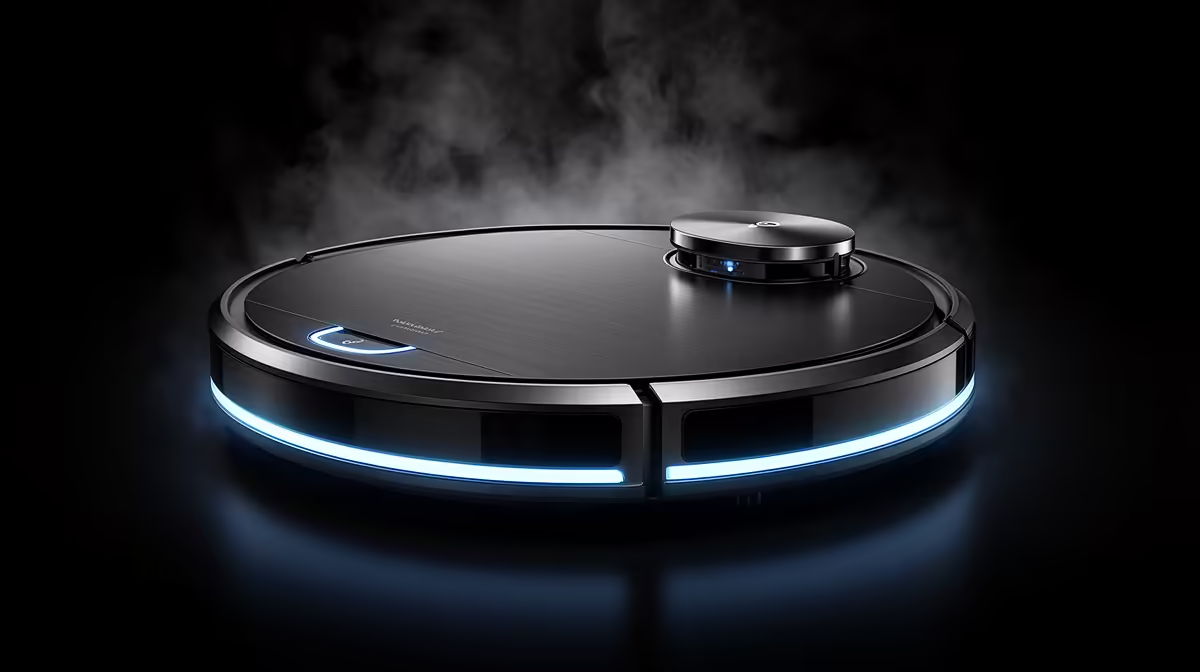
Two robot vacuums can sit on the same shelf and navigate your home in completely different ways. One spins a laser to measure the room, the other watches it through a camera. That single design choice, LiDAR vs camera navigation, decides how fast the vacuum learns your floor plan, whether it can clean in the dark, and how cleverly it dodges a stray charging cable. Understanding the split helps you avoid buying a model that bumps around your lounge at night.
Quick Answer
LiDAR vacuums spin a laser to build a precise room map and work in total darkness. Camera-based vSLAM vacuums need ambient light to see and navigate, so they struggle in dark rooms. Many 2026 flagships now run hybrid systems combining both, giving dark-room accuracy plus AI obstacle recognition.
How LiDAR navigation works
A LiDAR vacuum carries a small spinning laser turret, usually the raised puck on top. It fires laser pulses in every direction and times how long each takes to bounce back, measuring distances to walls and furniture hundreds of times a second. From those measurements it draws an accurate floor plan and tracks its own position within it. Because the laser supplies its own light, a LiDAR vacuum maps and cleans just as well at midnight as at midday, which is its biggest practical advantage.
The result is fast, methodical coverage in neat rows, fewer missed patches and reliable room recognition for features like no-go zones and room-specific cleaning.
How camera vSLAM navigation works
Camera-based models use vSLAM, short for visual simultaneous localisation and mapping. An upward or forward-facing camera takes a stream of images and identifies visual landmarks, the edge of a doorway, a picture frame, the corner of a couch, to figure out where it is and stitch together a map. The clever part is that it builds spatial awareness from ordinary images rather than a laser.
The catch is light. A camera cannot see in the dark, so a vSLAM vacuum scheduled to clean at night, or sent into a windowless room with the lights off, can lose its bearings and clean erratically. In well-lit homes during the day, though, vSLAM works well and often comes at a lower price.
Where hybrid systems change the picture
The interesting development in 2026 flagships is that the debate is no longer strictly either-or. Many premium models now fuse both approaches, using LiDAR for fast, accurate mapping that works in the dark, and adding a camera for AI obstacle recognition. The camera lets the vacuum identify and steer around specific hazards, charging cables, shoes, pet messes, that a pure-LiDAR sensor would simply register as a generic obstacle or drive into. This pairing delivers the dark-room reliability of LiDAR with the smarter object avoidance of vision.
If you have pets or a cluttered floor, that obstacle recognition is often worth the premium, because the most expensive cleaning failure is the one that drags a mess across the carpet.
Practical Limits of Each System
LiDAR handles maps reliably but treats every obstacle as solid. It can read a hanging fabric valance as a wall, avoid a mirror because the laser reflects unpredictably, or refuse to push through a light curtain to clean beneath a sofa. These are edge cases for most homes but real ones. The mechanical turret is also a moving part that can wear over years, and in rare cases can be confused by highly reflective or glass surfaces.
vSLAM robots have narrower profiles because there is no raised puck, which helps in homes with especially low furniture. The camera also updates the map dynamically: if you rearrange furniture, a vSLAM robot picks up the change on its next run through visual recognition. LiDAR maps tend to be stickier and may need a manual remap after major furniture changes.
The Hybrid Argument in 2026
The 2026 flagship landscape has largely settled on LiDAR as the mapping backbone and a forward-facing camera as the obstacle-recognition layer. The camera identifies what a laser only detects: a charging cable versus a chair leg, a pet mess versus a toy. The result is smarter navigation in cluttered rooms without sacrificing the dark-room reliability of laser mapping. If your budget stretches to a current flagship, a hybrid system is the most capable option for SA homes that run scheduled overnight cleans in rooms that are not kept uniformly tidy.
Which One Should You Buy?
For most South African homes, a LiDAR model is the safer default. It maps quickly, runs reliably regardless of lighting, and handles scheduled cleans while you are out or asleep. Choose a camera-only vSLAM model if you are working to a tighter budget and your home stays well lit during cleaning hours. If your floor is busy with cables, toys or pets, look at a hybrid that adds AI obstacle avoidance on top of laser mapping. You can compare current models in the smart home and cleaning range at Evetech to see which navigation type each one uses before you commit.
It is also worth stocking the consumables, brushes, filters and mop pads, that keep any vacuum running well, all of which sit in the accessories range.
Frequently Asked Questions
Which navigation type works better in the dark?
LiDAR, without question. It supplies its own laser light and maps in total darkness. Camera vSLAM needs ambient light, so it can lose its bearings during night-time or windowless-room cleaning.
Is LiDAR always more accurate than a camera?
For mapping speed and consistency, LiDAR generally edges ahead and is lighting-independent. Cameras add value for recognising specific objects, which is why the strongest models combine both rather than relying on one.
What is vSLAM in a robot vacuum?
vSLAM is visual simultaneous localisation and mapping. The vacuum uses a camera to spot visual landmarks and work out its position, building a map from images instead of a laser scan.
Are hybrid LiDAR and camera vacuums worth the extra cost?
If you have pets, children's toys or loose cables on the floor, yes. The camera adds AI obstacle recognition that avoids hazards a laser-only model might drive into or smear across the floor.
Can a camera vacuum clean a dark room at all?
Not reliably. With the lights off it loses the visual landmarks it depends on and can navigate erratically. Schedule camera-based models for daylight hours or rooms that stay lit.
Want a vacuum that maps your home accurately every time? Compare LiDAR, camera and hybrid models in the smart home range at Evetech and match the navigation type to your floors.