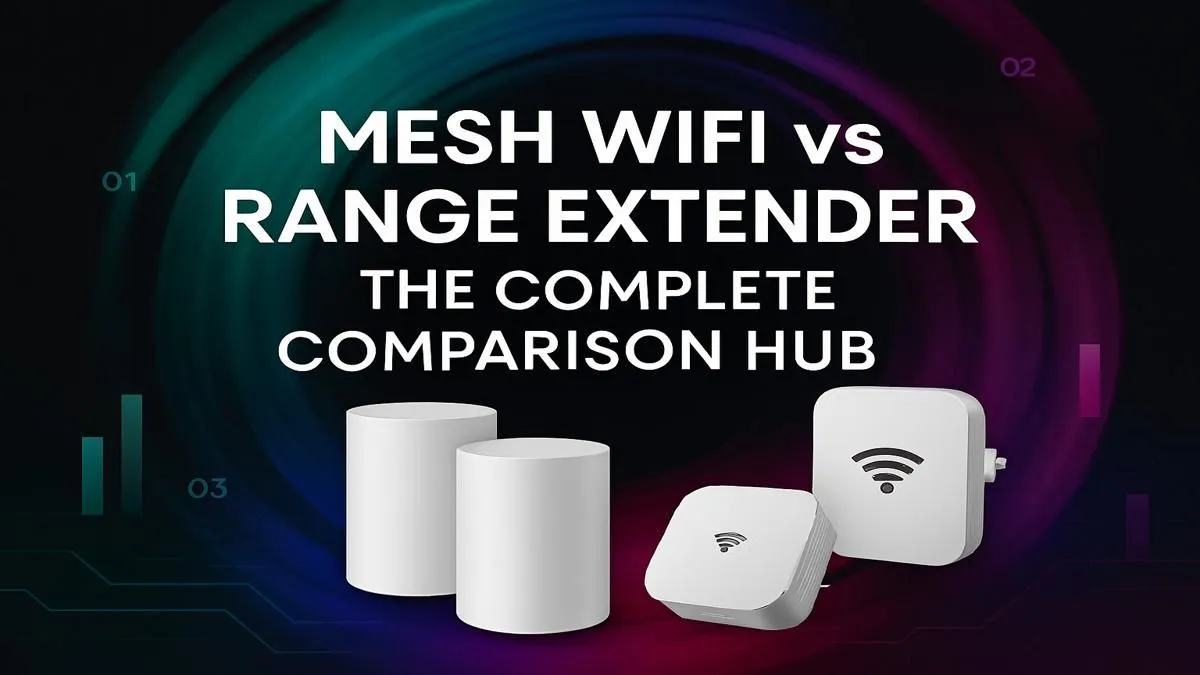
Is your WiFi signal weaker than a level one mob in the furthest corner of your house? You’re not alone. From the braai area to the back bedroom, WiFi dead spots are a massive pain for South African gamers and remote workers. You're trying to clutch a win, and... buffering. The good news? You don’t have to move your router. The real debate is: Mesh WiFi vs Range Extender. Let's find the right fix for your home.
What Exactly is a WiFi Range Extender?
Think of a WiFi range extender as a simple signal booster. It captures the existing wireless signal from your main router and rebroadcasts it to cover a larger area. It’s a straightforward, often budget-friendly way to push your signal into one or two specific dead zones, like a home office or patio.
The primary drawback is performance. Because it uses the same radio to both receive and transmit the signal, it effectively halves the potential bandwidth. It also creates a separate network (e.g., "MyHomeWiFi_EXT"), so you have to manually switch between them as you move around. For a quick and cheap fix for a single room, a wireless range extender can be a perfectly good solution.
How Does Mesh WiFi Work? ✨
A mesh WiFi system is a more modern, intelligent solution. Instead of one device boosting another, a mesh system consists of a main router connected to your modem and a series of satellite "nodes" placed around your home. Together, they form a single, seamless network under one name.
As you move through your house, your device automatically connects to the strongest node without any interruption. It’s like having a powerful router in every room. This intelligent system routes traffic efficiently, ensuring high speeds and stable connections everywhere. While the initial investment is higher than a single extender, mesh systems offered alongside traditional wireless routers are designed for total home coverage.
Mesh WiFi vs Range Extender: The Head-to-Head Showdown
So, how do they stack up in the areas that matter most to gamers and power users? Let's break it down.
Performance & Speed
A range extender will always create a performance bottleneck. A mesh system, on the other hand, is designed to maintain high speeds across your entire home, making it far superior for 4K streaming, competitive online gaming, and large file downloads.
Coverage & Roaming
This is mesh WiFi’s biggest win. The ability to walk from your lounge to your bedroom without your video call dropping or your game lagging is a huge quality-of-life improvement. With an extender, you’d have to manually disconnect and reconnect, which is far from ideal.
Optimal Placement is Key 🔧
Whether you choose a mesh node or a range extender, don't hide it in a cabinet or behind the TV. For best results, place the device in an open area, about halfway between your main router and the WiFi dead zone. This ensures it gets a strong signal to rebroadcast.
Ease of Use & Setup
Modern mesh systems are incredibly user-friendly, usually managed through a simple smartphone app. Range extenders can sometimes be a bit more finicky to set up and may require more manual configuration to get working just right. Even older PCs can benefit from these network upgrades, especially when paired with powerful wireless adapters that can handle the latest WiFi standards.
Cost
There's no contest here. A range extender is the undisputed budget champion. A good one can cost you under R600. A starter two-piece mesh system typically starts around the R2,000 mark and goes up from there. You're paying for convenience, performance, and superior technology.
So, Which WiFi Solution is Right for Your SA Home? 🚀
The choice in the mesh WiFi vs range extender debate ultimately comes down to your needs and budget.
Choose a Range Extender if:
- You have a smaller home or flat.
- You only need to fix one or two specific dead spots.
- You're on a tight budget and just need a "good enough" solution.
Choose a Mesh WiFi System if:
- You have a medium-to-large or multi-story home.
- You have many connected devices (phones, laptops, consoles, smart home tech).
- You demand seamless, high-performance internet for gaming, streaming, or working from home.
Ultimately, both options are part of a broader ecosystem. Understanding all the pieces of the puzzle is the best way to build a flawless home network, and exploring a full range of wireless networking components can help you make the most informed decision.
Ready to Banish Buffering for Good?
Lag spikes and dead zones don't have to be your reality. Whether you need a simple boost or a whole-home overhaul, the perfect solution is waiting. Explore our massive range of wireless networking gear and build the powerful, reliable network you deserve.