



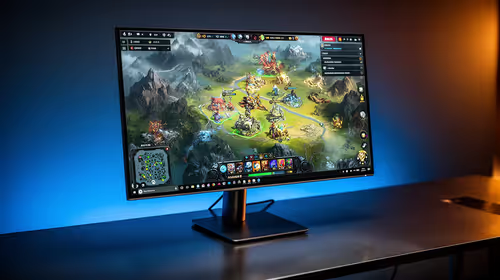
IPS vs VA for Strategy and Sim Games in SA
IPS vs VA for strategy and sim games should be judged by fit, not a single winner. Compare compatibility, latency, capacity, upgrade path, cost planning, and South African setup needs.
Read moreDiscover the massive leap in storage speed in our NVMe Gen3 vs Gen4 vs Gen5 breakdown. 🚀 From standard load times to instant gaming, see how PCIe technology has evolved and which drive fits your rig best. 💾

Staring at another loading screen while your mates are already dropping in? We've all been there. That sluggish feeling can ruin a good gaming session. The culprit is often your storage. But with terms like NVMe Gen3, Gen4, and Gen5 flying around, choosing an upgrade can feel like decoding a complex puzzle. Don't stress... we're here to break down the ultimate SSD evolution and help you pick the perfect drive for your rig.
Before we dive into the NVMe Gen3 vs Gen4 vs Gen5 debate, let's get one thing straight: any NVMe SSD is a massive leap from an old hard drive or even a SATA SSD. NVMe (Non-Volatile Memory Express) drives connect directly to your motherboard's PCIe lanes—the same super-fast highway your graphics card uses. This direct connection unlocks staggering speeds. The "Gen" simply refers to the generation of that PCIe interface, with each new version roughly doubling the potential speed.
NVMe Gen3 was the standard for years, and for good reason. With read speeds topping out around 3,500 MB/s, these drives are still incredibly fast for everyday tasks and most gaming scenarios. They boot Windows in seconds, load game levels swiftly, and offer fantastic value for money. If you're on a tighter budget or upgrading a slightly older PC, a Gen3 SSD remains a brilliant and cost-effective choice.
This is where things get really interesting. NVMe Gen4 doubles the theoretical bandwidth, pushing speeds up to a blistering 7,500 MB/s. For PC gamers, this means near-instantaneous loading. For PlayStation 5 owners, a Gen4 drive is a must-have for expanding storage without compromising performance. As games become more complex and leverage technologies like Microsoft's DirectStorage, the benefits of Gen4 will only grow. A drive like the Klevv CRAS C925G 1TB Gen4 NVMe SSD represents the perfect balance of price and next-level performance for today's demanding titles.
Welcome to the bleeding edge. NVMe Gen5 drives are the new titans, capable of speeds exceeding 12,000 MB/s. These are for enthusiasts who demand absolute maximum performance for tasks like 8K video editing or working with massive datasets. However, this power comes at a premium price and requires a modern motherboard (like AMD's AM5 or Intel's Z790 platforms) to even function. Brands are innovating rapidly in this space, and it's worth keeping an eye on Klevv's range of high-performance memory and storage as this technology becomes more mainstream. For now, it's more of a specialised tool than a must-have for most gamers.
For pure gaming, the real-world difference between a fast Gen3 and a Gen4 drive can be just a second or two on a loading screen. So, is Gen4 worth it? Yes, especially for future-proofing. As new games are built to take advantage of faster storage, having a Gen4 drive will ensure you're ready.
Where the NVMe Gen4 vs Gen5 comparison really shines is in productivity. If you're a content creator who regularly moves huge files, the time saved can be significant. For everyone else, Gen4 offers more than enough speed for a flawless, snappy experience in everything you do.
Before you buy, always check your motherboard's specifications! Look for the M.2 slots and see which PCIe generation they support (e.g., "PCIe 4.0 x4"). Putting a Gen4 SSD in a Gen3 slot will work, but it will be limited to Gen3 speeds. You need a matching slot to get the full performance you're paying for.
Choosing the right SSD in the NVMe Gen3 vs Gen4 vs Gen5 race comes down to three things: your motherboard, your use case, and your budget.
Ultimately, any NVMe drive will make your system feel more responsive. The key is to match the drive's capabilities to your specific needs so you're not paying for speed you won't use. To see what fits your build and budget, you can browse our full range of SSDs and find the perfect upgrade today.
Ready for Warp Speed? Whether you're eliminating load times or speeding up your creative workflow, the right NVMe SSD is waiting. From budget-friendly Gen3 drives to bleeding-edge Gen5 powerhouses, we've got the perfect match for your rig. Explore our massive range of SSD deals and give your PC the upgrade it deserves.
Yes, NVMe drives are backwards compatible. A Gen5 SSD fits a Gen4 slot but runs at slower Gen4 speeds, limiting its max potential.
Gen5 SSDs offer speeds up to 14,000 MB/s, effectively doubling the theoretical 7,000 MB/s cap of Gen4 drives for extreme performance.
Yes, Gen5 NVMe drives generate significant heat and require active cooling or beefy heatsinks to prevent thermal throttling during heavy loads.
Absolutely. Gen3 NVMe SSDs still provide fast load times for most games, though Gen4 and Gen5 are superior for future DirectStorage titles.
PCIe 5.0 doubles the bandwidth per lane compared to 4.0, allowing for massive data transfer rates ideal for AI, 8K editing, and heavy workloads.
Consumer NVMe Gen5 SSDs began entering the market in late 2022 and early 2023, coinciding with new motherboard platforms supporting PCIe 5.0.
IPS vs VA for strategy and sim games should be judged by fit, not a single winner. Compare compatibility, latency, capacity, upgrade path, cost planning, and South African setup needs.
Read more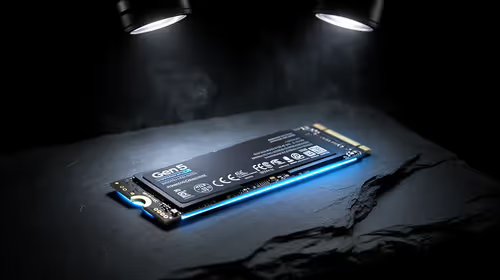
Gen 5 NVMe SSD guide for Bloemfontein gamers should be shortlisted around the job it must do. South African buyers should compare capacity, speed, thermals, and motherboard support, warranty path, and upgrade room before treating any pick as best.
Read more
Skip the RTX 5070 if your first-time builder budget needs better balance. Better SA picks can free room for the right CPU, PSU, case, monitor, storage, and cooling while still giving a strong first gaming PC experience this year in South Africa.
Read more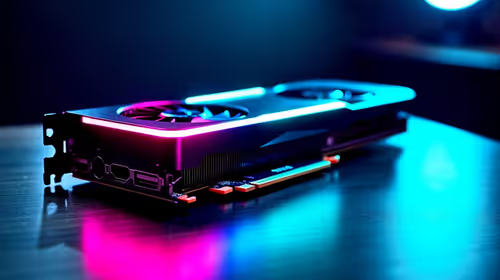
RTX 5080: weighing the pros and cons for SA should be shortlisted around the job it must do. South African buyers should compare GPU tier, VRAM, cooling, and PSU headroom, warranty path, and upgrade room before treating any pick as best.
Read more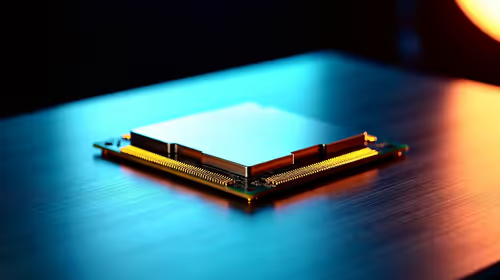
Core i5-13400F gives South African PC builders a capable mid-range CPU choice with clear limits. Check its gaming fit, discrete GPU requirement, LGA1700 platform costs, and upgrade path before locking in your parts list.
Read more
Pros and cons of the Wi-Fi 7 routers for SA should be shortlisted around the job it must do. South African buyers should compare WiFi standard, coverage, latency, and device support, warranty path, and upgrade room before treating any pick as best.
Read more
Steam content servers unreachable needs a download-path check, not an immediate reinstall of every game. Restart the client, inspect download settings and compare another connection when practical. Clearing the download cache is separate from deleting installed games.
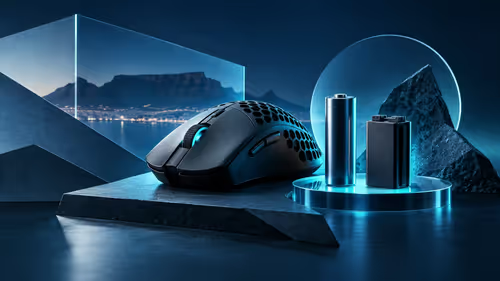
Keychron G6 HE has built-in and swappable battery versions with different weights. The product brief lists 42g and 46g respectively, each with a 3g tolerance. Choose by grip and battery preference before treating one headline weight as universal.

Corsair HS80 v2 MAX supports 2.4GHz wireless and Bluetooth. Its maximum battery figures use RGB-off conditions and differ by connection. Check microphone routing, comfort and the exact device support before assuming every wireless mode behaves alike.

Windows taskbar notification badges can be shown or hidden in Taskbar behaviours. This changes the small app indicators, not the underlying messages. Choose a calmer desktop while keeping a deliberate routine for checking important conversations and app updates.

Windows title bar window shake can minimise other open windows when you shake the active window by its title bar. Inspect the Multitasking setting and switch it off if that gesture interrupts your work. The preference costs R0 and does not require new hardware.

Windows Print Screen opens Snipping Tool when its keyboard preference is enabled. Change the option under Accessibility, Keyboard to choose another workflow. Test whether you need a clipboard image or a saved file.

Windows desktop icons missing may be a visibility setting. Right-click the desktop, choose View and inspect Show desktop icons. If only system icons are absent, use Desktop icon settings. Check the Desktop folder before assuming files were deleted.

Windows set time zone automatically greyed out calls for a location and device-policy check. Automatic time-zone selection relies on location services. A manual time-zone choice is separate from synchronising the clock; check both before replacing hardware.
Windows title bar window shake can minimise other open windows when you shake the active window by its title bar. Inspect the Multitasking setting and switch it off if that gesture interrupts your work. The preference costs R0 and does not require new hardware.
Windows Print Screen opens Snipping Tool when its keyboard preference is enabled. Change the option under Accessibility, Keyboard to choose another workflow. Test whether you need a clipboard image or a saved file.
Windows desktop icons missing may be a visibility setting. Right-click the desktop, choose View and inspect Show desktop icons. If only system icons are absent, use Desktop icon settings. Check the Desktop folder before assuming files were deleted.
Windows set time zone automatically greyed out calls for a location and device-policy check. Automatic time-zone selection relies on location services. A manual time-zone choice is separate from synchronising the clock; check both before replacing hardware.