


80+ Gold vs 80+ Platinum for Couch co-op gaming in SA
80+ Gold vs 80+ Platinum for couch co-op gaming is about PSU efficiency, heat, fan behaviour, quality, and wattage headroom, not direct FPS. SA buyers should compare the whole build.
Read moreExplore all OLED gaming monitor connectivity options to unlock your display's full potential. From HDMI 2.1 to DisplayPort 2.1 and USB-C, we break down which ports you need for peak refresh rates and resolutions. Get ready to build the ultimate gaming setup! 🚀🎮
So, you’ve just unboxed a glorious new OLED gaming monitor. The colours are mind-blowing, the blacks are perfect... but now you’re staring at the ports on the back, wondering which cable will actually unlock its full power. HDMI? DisplayPort? Does it even matter? In South Africa, getting the most from your high-end gear is everything. This guide breaks down all the OLED gaming monitor connectivity options to ensure you’re not leaving performance on the table.
Choosing the right cable isn't just about getting a picture on the screen. It's about bandwidth. Think of it like a highway: you need enough lanes to carry all the data for 4K resolution, 240Hz refresh rates, and vibrant HDR colour without causing a traffic jam. An old cable on a new monitor is like trying to drive a Ferrari on a dirt road… you’re just not getting what you paid for. The two main players you'll find on the back of most PC monitors are HDMI and DisplayPort, and the version of each port matters immensely.
For years, HDMI was seen as the "good enough" option for PCs, but that changed with HDMI 2.1. This standard is an absolute beast, offering a massive 48Gbps of bandwidth.
What does that mean for you? It means your monitor can handle uncompressed 4K resolution at a buttery-smooth 120Hz, which is the gold standard for PlayStation 5 and Xbox Series X. It also enables crucial gaming features like Variable Refresh Rate (VRR) to eliminate screen tearing and Auto Low Latency Mode (ALLM) for a more responsive feel. If you're a console gamer, using an HDMI 2.1 port is non-negotiable. It's the standard for the latest 5K and 4K monitors designed for next-gen immersion.
While HDMI 2.1 has caught up, DisplayPort has traditionally been the top choice for PC enthusiasts, and for good reason. The most common standard today, DisplayPort 1.4, offers 32.4Gbps of bandwidth and uses a clever technology called Display Stream Compression (DSC). DSC is a visually lossless compression that allows DisplayPort 1.4 to handle insane refresh rates at high resolutions, like 4K at 144Hz or even 1440p at 240Hz and beyond.
Most high-end graphics cards from NVIDIA and AMD feature multiple DisplayPort outputs, making it the default connection for PC-centric setups. For gamers chasing the highest possible frame rates, DisplayPort is often the only way to achieve the advertised speeds of many of the top gaming monitors on the market.
Not all cables are created equal. A cheap, old DisplayPort or HDMI cable might not support the full bandwidth needed for your monitor's top specs. Always use the high-quality cable that came in the box, or buy a certified Ultra High Speed HDMI (for 2.1) or DP 1.4 2.1 cable to avoid frustrating issues like screen flickering or signal dropouts.
Let's make this simple. The right OLED gaming monitor connectivity option for you depends entirely on your primary gaming machine.
Use HDMI 2.1. It's the only way to get the full 4K 120Hz experience with all the bells and whistles like VRR. Don't even think about anything else.
It's a tougher choice, but here’s a good rule of thumb: start with DisplayPort 1.4 (or higher). It generally provides the most bandwidth for ultra-high refresh rates. However, if your graphics card and OLED monitor both have HDMI 2.1, it's an equally excellent choice and delivers a virtually identical experience. Check your monitor's manual to see which port supports its maximum advertised refresh rate and resolution. The immersive experience on modern curved monitors often benefits from the high bandwidth of either connection.
Some OLED monitors, especially those focused on productivity or portability, include a USB-C port that supports DisplayPort Alternate Mode. This is fantastic for connecting a gaming laptop with a single cable that can carry video, data, and even power. This is especially useful for connecting a powerful rig to one of the latest portable monitors for a dual-screen setup on the go.
Beyond the main video inputs, your monitor likely has other useful ports. A 3.5mm audio-out jack lets you connect headphones or speakers directly to the monitor, which is handy for consoles. Many monitors also feature a built-in USB hub, allowing you to plug your mouse, keyboard, or webcam into the monitor itself, cleaning up your cable management. Finding the best PC monitor deals often means looking at the complete package, including these quality-of-life features.
Choosing the right connection is the final, crucial step in setting up your dream rig. By understanding your OLED gaming monitor's connectivity options, you guarantee that you’re squeezing every drop of performance and visual fidelity out of your investment. Happy gaming! ✨
Ready to Witness True Inky Blacks? Understanding your monitor's ports is the final step to unlocking pixel-perfect performance. Now that you know what to look for, explore our massive range of OLED gaming monitors and find the perfect display to conquer your world.
For most PC gamers, DisplayPort 1.4 or 2.1 is ideal for achieving the highest refresh rates. However, HDMI 2.1 is essential for console gaming on PS5 and Xbox Series X.
Yes, if you want to achieve 4K at 120Hz or higher, especially on next-gen consoles. HDMI 2.1 provides the necessary bandwidth for top-tier performance on modern hardware.
Absolutely. Many OLED monitors feature USB-C with DisplayPort Alt Mode, allowing you to transmit video, data, and power to a device like a laptop with a single cable.
The choice between DisplayPort vs HDMI for OLED gaming depends on your hardware. DisplayPort often supports higher PC refresh rates, while HDMI 2.1 is crucial for consoles.
To run a 4K 240Hz OLED monitor at its full potential, you must use a certified Ultra High Speed HDMI 2.1 cable or a VESA certified DisplayPort 2.1 cable.
A built-in KVM switch lets you control multiple computers (like a gaming PC and a work laptop) with one keyboard and mouse connected directly to the monitor, simplifying your setup.
Yes, most OLED gaming monitors include a 3.5mm audio-out jack. This allows you to easily connect headphones or external speakers directly to your display for immersive sound.
80+ Gold vs 80+ Platinum for couch co-op gaming is about PSU efficiency, heat, fan behaviour, quality, and wattage headroom, not direct FPS. SA buyers should compare the whole build.
Read more
80+ Platinum or 80+ Titanium for competitive should be shortlisted around the job it must do. South African buyers should compare fit, performance, compatibility, and upgrade room, warranty path, and upgrade room before treating any pick as best.
Read more
The real world difference between IPS and OLED for AAA single-player gaming is immersion versus versatility. OLED lifts contrast and dark scenes, while IPS can suit bright rooms, mixed PC use, and SA buyers watching total setup cost.
Read more
HDMI 2.1 vs HDMI 2.0 for SA MMO needs a workload-first comparison. For SA buyers, judge real performance, platform fit, warranty path, power needs, and upgrade timing before choosing either side.
Read more
USB4 and Thunderbolt 4 differ for competitive esports through dock, display, and capture consistency. Use this real world difference between usb4 and thunderbolt 4 for competitive guide to keep SA tournament desks tidy without assuming better ping.
Read more
Magnetic switches vs Mechanical switches depends on Competitive esports needs, platform limits, and budget fit. Compare compatibility, latency, upgrade path, and real setup constraints before choosing for an SA build.
Read more
NVIDIA lists 550W required system power for the RTX 5060 reference specification, based on a high-end test system. A quality 550W unit can be enough, but CPU draw, transient load, connectors and ageing decide real headroom.
80+ Gold vs 80+ Platinum for couch co-op gaming is about PSU efficiency, heat, fan behaviour, quality, and wattage headroom, not direct FPS. SA buyers should compare the whole build.
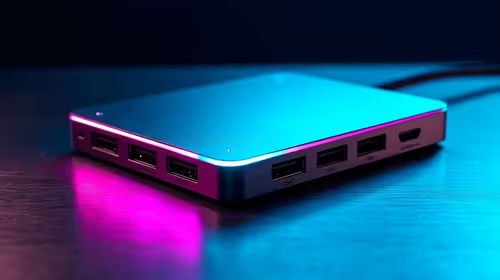
Upgrade your setup with the best USB-C hubs for creators. Discover why high-capacity card readers and dual 4K output are essential for professional South African content production. 🚀💻

B850 motherboard FPS drops needs a methodical troubleshooting pass. Review drivers, thermals, power settings, background apps, cables and game settings before replacing parts in an SA gaming setup.
NVIDIA lists 550W required system power for the RTX 5060 reference specification, based on a high-end test system. A quality 550W unit can be enough, but CPU draw, transient load, connectors and ageing decide real headroom.

OpenRGB's master branch now carries changes labelled for 1.0 final, including translation and platform work, but the official tags page still lists 1.0rc3.1 as the newest packaged release. Stable users should wait for the signed release channel.

A motherboard can remain useful for many years when power, cooling and connectors stay healthy. Replace it for confirmed faults, damaged power delivery or a blocked platform need, not simply because the calendar reaches a fixed age.
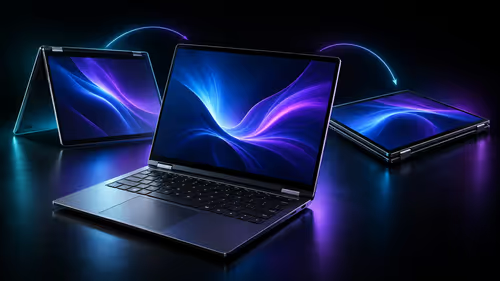
The VAIO T combines a 13.3-inch display with a multi-flip mechanism for laptop, tablet and outward-facing viewing modes. Orders begin in Japan on 18 September; South African availability is unconfirmed.
NVIDIA lists 550W required system power for the RTX 5060 reference specification, based on a high-end test system. A quality 550W unit can be enough, but CPU draw, transient load, connectors and ageing decide real headroom.
The VAIO T combines a 13.3-inch display with a multi-flip mechanism for laptop, tablet and outward-facing viewing modes. Orders begin in Japan on 18 September; South African availability is unconfirmed.
OpenRGB's master branch now carries changes labelled for 1.0 final, including translation and platform work, but the official tags page still lists 1.0rc3.1 as the newest packaged release. Stable users should wait for the signed release channel.
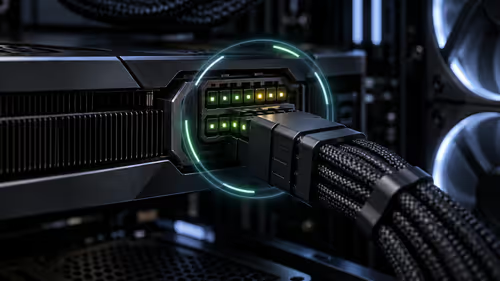
The Cooler Master GPU Shield Adapter monitors current on individual 12+4-pin contacts, adds visual and audible warnings, and can reduce system power during a severe abnormality. Local availability is unconfirmed.