Strap a headset to your face and your gaming PC suddenly has to draw two high-resolution images at once, one per eye, at a refresh rate fast enough to keep your stomach settled. PC-VR and VR-ready PCs live and die by the graphics card, because rendering each eye separately at high refresh roughly doubles the load of ordinary flat-screen gaming. Spend on the GPU first, then the headset.
Quick Answer
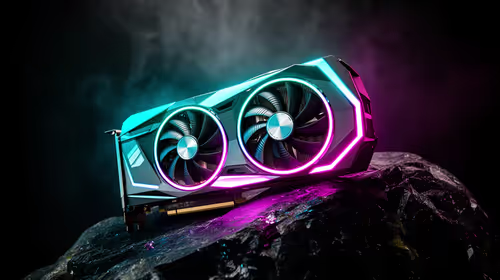
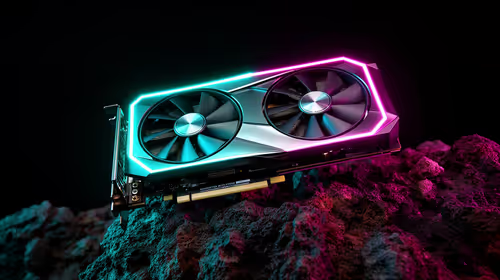
A VR-ready PC needs an RTX-class GPU above everything else, ideally something in the RTX 4070 tier or higher for comfortable headroom with a headset like the Meta Quest 3 driven over Link. Pair that with a modern six-core CPU or better and 16GB of RAM as a baseline. Budget the graphics card before you budget the headset, because a weak GPU produces stutter that no headset can fix.
Why VR Hammers the GPU
A normal monitor shows one image at, say, 1080p and 60 frames per second. A VR headset shows two images, one for each eye, each at its own high resolution, and it wants 90 frames per second or more to avoid making you queasy. Multiply a higher per-eye resolution by two eyes by a higher frame rate target and the GPU workload climbs steeply past what the same game asks of a flat screen.
This is why the graphics card outranks every other component in a VR-ready build. Drop below the frame rate your headset expects and the system reprojects frames to compensate. You get juddery motion, smearing, and the kind of discomfort that ends a session early. A capable GPU keeps frame rates above that threshold consistently, which is what makes VR feel solid rather than sickening.
The GPU Tiers, In Plain Terms
Spending at the top of the GPU market is unnecessary, but clearing a genuine performance threshold is non-negotiable.
Entry Into Comfortable VR
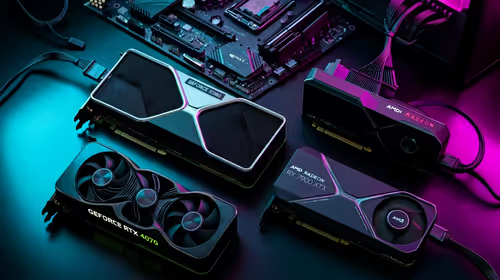
A current-generation RTX card around the RTX 4070 class is the sensible floor for smooth modern VR. It holds the frame rates a Quest 3 wants over a Link connection and gives you margin for more demanding titles.
Headroom For Demanding Titles
If you want high-fidelity VR games at full clarity, or you plan to push higher-resolution headsets, step up to a higher-tier RTX card. The extra rendering muscle means you spend less time fighting reprojection and more time inside the game.
The Card To Avoid
An older or low-end GPU may technically launch a VR title, but it will struggle to hold the refresh target. That is the build that gives VR a bad name. If your budget forces a compromise, compromise elsewhere and protect the graphics card.
The Supporting Cast: CPU, RAM, and Ports
Rendering power drives the experience, but the rest of the system still needs to keep pace.
CPU
VR still leans on the processor for physics, tracking, and feeding the GPU. A modern six-core chip or better keeps the graphics card fed so it never sits waiting. Pairing a strong GPU with a weak CPU just moves the stutter, it does not remove it.
Memory
16GB of RAM is the practical minimum for VR today, and stepping up to 32GB means the system stays comfortable when the headset runtime and other background processes share memory. VR titles and the runtime that drives the headset both want memory.
Connectivity
Check that your machine has the right ports for your headset. A wired tethered setup needs a suitable video output, while a Quest-style headset over Link wants a solid USB connection, and many players add a dedicated link cable or a strong wireless setup for untethered play.
Headsets and the SA Picture
The Meta Quest 3 is the standalone headset most South African PC-VR players reach for, since it works on its own and also plugs into a PC over Link to play the bigger library that only a desktop GPU can drive. When you are spec'ing the rig, weigh the headset and the GPU as one budget rather than buying a headset first and discovering the PC cannot feed it.
If you are exploring the wider mixed-reality and AR space alongside VR, it is worth seeing what is current in the AR glasses and headset category before you commit. And once the core PC is sorted, the right cables, mounts, and PC accessories make the difference between a tidy VR station and a tangle of wires.
Wired, Wireless, and Standalone: Three Ways To Play
How you connect the headset shapes both the experience and the build, so it is worth understanding the routes before you buy.
Tethered Over A Cable
A direct cable from headset to PC gives the most stable, lowest-latency feed and the sharpest image, because the data never has to compress for a wireless hop. The cost is a wire trailing from your head, which some players never notice and others find limiting. For seated experiences and sim racing or flight, tethered is often the purist's pick.
Wireless To The PC
A Quest-style headset can stream PC games wirelessly over your home network. It frees you from the cable but leans on a strong, low-latency connection, ideally the headset on a dedicated link to a fast router, because any congestion shows up as compression artefacts or lag. Done well it is liberating for room-scale games where you spin and duck.
Standalone, No PC At All
The Quest 3 also runs its own library with no computer involved. That is the simplest entry into VR, but the on-board chip cannot match a desktop GPU, so the most graphically ambitious titles still want the PC behind them. Many players use the headset both ways: standalone for quick sessions, tethered or wireless to the PC for the big games.
Common Build Mistakes To Sidestep
A few traps catch first-time VR builders. The biggest is spending the headset budget first and leaving scraps for the GPU, which guarantees stutter. Another is pairing a strong graphics card with an old quad-core CPU, which just relocates the bottleneck to the processor. A third is forgetting connectivity, then discovering the case lacks a convenient front USB port for the link cable. Plan the whole system as one budget, lead with the GPU, and confirm the small details before you order.
Build Priorities, Ranked
- GPU first. RTX 4070 class or higher. This is non-negotiable for comfortable VR.
- CPU second. A modern six-core or better to keep the GPU fed.
- RAM third. 16GB minimum, 32GB if you multitask.
- Connectivity and headset last. Confirm ports, then choose the headset your GPU can actually drive.
Get that order right and your VR rig stays smooth as the games get heavier. Get it wrong, by buying the headset first and the GPU last, and you will be staring at reprojection artefacts wondering why the magic is not happening.
Frequently Asked Questions
What GPU do I need for PC-VR?
An RTX-class card around the RTX 4070 tier is the comfortable starting point for smooth modern VR. Higher-tier RTX cards give more headroom for demanding titles and higher-resolution headsets.
Why does VR need so much more GPU power than normal gaming?
A headset renders two images, one per eye, each at high resolution, and targets 90 frames per second or more. That roughly doubles the work of flat-screen gaming, so the GPU has to be much stronger.
How much RAM does a VR-ready PC need?
16GB is the practical minimum today, with 32GB recommended if you run other applications alongside your VR games. Both the game and the headset runtime consume memory.
Can I use a Quest 3 with my gaming PC?
Yes. The Quest 3 works standalone and also connects to a PC over Link, letting it play the larger PC-VR library that needs a desktop GPU to drive it.
Does the CPU matter for VR or is it all about the GPU?
The GPU is most important, but the CPU still handles tracking, physics, and feeding the graphics card. A weak CPU bottlenecks even a strong GPU, so a modern six-core chip or better is recommended.
Building a rig that can actually drive a headset without the stutter? Start with the graphics card and explore current PC components and accessories at Evetech to put together a VR-ready machine that holds its frame rate.