A premium kit earns extra Rand when its strongest resources remove constraints the buyer encounters often, not when the specification sheet is admired from a distance. Is a premium gaming upgrade kit worth the Rand becomes a workload-and-balance question. At R38,999, the 9950X3D package concentrates substantial budget in the platform core.
Quick Answer
The R38,999 kit is worth the premium when cache-sensitive games use the 9950X3D's 144MB GameCache, real multitasking benefits from 48GB DDR5, the Dark Hero satisfies required platform connections and the LQ360 fits the thermal design. It is poor value when those resources remain idle or leave too little budget for graphics, storage, power and chassis. Compare complete systems against named performance targets.
🎯 Define what the premium must fix
Write down the current limitation before comparing kits. A game may miss its frame target while the GPU is fully occupied, a creation task may wait on CPU work, or several applications may crowd the memory pool. These conditions need different investments.
For gaming, identify resolution, settings and the difficult scene. High-refresh, CPU-sensitive play can give processor performance more weight. At demanding 4K settings, the graphics card may dominate, making a large CPU spend less visible.
For mixed work, list creation and streaming tasks with frequency. A daily export or compile carries more value than an occasional synthetic benchmark. Memory pressure should be observed through capacity use, application reloads and storage activity rather than assumed.
Set a hard complete-system ceiling. The R38,999 core is only one row. The graphics card, storage, PSU, case and display plan must remain capable of meeting the same outcome.
Browse Evetech's AMD upgrade kit range with that outcome list beside every package.
🧠 Make CPU and memory show their value
The 9950X3D's 144MB GameCache can reduce some trips to system memory in engines that reuse cache-friendly data. It does not guarantee a fixed uplift. Game design, scene, graphics load, resolution and memory configuration shape the result.
Test a repeatable CPU-demanding scene with the same GPU and settings. Use averages and frame-time consistency, then repeat at the intended resolution. A lower-resolution test exposes processor capability; the real-play test shows whether that difference survives the graphics workload.
Up to 5.7GHz is maximum boost capability, not a permanent all-core clock. Active cores, power, temperature and task behaviour influence observed frequency. The LQ360 supports thermal operation without changing the meaning of the number.
Forty-eight gigabytes of KLEVV CRAS V RGB DDR5 can provide headroom for games, streaming tools and creative applications together. Its 7200MHz rating is a transfer target that needs stable configuration on the 9950X3D and Dark Hero.
Separate capacity from speed. Capacity value appears when the active working set pressures a smaller pool; transfer performance appears only in responsive workloads. A stable lower memory setting is more useful than an unreliable attempt to hold the rating.
Compare processor alternatives through Evetech's AMD CPU selection. A less expensive CPU may preserve enough performance while funding a stronger GPU; the 9950X3D may be better when several CPU-heavy tasks recur.
🧱 Require work from board and cooling
For X870E, the ROG Crosshair Dark Hero from ASUS should pass an exact connection inventory. List planned storage, graphics, external devices, case ports and credible expansion. The chipset label alone does not reveal every detail, so use the named-board documentation.
Physical integration belongs in the value test. Confirm Dark Hero fit, LQ360 radiator location, memory clearance, graphics clearance, cable access and airflow in the chosen case. A premium part that forces an unsuitable chassis arrangement weakens the package.
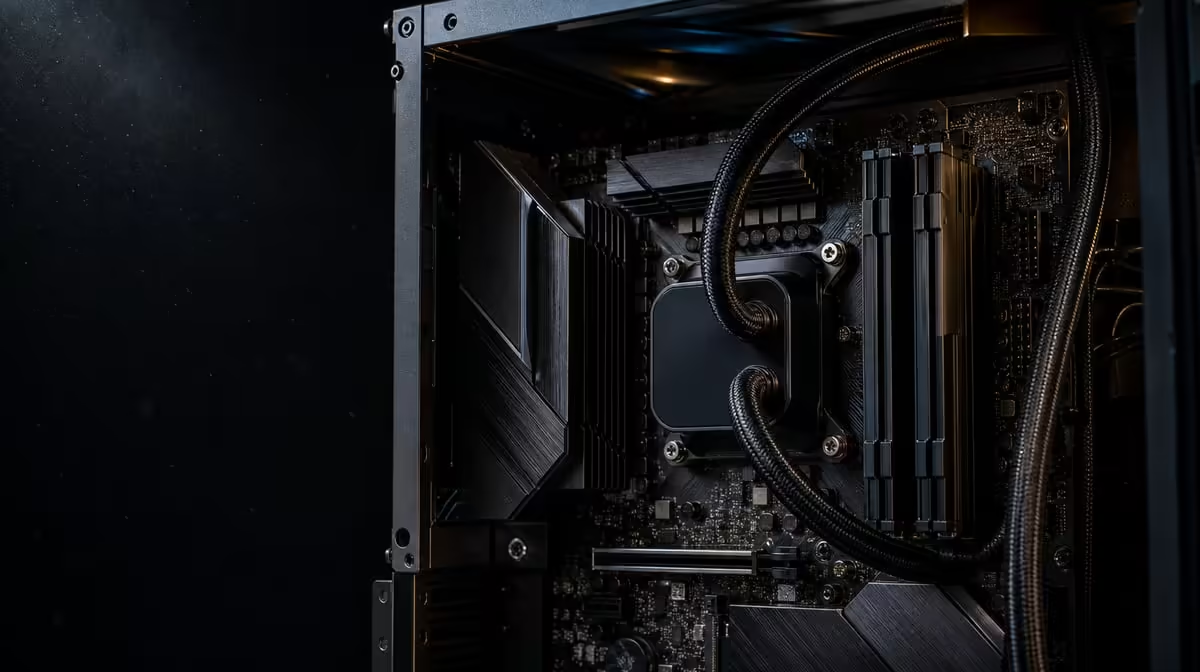
The LQ360 removes the need to choose a separate CPU cooler. Its value still depends on mounting, pump and fan connections, case airflow and acceptable sustained behaviour. A 360mm radiator does not promise one temperature or more frames in a GPU-limited game.
Establish a platform baseline after assembly. Confirm full 48GB recognition, cooler operation and normal application stability before tuning. Record firmware, memory settings and thermal behaviour. Premium controls become useful when they can be changed deliberately and reversed to a working state.
Review named alternatives in Evetech's AMD motherboard category. If a less expensive exact board passes every critical requirement, model the complete build with the savings moved to graphics or storage. If it misses an essential connection, the Dark Hero has a specific reason to remain.
💵 Reach a defensible R38,999 conclusion
Create a five-column table: part, required job, evidence, frequency and failure consequence. The processor row should name games or applications. The memory row should name capacity or bandwidth demand. The board row should name connections. The cooling row should name case and sustained-work behaviour.
Add an unused-capability column. Headroom for a credible planned task can carry some value, but an undefined future should not score like work done every day. This stops premium resources from justifying themselves.
Build a complete alternative with the same GPU, storage outcome and display target. Compare current totals, not one discounted part against the whole kit. The difference should identify a required task that improves.
After the PC is stable, run an acceptance sequence: game through the difficult scene, perform the main professional task, switch between applications and observe memory and temperature. The sequence tests the reasons the package was purchased.
Review the scorecard after a month. If a platform feature remains unused, note it for the next buying decision. If the CPU, memory, board and cooler all solve recurring work, the R38,999 premium has a coherent case.
The final statement should remain bounded: this kit is worth extra Rand for buyers who can use its cache-focused CPU, memory headroom, exact premium board and liquid-cooling layout while preserving complete-system balance. Check current availability when that sentence is supported by the costed build.
Add a sensitivity test to the final comparison. Lower the frame-rate target, reduce the creation frequency or remove the planned expansion one at a time. If the premium case collapses when a minor assumption changes, the buyer may be paying for a narrow best-case scenario. If several high-priority needs still point to the same package, the rationale is more resilient.
Run the opposite test by increasing one credible demand. Model the next project size, the intended high-refresh display or the normal streaming stack. Do not invent an unlimited future; use a task with a realistic date. The R38,999 kit earns headroom value when that near-term change uses resources already inside the bundle.
Keep opportunity cost visible after purchase. If the selected GPU, storage and display still meet their targets, the platform premium has not damaged balance. If one open part had to be reduced below a critical requirement, revisit the core even if its own benchmarks are strong.
Document the acceptance result in plain language. Name the game scene, project task, memory state, board connection and cooler behaviour that passed. This prevents a later discussion from collapsing back into broad premium labels.
The review should also capture any feature that did not matter. Unused capability is not necessarily a defect, but it should receive less weight in the next upgrade decision. Honest post-build evidence improves future spending without rewriting the current purchase as a mistake.
Keep the complete alternative beside that review. If later prices or workloads change, refresh both baskets and preserve the same acceptance tests. The premium remains defensible only while its recurring advantages outweigh the opportunities created by a less expensive core.
Frequently Asked Questions
When is a premium kit worth extra Rand?
When its fixed resources solve frequent, measured gaming or work constraints and the remaining PC stays balanced.
What does R38,999 buy?
It buys a 9950X3D processor, KLEVV 48GB DDR5-7200, an ASUS X870E Dark Hero and DeepCool's LQ360.
How can 144MB GameCache add value?
It can help cache-sensitive games by keeping more selected data close to the processor cores, subject to the wider bottleneck.
Who gains from 48GB?
Users whose games, creative tools and background applications pressure a smaller memory pool.
Does the premium board prove better frame rates?
No. The board supplies the platform; CPU, GPU, memory, software and settings determine performance.
What does the included cooler save?
It removes a separate CPU-cooler purchase if the LQ360 suits the case and passes installation and thermal checks.
Who should choose a cheaper platform?
Buyers whose workloads cannot use the premium resources or whose graphics, storage or case plan needs more budget.
Ready to make every extra Rand answer to a named gaming or work constraint?
Compare Evetech AMD upgrade kits and choose the R38,999 platform only when the complete PC preserves its balance.