Quick Answer
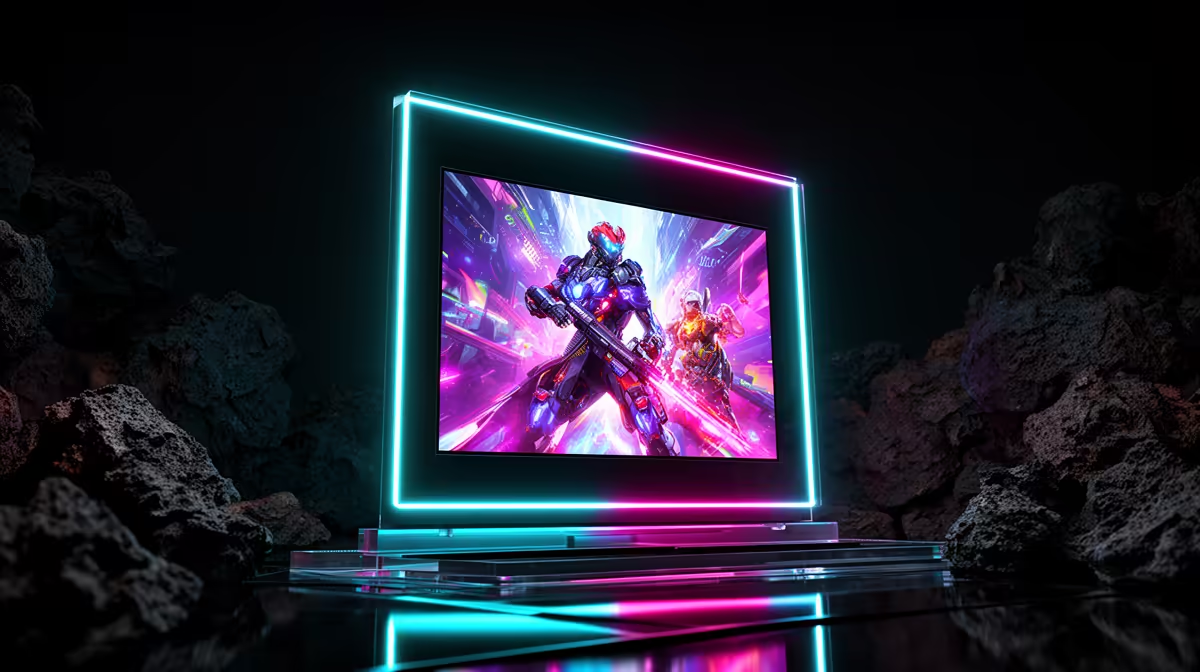
OLED and QD-OLED make sense when contrast, pixel response, and fast motion matter more than office-style static screen use. For SA buyers, the practical budget band is about R14,000-R35,000, with 1440p high-refresh panels giving better value than oversized 4K options unless your GPU is already strong.
Match the panel to your GPU
A QD-OLED monitor should be paired with the GPU you actually use. A Radeon RX 9070, RX 9070 XT, GeForce RTX 4070-class card, or stronger option is a better match for 1440p at 144-240 fps than an entry GPU trying to drive 4K.
For SA buyers, courier timing, warranty support, and local stock visibility matter because the best spec only helps when it can be bought and supported locally. For esports, 240 Hz matters; for story games, HDR contrast and colour accuracy matter more. Check 240 Hz refresh, 0.03 ms response, adaptive sync, HDMI 2.1 or DisplayPort, and panel warranty terms before comparing size or stand design.
Models and price bands to compare
Useful model families include Samsung Odyssey OLED G8, LG UltraGear OLED 27GR95QE, Alienware AW3423DWF, and Alienware AW3225QF. Treat model names as comparison anchors and confirm live Evetech stock before choosing a specific finish or size.
For 27-inch desks, 1440p is usually sharp enough and easier to drive. For 32-inch 4K, make sure your GPU can hold 80-120 fps in the games you care about, otherwise you pay for pixels your PC cannot use smoothly.
Delivery and setup details
Keep the box until the panel has been checked for damage, dead pixels, and the correct refresh rate in Windows. Use DisplayPort or HDMI 2.1 where required, then set the monitor to its maximum Hz in Windows display settings.
FAQ
Is OLED better than Mini-LED for gaming?
OLED has the fastest pixel response and true black levels, so it feels excellent in dark games and fast motion. Mini-LED can be brighter and may suit mixed work and gaming better if static desktop use is heavy.
What refresh rate should SA gamers target?
For competitive games, 144 Hz is the baseline and 240 Hz is the premium target. For cinematic games, 120-165 Hz with strong HDR can be a better use of budget than chasing the highest number.
Should I buy 1440p or 4K?
Choose 1440p for stronger Rand-per-frame value and easier GPU pairing. Choose 4K only when you have a high-end GPU and want image sharpness more than maximum frame rate.