The Valve Index was the enthusiast's PCVR headset for years: lighthouse tracking, finger-sensing controllers, a buttery refresh rate. Then the Quest 3 arrived as a lighter, cheaper, standalone unit that also plugs into your PC when you want full-fat VR. So the honest question for a South African buyer in 2026 is whether a tethered, base-station headset still earns its place, or whether the convenience of an all-in-one has quietly won.
Quick Answer
For most South African buyers, no, a tethered Valve Index is no longer the smart first choice. The Index weighs around 809g, demands a capable gaming PC plus two external base stations, and carries heavy import and setup overhead here. The Quest 3 is lighter, cheaper, works standalone, and still delivers solid PCVR over a cable or wireless link. The Index only wins for a specific enthusiast chasing its tracking precision and controllers.
How the two headsets differ at a hardware level
These are two different philosophies of VR, not just two products.
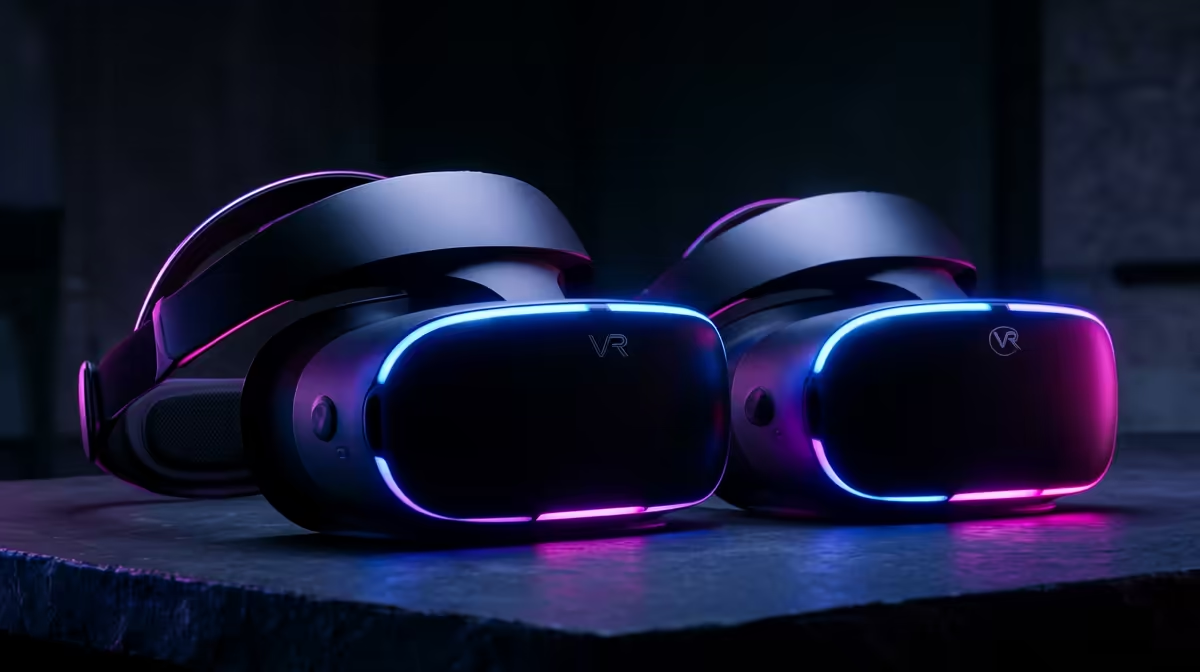
The Valve Index is a tethered, room-scale system. It uses lighthouse tracking, where two base stations you mount in the corners of your room sweep the space with infrared, and sensors on the headset and controllers read those sweeps for extremely precise positional tracking. It runs at high refresh rates and its knuckle controllers track individual fingers. But it cannot do anything without a gaming PC driving it.
The Quest 3 is a standalone headset with its own processor, so it runs games without any PC at all. It uses inside-out tracking, where outward-facing cameras on the headset map your surroundings, so there are no base stations to mount. It also has full-colour passthrough for mixed reality, and when you do want PC-grade VR, it connects to your machine by cable or over Wi-Fi.
The accessory ecosystem around PCVR, including AR and smart glasses, keeps growing too. You can see how the broader category is shaping up in the AR glasses range at Evetech.
Tracking: base stations versus inside-out
This is the heart of the comparison, and the answer has shifted over time.
Where lighthouse tracking still leads
The Index's base-station tracking remains the gold standard for precision. Because external stations track the headset rather than the headset tracking itself, it stays rock-solid even when controllers move behind your back or below your waist. For fast rhythm games and competitive VR, that reliability is genuinely felt. The knuckle controllers also strap to your hand and sense finger position, which adds a layer of immersion the Quest's controllers do not match natively.
Where inside-out has closed the gap
Inside-out tracking used to lose your controllers the moment they left the cameras' view. On the Quest 3 that is now rare in normal play. For the vast majority of titles, the tracking is more than good enough, and you gain something the Index cannot offer: no base stations to mount, align, power and re-calibrate. For a South African renting a flat, or anyone who does not want to drill mounts into a wall, that simplicity matters.
The South African cost and setup reality
Hardware specs are only half the story here. The Index is an older, niche product that arrives in South Africa with import cost and limited local availability, and it is a multi-part purchase: headset, two base stations, controllers, plus the gaming PC to run it. That stacks up fast and adds real setup complexity.
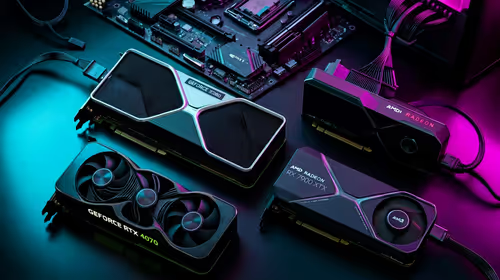
The Quest 3 is a single box. Buy it, charge it, and you are in VR standalone. Add a PC later for high-end titles if you want to. The lower barrier to entry, lighter physical weight on your face, and absence of wall-mounted hardware make it the far easier headset to live with day to day. If you are building or upgrading the PC that will eventually drive serious PCVR, the components that matter for VR sit alongside the rest of the gear in the accessories best sellers.
Who should still buy a tethered Index
A small group genuinely benefits from the Index in 2026: the VR enthusiast who already owns a strong gaming PC, wants the absolute best tracking for competitive or rhythm play, values the finger-tracking controllers, and is happy to set up a permanent room-scale space. For that person, the Index still delivers an experience the Quest 3 does not fully replicate.
For everyone else, the lighter, cheaper, standalone Quest 3 with optional PCVR is the sensible pick. It does most of what the Index does, with a fraction of the setup and cost, and it doubles as a mixed-reality device the Index cannot be.
Frequently Asked Questions
Is the Valve Index still worth buying in 2026?
Only for a specific enthusiast. If you already have a capable gaming PC, want the best-in-class base-station tracking and finger-sensing controllers, and do not mind a permanent room setup, it remains excellent. For most buyers the Quest 3 is the better all-round value.
Does the Quest 3 work as a PCVR headset?
Yes. While the Quest 3 runs games standalone, it also connects to a gaming PC by cable or over Wi-Fi to play full PCVR titles. That flexibility is a big part of why it has displaced dedicated tethered headsets for most people.
Why does the Index need base stations and the Quest 3 does not?
The Index uses external lighthouse base stations that track the headset and controllers with high precision. The Quest 3 uses inside-out tracking, where cameras on the headset map your room, so it needs no external hardware to mount or calibrate.
Is the Index heavier than the Quest 3?
Yes. The Index weighs around 809g, which is noticeably heavier on the face than the Quest 3, especially over long sessions. Headset weight is a real comfort factor for extended play.
Do I need a powerful PC for either headset?
The Index requires a capable gaming PC to function at all. The Quest 3 only needs one if you want to play PCVR titles; for standalone games it runs entirely on its own hardware. That makes the Quest 3 far cheaper to get started with.
Building the PC to drive serious VR, or kitting out a mixed-reality setup? Explore the AR glasses range at Evetech to see where the category is heading, and check the accessories best sellers for the components and gear that complete your VR battlestation.