Quick Answer
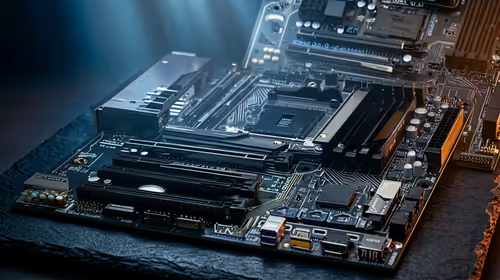
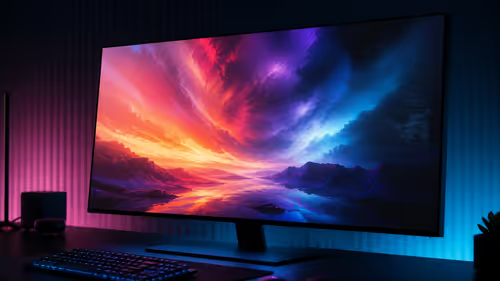
For competitive esports, an mATX build is the smart choice over full ATX — esports needs no extra expansion slots, so mATX delivers identical frame rates in a smaller, cheaper package. A B650M board (around R2,600) plus a Ryzen 5 7600 and a 240Hz monitor is a complete esports setup. Pick ATX only if you genuinely need many add-in cards.
Why form factor does not change fps
Esports frame rates come from the GPU, CPU and monitor, not the motherboard size. An mATX board runs the same chips at the same speed as ATX, so CS2 and Valorant hit identical numbers. What you lose with mATX are extra PCIe and DIMM slots most esports players never fill. What you gain is a smaller case and lower cost — money better spent on a 240Hz panel or a faster mouse.
Where to put the savings
The components that actually raise esports performance are a high-refresh monitor, a capable GPU for 240+ fps, and a low-latency mouse and keyboard. Going mATX over ATX frees budget for those without sacrificing anything you would use. A B650M board still offers Wi-Fi, an M.2 slot or two, and a full GPU slot — everything a competitive rig needs.
Build checklist
Confirm GPU length fits your mATX case, run 32GB DDR5-6000 with EXPO, and use a 650W PSU. All boards and parts are stocked locally so you can match sizes and pair with a 240Hz monitor.
FAQ
Does mATX lower esports fps versus ATX?
No. Both run the same CPUs and GPUs at the same speed, so frame rates are identical. mATX just saves space and money.
What do I give up going mATX for esports?
Mainly extra PCIe and DIMM slots competitive players never use. Core features stay, so you lose nothing that affects performance.
Where should the savings go?
Into a 240Hz monitor, a faster GPU, or a low-latency mouse — the parts that actually raise esports performance.
Before you buy
For esports, mATX matches ATX frame-for-frame — bank the savings into a 240Hz monitor and a low-latency mouse.