A beginner standing in front of two boxes, one labelled "robot kit" and one "electronics starter kit", is really choosing between two different first lessons. One teaches you how electricity and circuits actually work; the other hands you a moving machine to program. The robot kit vs electronics starter kit question matters because the wrong first kit can either bore someone with theory they are not ready for, or overwhelm them with a robot they do not understand. The right first choice depends entirely on what you want to learn first.
Quick Answer
For most beginners, an electronics starter kit comes first. It teaches circuit fundamentals on a breadboard with no soldering, giving the cleanest grasp of how sensors, power and components behave. A robot kit adds motors and a programmable board for a moving result, but it assumes some of that groundwork already exists.
What an Electronics Starter Kit Teaches
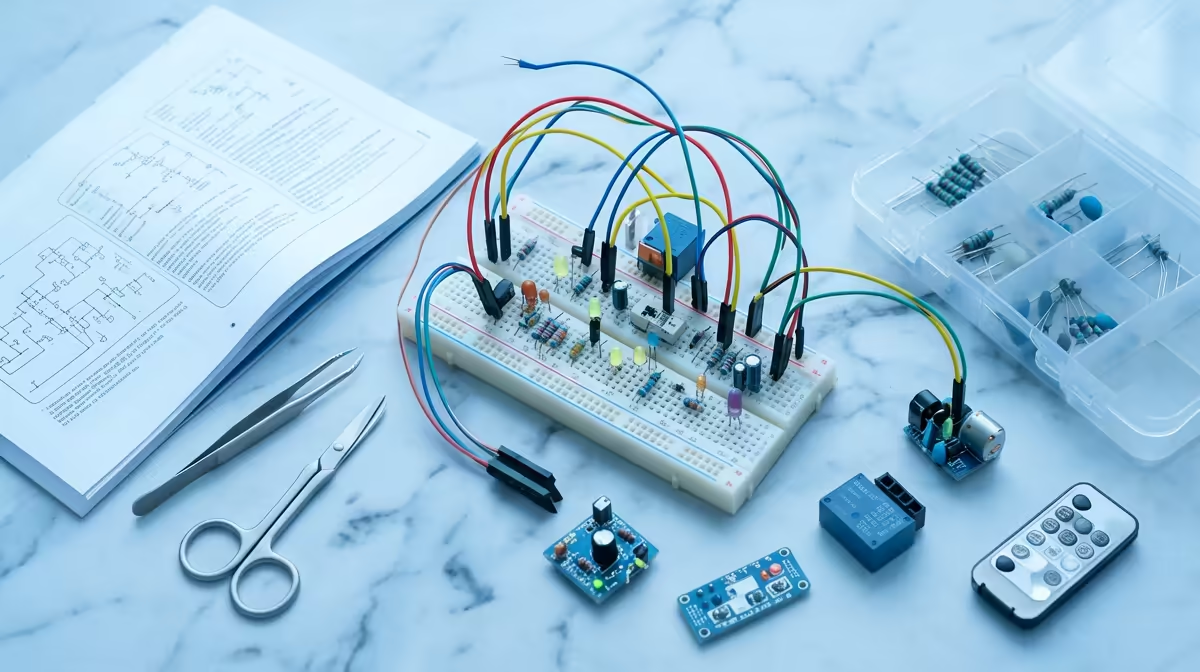
An electronics starter kit is built around a breadboard and a bag of loose components: resistors, LEDs, sensors, buttons, jumper wires, and usually a microcontroller board. You build circuits by pushing components into the breadboard, no soldering required, so mistakes are free to undo. Wire something wrong, an LED simply does not light, and you pull it out and try again.
This is the most direct way to understand the actual physics underneath every gadget. You learn what a resistor does because you watch what happens when you leave it out. You learn how a sensor turns light or temperature into a signal the board can read. By the time you have blinked an LED, read a sensor, and driven a small output, you understand the building blocks that every robot is made from.
Why fundamentals first pays off
The concepts from a starter kit are portable. Once you understand circuits, inputs, outputs and basic code, you can apply them to almost anything, including a robot you build later. Skip this and a robot becomes a black box: it moves, but you do not really know why, and you struggle the moment something breaks.
What a Robot Kit Offers Instead
A robot kit packages motors, a chassis, wheels or legs, sensors, and a programmable board into something that physically moves. The payoff is immediate and motivating: you assemble the kit, load a program, and watch your creation drive across the floor or avoid a wall. For many learners, especially younger ones or anyone who needs a tangible goal, that motion is the hook that keeps them going.
The catch is that a robot kit folds several skills together at once. You are building hardware, wiring motors and sensors, and writing code that coordinates all of it. A complete beginner can absolutely follow the instructions, but without circuit fundamentals they are often copying steps rather than understanding them. That works fine until the project goes off-script and there is no clear mental model to debug with.
How to Choose Based on Your Goal
The honest deciding question is what you want out of the first month. If you want to genuinely understand electronics, start with the starter kit. The breadboard, the loose components and the no-solder workflow give you a real foundation that makes everything afterwards easier, including robotics.
If your main motivation is a finished, moving project, and a slower theory build would put you off entirely, a robot kit can be the better first buy precisely because it keeps you engaged. Motivation matters; a kit you actually use beats a more "correct" kit that stays in the box. For tactile learners and goal-driven beginners, the moving result is the whole point.
A sensible progression
Many people get the best of both by sequencing them. Begin with an electronics starter kit to learn circuits and basic programming, then move to a robot kit to apply those skills to something that moves and senses. The fundamentals you built make the robot far easier to understand and modify, so the two kits reinforce each other rather than competing. You can line up both routes by browsing the smart home and learning tech range at Evetech and seeing which kit speaks to the learner in front of you.
Where Each Kit Takes a Learner Next
Understanding the next step from each starting point helps set expectations before you buy.
A learner who starts with an electronics starter kit and finishes the included projects is typically ready for a robot kit, a standalone Arduino project, or a Raspberry Pi Pico build. The breadboard habits, the reading of simple schematics, and the grasp of inputs and outputs all carry forward. From there, the path branches: some learners pursue hardware more deeply through Arduino shields and custom PCBs; others shift focus to the software side and use MicroPython on a Pico for more capable projects.
A learner who starts with a robot kit and enjoys it usually goes one of two directions. If the programming was the most satisfying part, the natural next step is a more capable coding board or a second robot with more sensor options. If the mechanical build was the draw, they often gravitate toward electronics starter kits to understand the components that make the machine work.
Neither path is a dead end. The two types of kit are complementary rather than competing, and most serious learners end up with experience of both over time. The decision is really about where to begin, not where to stop.
Budget and Practical Notes for SA Buyers
Electronics starter kits are generally the more affordable entry point and need nothing extra to begin, since the breadboard approach avoids soldering tools. Robot kits cost more because of the motors, chassis and mechanical parts, and some assume you already have a computer to program from, so factor that in. Either way, both kits tend to need a few everyday extras over time, from batteries to spare cables, and the accessories best sellers at Evetech cover the consumables that keep projects running.
Frequently Asked Questions
Which kit is genuinely better for a complete beginner?
An electronics starter kit, for most people. It teaches the underlying circuit and component knowledge with a forgiving, no-solder breadboard, so later projects including robots make sense rather than feeling like magic.
Do I need to know how to solder for a starter kit?
No. The standard electronics starter kit is built around a breadboard, where components push in and pull out by hand. That keeps it beginner-friendly and means mistakes cost nothing to fix.
Is a robot kit too advanced to start with?
Not necessarily, but it combines several skills at once, so a beginner without circuit basics may end up following instructions without fully understanding them. If motion is what keeps you motivated, it can still be a good first kit despite that.
Can I learn coding from an electronics starter kit?
Yes. Most starter kits include a programmable microcontroller, so you write code to read sensors and control outputs. That programming carries straight over to robotics and other projects later.
Should I buy both, and in what order?
If you can, start with the electronics starter kit to build fundamentals, then add a robot kit to apply them to a moving, sensing machine. That order makes the robot far easier to understand and modify.