You've saved up your hard-earned Rands. The GeForce RTX 4070 Ti is in your sights—a beast for 1440p gaming that promises silky-smooth frame rates. But then you see the chatter online: whispers of "VRAM issues" and a potential RTX 4070 Ti memory bottleneck. Is this a real problem that will kneecap your new rig, or just forum talk? Let's plug in and get to the truth for South African gamers. ⚡
Deconstructing the RTX 4070 Ti Memory Specs
First, let's break down the hardware. The concern centres on two specs: the card's 12GB of GDDR6X VRAM and its 192-bit memory bus. Critics point out that this bus is narrower than the previous generation's RTX 3080. On paper, a narrower bus means less data can travel between the GPU core and its memory at once.
However, NVIDIA engineered a clever solution: a massive L2 cache. This super-fast, on-chip memory acts as a buffer, reducing the need for the GPU to constantly access the main VRAM over that 192-bit bus. By satisfying most data requests directly from the cache, the system sidesteps many potential slowdowns. Understanding the relationship between these components is key when you browse the specs of modern NVIDIA & ATI graphics cards.
How Memory Affects Your Actual Gaming Sessions
Theory is one thing, but what happens when you're dropping into Apex Legends or exploring the world of Cyberpunk 2077? Does the RTX 4070 Ti memory bottleneck actually show up? The answer depends entirely on how you play.
The 1440p "Lekker" Zone
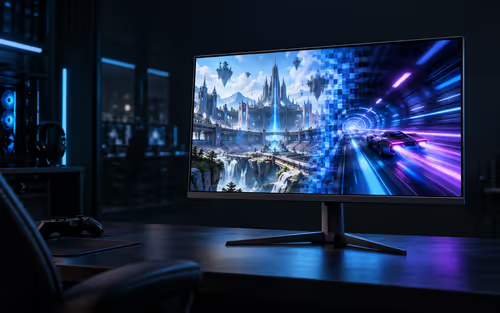
For its target resolution of 1440p (2560x1440), the RTX 4070 Ti is an absolute powerhouse. At this resolution, even with high settings, most current games struggle to use more than 10-11GB of VRAM. The 12GB frame buffer combined with the large L2 cache provides more than enough headroom. You get exceptional performance with DLSS 3 and Frame Generation, making it a fantastic investment for high-refresh-rate 1440p monitors. For Mzansi gamers, this is the sweet spot for performance and price.
Optimise Your Textures 🔧
If you're ever worried about VRAM usage, the 'Texture Quality' setting is the biggest consumer. Dropping it from 'Ultra' to 'High' can save 1-2GB of VRAM with almost no visible difference in quality, giving you extra performance headroom for free.
The 4K Gaming Question Mark
This is where the debate gets heated. If you push the RTX 4070 Ti to 4K (3840x2160) with every setting maxed out, especially in poorly optimised titles with massive texture packs, you can hit the VRAM limit. In these edge cases, the memory system can become the limiting factor, leading to stuttering as the card shuffles data. It doesn't happen often, but it's a reality for 4K enthusiasts who refuse to compromise on settings. If that's your goal, finding the best graphics card deals on a card with a beefier memory system might be your next move.
So, Is the RTX 4070 Ti a Smart Buy in SA?
Let's be clear: the RTX 4070 Ti memory bottleneck is more of a myth for its intended audience. It's a world-class 1440p card that delivers incredible value and future-proof features like DLSS 3. For the vast majority of South African gamers, it will chew through any game you throw at it without breaking a sweat. 🚀
If your budget is flexible and 4K gaming is non-negotiable, exploring AMD Radeon's latest offerings with more VRAM is a valid strategy. Even new contenders like Intel Arc are making waves and offering more choice. But for a balanced, powerful, and efficient build, the 4070 Ti remains a top-tier choice.
The verdict? Don't let the online noise scare you. The RTX 4070 Ti is a fantastic GPU for the price in ZAR, perfectly suited for the high-refresh-rate 1440p gaming that most of us love. ✨