


PCIe 5.0 vs PCIe 4.0 for Strategy and Sim Games in SA
PCIe 5.0 and PCIe 4.0 differ most in lane support, compatibility, and upgrade value for strategy and sim games. SA buyers should match the choice to their actual hardware and games.
Read moreSocket bracket support on static-pressure radiator fans now spans AM4, AM5, LGA 1700 and LGA 1851, so upgrade paths stay open across the next two CPU generations. SA pricing, warranty cover and current stock are factored in.
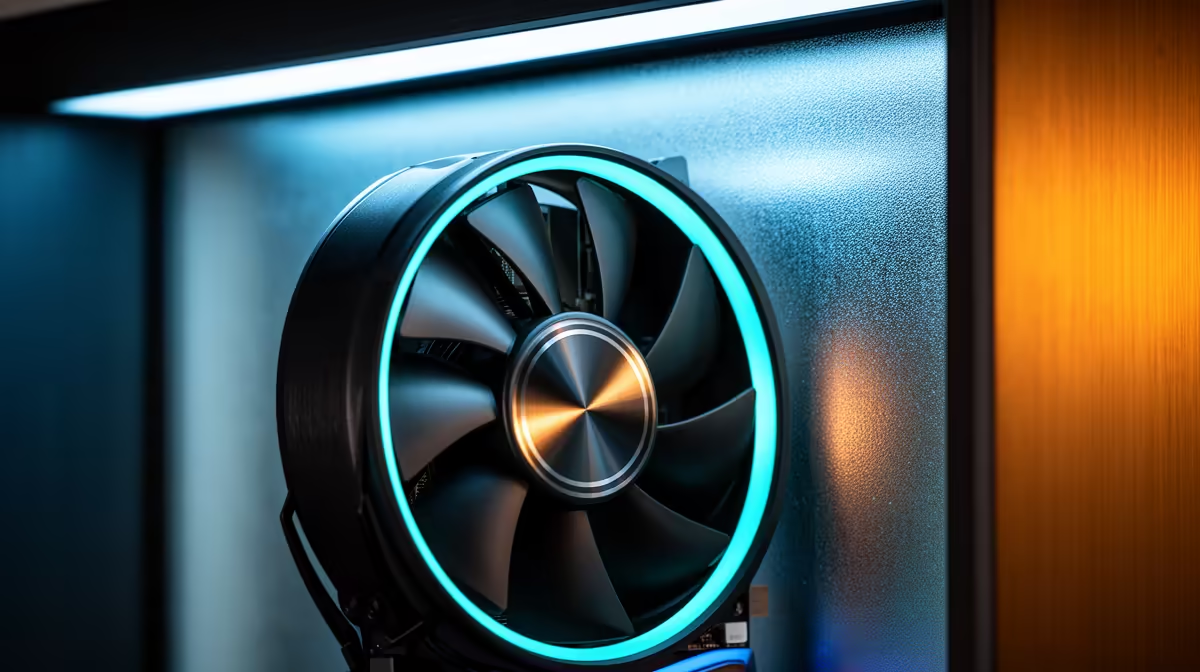
For radiator cooling, static pressure fans are more effective than high-airflow fans. Radiator fins present significant resistance to air movement, and static pressure fans are designed to push air through that resistance efficiently. High-airflow fans are optimised for unrestricted spaces like case panels where resistance is low.
A radiator's fin stack creates backpressure that chokes a high-airflow fan's performance disproportionately. Static pressure fans use denser blade geometry, narrower blade pitch angles and reinforced motor torque to maintain volume flow against resistance. Measured in millimetres of water column (mmH2O), static pressure ratings above 2.5 mmH2O are considered suitable for radiator duty. Popular static pressure options like the Noctua NF-A12x25, Arctic P12 and be quiet! Silent Wings Pro 4 all deliver strong static pressure figures while maintaining reasonable noise levels. On a 360mm radiator, the difference between matched static pressure fans and basic high-airflow fans can translate to 3 to 6 degrees Celsius in CPU temperature at equivalent fan speeds.
High-airflow fans belong on unrestricted intake and exhaust points: side panels, rear exhausts and front panels in cases with open mesh front designs. On these positions there is minimal resistance to airflow, and a high-CFM fan moves more total air volume than an equivalent static pressure fan. A well-balanced build uses static pressure fans on radiators and high-airflow fans on open case positions. Mixing this way optimises both radiator heat dissipation and overall chassis airflow simultaneously. Matching all fans to a single type, either all static pressure or all high-airflow, is a common beginner mistake that leaves performance on the table.
In South Africa's summer climate, particularly in inland cities like Pretoria and Johannesburg where ambient temperatures can exceed 35 degrees Celsius, the radiator fan choice has a meaningful impact on CPU thermals. At 35-degree ambient, every degree of efficiency gained from correct fan selection delays thermal throttling on a Ryzen 9 9950X or Core Ultra 9 285K. Static pressure fans suitable for 360mm radiator duty are stocked at Evetech in both 120mm and 140mm formats, with prices ranging from around R180 to R650 per fan depending on the tier. For a complete 360mm radiator, budget for three fans and consider a matched set from a single brand for consistent performance data and aesthetic uniformity.
Static pressure fans have a specific airflow direction indicated by an arrow on the frame. Confirm the arrow points through the radiator in your intended direction (intake or exhaust) before screwing the fan to the radiator. Reversing a fan once mounted in a tight case requires partial disassembly.
Both interact: a higher RPM static pressure fan will outperform a lower RPM one, but at the same RPM, static pressure design beats high-airflow design on a radiator. For quiet operation, choose a fan with high static pressure and large blade diameter that reaches adequate airflow at lower RPM.
No. A 360mm radiator uses three 120mm fan positions. A 420mm radiator uses three 140mm fans. Confirm your radiator and case dimensions carefully, as some cases that claim 360mm support only fit 120mm fans on that mount.
Look for the mmH2O figure in the fan specifications. Values above 2.0 mmH2O indicate meaningful radiator-suitable static pressure. Cross-reference with noise level (dBA) at maximum RPM to find the best efficiency-to-noise ratio for your use case.
Building or upgrading a liquid cooling setup? Find static pressure fans and complete radiator fan sets at Evetech, matched for 120mm and 140mm radiator positions.
PCIe 5.0 and PCIe 4.0 differ most in lane support, compatibility, and upgrade value for strategy and sim games. SA buyers should match the choice to their actual hardware and games.
Read more
AM5 vs AM4 for video editing in 4K Difference explained is mostly about compatibility, budget, upgrade path, and setup fit. SA buyers should check device support and real needs before expecting a clear win from either option.
Read more
OLED vs QD-OLED for strategy and sim games buyers - what changes is mostly about compatibility, budget, upgrade path, and setup fit. SA buyers should check device support and real needs before expecting a clear win from either option.
Read more
DisplayPort 2.1 and 1.4 differences matter when SA PC builders match GPUs, monitors, and refresh targets. Use this difference between displayport 2 1 and displayport 1 4 explained pc builders guide to avoid mismatched parts.
Read more
Ray tracing vs Path tracing depends on Strategy and sim games needs, platform limits, and budget fit. Compare compatibility, latency, upgrade path, and real setup constraints before choosing for an SA build.
Read more
wireless mouse guide for Gqeberha gamers should be shortlisted around the job it must do. South African buyers should compare sensor, shape, weight, and wireless latency, warranty path, and upgrade room before treating any pick as best.
Read more
From 1 October 2026, WhatsApp Business Platform service replies in South Africa are expected to cost about $0.0076, or 12 cents, per delivered message.
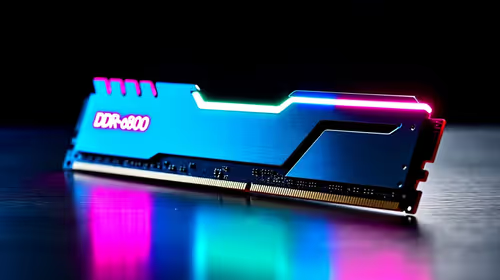
DDR5-8000 RAM Kits pros and cons depend on the build, budget, and workload. Weigh gaming needs, platform fit, power, cooling, warranty support, and South African pricing context before shortlisting it.

Wi-Fi 6E vs Wi-Fi 6 depends on AAA single-player gaming needs, platform limits, and budget fit. Compare compatibility, latency, upgrade path, and real setup constraints before choosing for an SA build.

Ryzen 9 9950X3D dead pixel checks should isolate the panel first. Run colour fills, inspect the monitor menu, test another cable or input, and capture proof before linking it to the SA CPU upgrade.

YouTube will count public views from the first frame across video formats from 24 August, while earnings and eligibility remain tied to engaged viewing.

Canonical expects Ubuntu on WSL users to outnumber native Ubuntu desktop users before the end of 2026. The software is open source and runs inside supported Windows PCs.
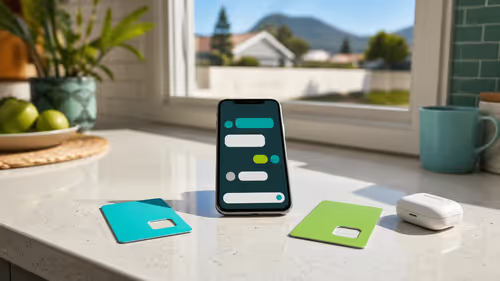
Telkom's daily bundles pair WhatsApp access with 10 all-network voice minutes. The R15 option includes 300MB, while the R17 option uses a fair-use threshold.

A 10,000-hour test found similar image retention across older and newer OLED TVs, while newer panels were brighter and more efficient. Local OLED monitors started at R9,999.
From 1 October 2026, WhatsApp Business Platform service replies in South Africa are expected to cost about $0.0076, or 12 cents, per delivered message.
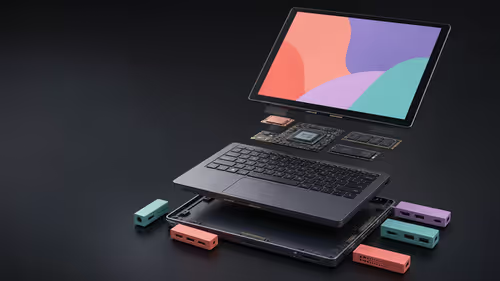
Framework has refreshed Laptop 12 with Intel Core Series 3 processors, Thunderbolt 4, a backlit keyboard and a claimed battery-life increase.

A Windows 11 Experimental Insider build adds per-app camera, microphone and location controls for Win32 programs, plus permission prompts.
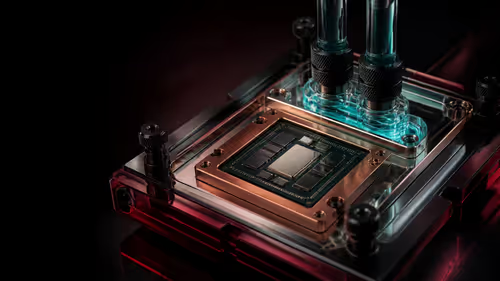
Thermal Grizzly is selling a tested, delidded Ryzen 9 9950X3D2 with its own 24-month warranty for experienced direct-die cooling builds.