Quick Answer
For OBS recording, a three-tier docking station plan runs from a R1,200-R1,800 USB-C hub dock for single 1080p capture, to a R2,500-R3,800 dock with dual-display and 100 W power delivery for a balanced setup, to a R5,000-R8,000 Thunderbolt 4 dock for high-bitrate multi-stream recording. Match the tier to your capture resolution and the number of displays OBS needs.
Budget Tier: Single-Display 1080p Capture
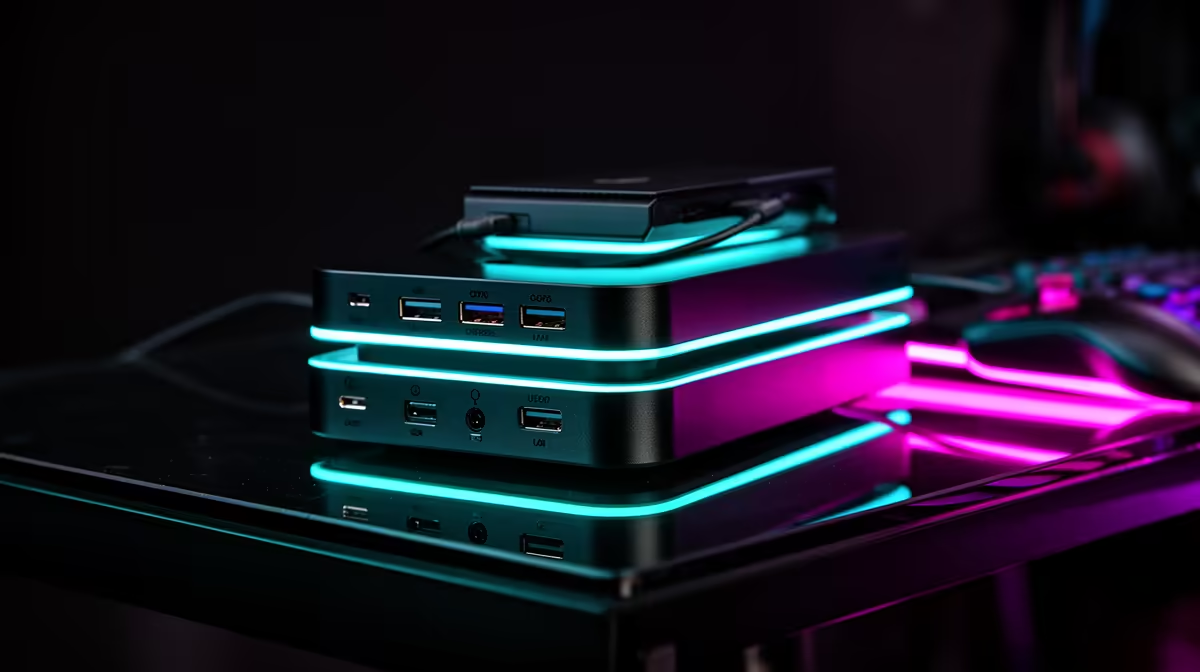
The budget tier suits a laptop recording a single 1080p OBS scene. A R1,200-R1,800 USB-C hub dock adds HDMI out, a couple of USB-A ports for your mic and capture device, and Gigabit Ethernet for a stable upload, off one cable. The limit is bandwidth: a USB 3.2 Gen 1 dock at 5 Gbps handles 1080p capture and a single external display comfortably, but tops out there. For a starter OBS setup recording locally at 1080p, this tier does the job without overspending.
Balanced Tier: Dual Display and Power
The balanced tier, R2,500-R3,800, adds dual external displays and 90-100 W power delivery so the laptop charges while it records, which matters for long sessions. A USB 3.2 Gen 2 dock at 10 Gbps drives two 1080p or one 1440p display plus capture without throttling. This is the sweet spot for most OBS recorders who want a multi-monitor layout, OBS on one screen and the game on another, with steady power.
Performance Tier: Thunderbolt 4 Multi-Stream
The top tier, R5,000-R8,000, is a Thunderbolt 4 dock with 40 Gbps of bandwidth for dual 4K displays, high-bitrate capture and multiple devices at once. It suits serious OBS work, 4K recording or simultaneous capture and stream, where lesser docks bottleneck. Only buy this tier if your laptop has a Thunderbolt 4 port and your capture demands genuinely exceed the balanced tier.
SA Buying Notes
Locally stocked docks at Evetech list connection type (USB-C, USB4, Thunderbolt 4), bandwidth, display outputs and power delivery. Confirm your laptop's port supports the dock's full bandwidth and that power delivery matches your charger wattage. A Thunderbolt dock needs a Thunderbolt port; on a USB-C-only laptop it falls back to lower bandwidth.
FAQ
What docking station do I need for OBS recording?
It depends on resolution and displays: a USB-C hub dock for single 1080p capture, a USB 3.2 Gen 2 dock with power delivery for dual-display 1080p/1440p, or a Thunderbolt 4 dock for 4K or multi-stream. Match the tier to your actual capture and monitor needs.
Does the dock affect OBS recording quality?
Indirectly. A dock with enough bandwidth and Gigabit Ethernet keeps capture and upload stable, while an underpowered dock can throttle a capture device or drop a display. Choose a dock whose bandwidth comfortably exceeds your capture resolution.
Is Thunderbolt 4 necessary for OBS?
Only for demanding setups: 4K capture, dual 4K displays or simultaneous record-and-stream. For single or dual 1080p/1440p OBS recording, a USB 3.2 Gen 2 dock with power delivery is enough and far cheaper, provided your laptop's port matches.
dock tier to your OBS load: confirm your laptop's port bandwidth first, since a Thunderbolt dock on a USB-C-only laptop drops to lower speed and can throttle your capture during a long recording.