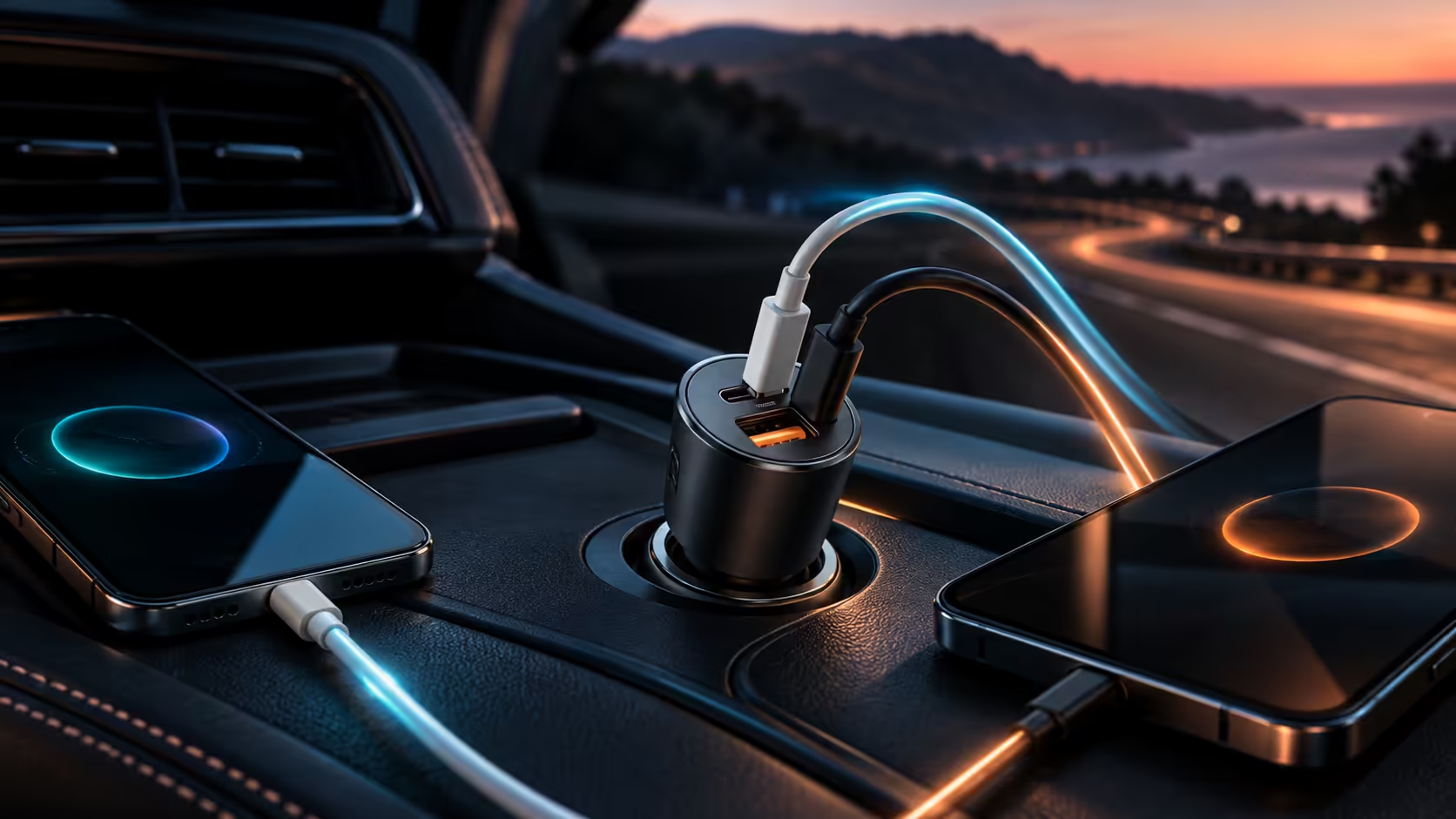
Not every phone treats a PPS charging port the same way, and that gap is not a flaw in the technology. It is the difference between a phone built to exploit fine voltage control and one that simply was not designed to ask for it.
Quick Answer
PPS lets a compatible phone request an exact voltage rather than rounding to the nearest fixed rung, moving in increments as small as 20mV on the voltage side and 50mA on the current side throughout the session. The phones that benefit most are ones that implement PPS in their own charging chip and run large batteries, since the finer matching reduces heat during the busiest part of a fast charge. A charger offering it, like Anker's 30W USB-C port on its R349 two-port unit, only uses PPS when the connected phone actually requests it.
🔋 What changes inside the phone
A phone charging over standard, fixed-voltage PD has to convert whatever voltage arrives, 5V, 9V, 15V or 20V, down to what its battery cell actually wants at that moment. The wider the gap between the two, the more of that conversion is lost as heat inside the phone's own circuitry rather than going toward useful charge.
PPS narrows that gap by letting the charger supply something much closer to the ideal figure, adjusted continuously rather than picked once from a short list. Less conversion work inside the phone means less heat generated for the same amount of energy delivered, which is the entire benefit PPS offers.
📱 Why some phones gain more than others
A phone's own charging chip has to implement PPS for any of this to apply; the charger alone cannot force it. Phones built around large batteries and aggressive fast-charging targets tend to include PPS support specifically because heat is the limiting factor on how fast they can safely charge, and PPS is one of the more effective tools for managing that heat without simply capping the wattage lower.
A phone with a smaller battery, or one whose charging chip was never built to request PPS, is not disadvantaged by a PPS-capable charger; it simply negotiates the nearest fixed PD rung instead and charges normally. The benefit PPS offers is specific to phones designed to use it, not a universal speed boost that applies regardless of what is plugged in. Small accessories such as earbuds rarely implement PPS at all, since their own charging draw is modest enough that the fine voltage matching buys them little.
🌡️ Heat matters more on a hot day
The heat-reduction argument for PPS is not purely theoretical comfort. A phone already warm from sitting in a hot car, or from running navigation with the screen on, has less thermal headroom before it throttles its own charging rate to protect the battery. Shaving heat off the charging process itself, which is what PPS does, buys back some of that headroom precisely when a phone would otherwise start slowing itself down.
That makes PPS more noticeably useful on a long, hot drive than on a five-minute top-up in a cool garage, since the benefit compounds the longer a session runs and the warmer the starting conditions already are. Anyone standardising on a single brand's ecosystem in the car can see how the Apple accessories range lines up with standard PD separately from any PPS discussion.
🔍 How PPS actually gets negotiated, step by step
The process starts the same way any Power Delivery session does: the charger and phone exchange a message announcing what each supports, and a PPS-capable phone specifically flags that it wants the programmable mode rather than settling for a fixed rung. From there, the phone sends periodic requests for a specific voltage and current combination within the range the charger has advertised, and the charger adjusts its output to match as closely as its own hardware allows.
This exchange repeats roughly once a second while conditions are changing quickly, sliding anywhere across a 3.3V to 21V window depending on what the spec allows, and less often once the battery settles into a steadier charging phase. None of it is visible to the person plugging the phone in; it happens entirely at the protocol level between the two devices.
🧪 A simple way to notice the difference yourself
Placing a hand near a phone's back panel partway through a fast charge on a standard fixed-voltage PD session, then repeating the same test on a PPS session at a comparable point in the charge, is a rough but genuine way to notice PPS working. A phone running noticeably cooler under PPS at a similar charge percentage is the heat-reduction benefit showing up in a way anyone can feel without needing to check a settings menu.
This is not a scientific measurement, and battery temperature varies with ambient conditions and how full the battery already is, but a difference of even 2 or 3 degrees at the same charge percentage is a reasonable everyday way to see that PPS is doing something real rather than being a marketing term with no practical effect.
Frequently Asked Questions
Does PPS work on every phone plugged into a PPS-capable port?
No. Only phones whose own charging chip implements PPS will use it; others charge over standard fixed-voltage PD instead, without any loss of basic charging function.
Is PPS the reason some phones charge faster than others on the same charger?
Partly, but not entirely. Battery size, thermal design and the phone's own charging chip all influence speed; PPS specifically affects how much heat is generated along the way rather than the raw ceiling.
Can I tell from a phone's settings whether PPS is active?
Some phones show a fast-charging indicator without naming the underlying protocol specifically, so PPS activation is not always visible directly, though a noticeably cooler-running phone during a fast charge is a reasonable sign it is working.
Does the car's own electrical noise interfere with PPS negotiation?
Not meaningfully for a properly protected charger, since the protection circuitry handling voltage swings sits ahead of the negotiation logic and keeps the interface it presents to the phone stable regardless of what the 12V rail is doing at that particular moment.
Does PPS shorten a phone's battery lifespan?
If anything, the opposite is more likely, since lower heat during charging is generally kinder to battery longevity than a hotter equivalent session at the same wattage.
Ready to charge a PPS-capable phone properly?
Have a look at the car charger range for a port that supports it.