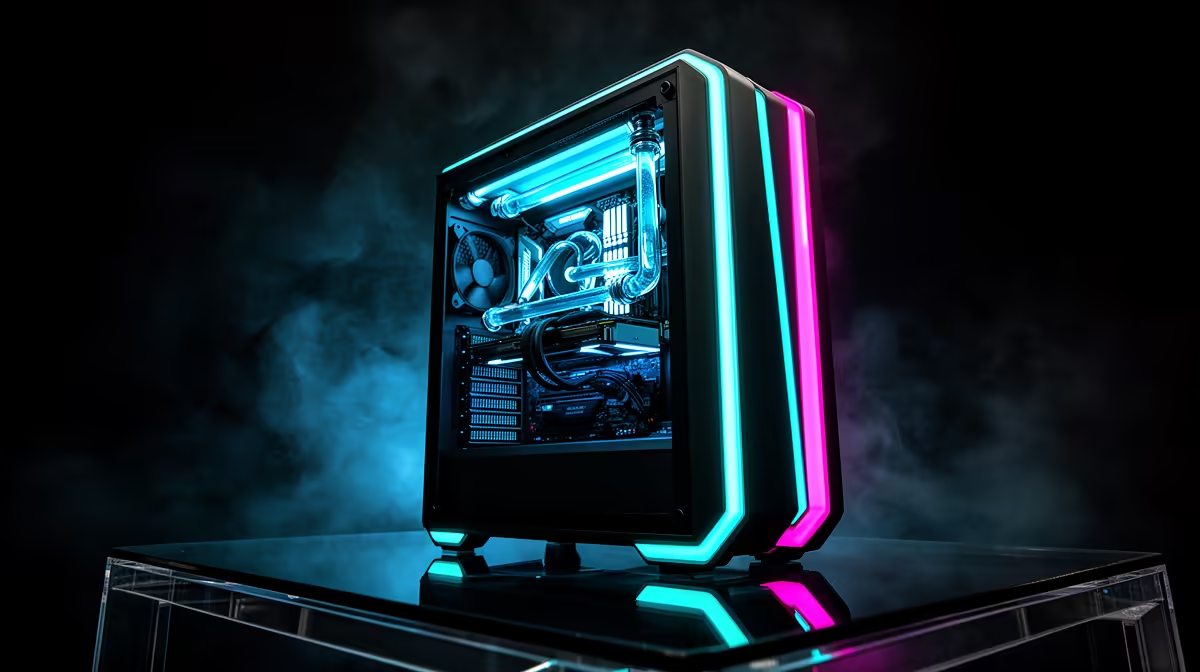
NVIDIA's RTX Spark is not another graphics card, it is a full Arm-based superchip that fuses a MediaTek-designed Grace CPU, a Blackwell RTX GPU and a large pool of unified memory onto one platform. Announced at Computex 2026 and due to ship in systems from fall 2026, it pitches a single machine that games at 1440p, runs creative apps, and hosts sizeable AI models locally. The interesting question is not whether it can do all three, but which of them it does well enough to change how you buy.
Quick Answer
An RTX Spark PC suits someone who wants one machine to game at 1440p, edit and create, and run local AI models without renting cloud GPUs. NVIDIA pegs the graphics at roughly RTX 5070 level, claims over 100 frames per second at 1440p with ray tracing and DLSS in modern titles, and pairs it with up to 128GB of unified memory for hosting large models up to around 120 billion parameters. It is a generalist's superchip, strongest where memory-hungry AI meets solid mainstream gaming.
The 1440p gaming case
RTX Spark's GPU is Blackwell-based with up to 6,144 CUDA cores and fifth-generation Tensor cores, which NVIDIA positions as roughly comparable to an RTX 5070. In gaming terms that lands it firmly in the 1440p high-refresh sweet spot: NVIDIA cites AAA titles running above 100 frames per second at 1440p with ray tracing on, leaning on DLSS 4.5 Multi Frame Generation and Reflex to reach those numbers. That is a genuinely capable target for the resolution most enthusiast monitors now sit at, though it is mainstream-strong rather than a 4K flagship. If raw frames at the highest resolution are your only goal, a discrete top-tier card still wins.
Where the unified memory changes the maths
The standout is the memory architecture. RTX Spark uses up to 128GB of LPDDR5X as one shared pool for CPU and GPU, with bandwidth quoted up to 300 GB/s. That matters most for AI: a single memory share that large lets the platform host local reasoning models reportedly up to around 120 billion parameters with one million token context windows, the kind of footprint that simply will not fit in a consumer GPU's VRAM. For anyone doing local model work, that is the headline feature, and it is why the platform shows up alongside the dedicated machines in the AI PC range at Evetech.
Creation and content work
Unified memory helps creative workloads for the same reason. NVIDIA specifically calls out editing 12K 4:2:2 video using the Blackwell decoder, generating 4K AI video, and loading 3D scenes north of 90GB with OptiX and DLSS rendering. None of that fits within the VRAM a typical 16GB creator laptop offers, so on a conventional x86 machine you would be forced to scale the project down or push it to the cloud. Combined with the Blackwell GPU's media and Tensor hardware, RTX Spark targets creators who want a portable workstation that does not choke on memory-heavy timelines.
The Windows on Arm trade-off
RTX Spark runs Windows on Arm, which is a meaningful consideration before buying. Native Arm apps and major creative and AI tools that have been ported will run at full performance. Older x86-only software runs through emulation, which can reduce performance or occasionally fail. For the mainstream creative and developer toolchain this is rarely a problem in 2026, but niche plugins, legacy tools and some anti-cheat implementations in older games remain worth checking. Confirm your specific software is Arm-ready before committing.
How RTX Spark compares to the DGX Spark
The RTX Spark shares the same GB10 Grace Blackwell superchip as the DGX Spark, but targets a different audience. DGX Spark is a Linux-only appliance built for developers and researchers who live in AI tooling, priced at around 4,699 US dollars. RTX Spark arrives as a Windows PC from multiple OEMs starting at roughly 2,899 US dollars for the N1X flagship, aimed at buyers who want one versatile machine rather than a dedicated AI appliance.
The practical performance difference is modest: early estimates put the DGX Spark roughly 20 to 30 percent ahead on sustained AI inference due to better data-centre-class thermal headroom and chip binning. For most users that gap does not justify the Linux requirement and higher price, which is why RTX Spark is the more natural choice for anyone who wants Windows and mainstream usability alongside AI work.
Who should actually want one
The clearest fit is the person juggling all three jobs: a developer or creator who games. If you only game, a conventional desktop with a strong discrete GPU, the sort of build leading the GPU best sellers, gives more frames per Rand. RTX Spark earns its place when local AI and creative work share the machine, because no standard card offers a 128GB memory pool to run large models on the same box you play on.
What to watch before buying
Two things temper the enthusiasm. First, it is an Arm platform, so Windows-on-Arm app and driver compatibility is worth checking for the specific software you depend on. Second, real-world gaming and AI figures will come from independent testing once shipping systems land in fall 2026, so treat NVIDIA's numbers as the ceiling, not a promise.
Frequently Asked Questions
Is RTX Spark as fast as an RTX 5070 for gaming?
NVIDIA positions the GPU as roughly RTX 5070-tier, with over 100 frames per second quoted at 1440p with ray tracing and DLSS in modern titles. Independent benchmarks on shipping hardware will confirm how close it lands in practice.
Can it really run a 120B-parameter AI model?
The up-to-128GB unified memory pool is what makes hosting very large local models feasible, something a normal consumer GPU cannot do on VRAM alone. NVIDIA specifically cites 120B parameter models with one million token context windows. Speed will depend on the model and quantisation, but the capacity is the real enabler.
Will my Windows games and apps run on an Arm chip?
Most mainstream software runs through Windows on Arm, but compatibility varies by title and tool, especially for anti-cheat systems and niche plugins. Check the specific programs you rely on before committing.
Should I buy RTX Spark just for gaming?
Probably not. For pure gaming value a desktop with a discrete GPU stretches your money further. RTX Spark makes sense when local AI or creative work shares the same machine as your gaming.
When do RTX Spark systems ship?
NVIDIA expects Spark systems to ship in fall 2026 from ASUS, Dell, HP, Lenovo, Microsoft Surface and MSI. Treat that as a target window and confirm firm availability closer to the time.
Weighing an all-in-one AI and gaming platform against a classic build? Compare the options in the AI PC range at Evetech and decide whether one superchip or a discrete GPU fits your workload.