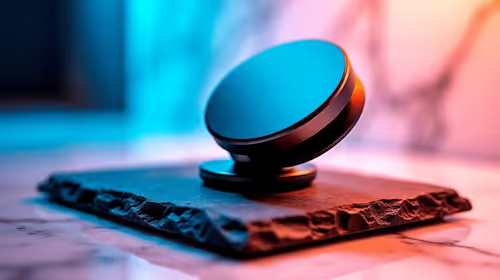
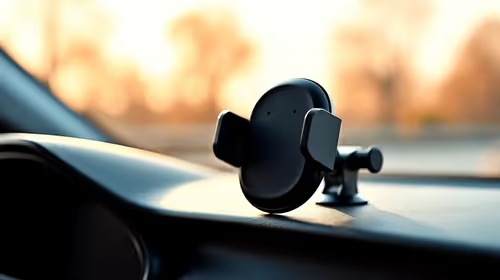
Two phone mount designs dominate South African dashboards: the magnetic phone mount that snaps the device on with one touch, and the fixed cradle that grips it with a spring clip or gravity lever. Both solve the same problem, but they solve it with completely different priorities, and the roads you drive on every day should guide the choice.
Quick Answer
Magnetic mounts win on speed and versatility for city commuters and suburban drivers; fixed gravity or spring cradles offer more unconditional security for rough roads, gravel tracks, or very heavy phones. Most SA drivers on surfaced roads will find a quality magnetic mount sufficient; those on degraded roads or using armoured cases should consider a fixed cradle.
🧲 The Magnetic Mount Advantage: Speed and Simplicity
Magnetic mounts remove the daily ritual of cramming a phone into a spring-loaded grip. One-handed placement takes under a second; removal is the same. For a Joburg commuter jumping between the car and a Sandton office block multiple times a day, that convenience accumulates into a genuinely better driving routine.
The mechanism relies on neodymium magnets in the mount head attracting a thin steel plate or ring attached to the back of the phone. No moving parts means nothing to break or stick. The ball joint on most quality mounts rotates through 360 degrees, so portrait and landscape orientations are equally accessible without adjusting the mount base.
Phones with flash-based storage are unaffected by the magnetic field, and the same goes for cellular, GPS, and Bluetooth signals. The only practical consideration is wireless charging: a plate placed over the Qi coil can interrupt charging, but a ring-shaped plate or a MagSafe-compatible case avoids this entirely.
🔒 The Fixed Cradle Argument: Mechanical Security on Any Surface
A fixed cradle, whether gravity-lever or passive spring clip, holds the phone between physical arms or inside a shaped cavity regardless of what the magnetic field is doing. There is no air gap to worry about, no plate alignment to get right, and no surface material dependency. A phone in a 10 mm armoured case goes into a properly sized cradle just as securely as a naked phone.
This matters on the Eastern Cape gravel roads or the rutted suburban streets in areas where road maintenance is inconsistent. Sustained vibration over corrugated surfaces applies a rapid series of small shear loads that can gradually nudge a magnetically held phone sideways, eventually causing it to tilt or drop if the mount is underspecified. A fixed cradle never loses grip to vibration because the phone is mechanically enclosed.
The trade-off is friction in the daily routine. Opening spring arms with one hand, especially in winter with a cold or gloved hand, is slower than a magnetic snap. Some cradles require two hands for safe placement while driving, which is worse for distraction risk than the phone momentarily held by one magnetic touch.
📊 Choosing by Use Case and Road Type
SA road quality varies dramatically by province and suburb. A driver in a well-maintained Pretoria suburb whose worst stretch is the occasional pothole is well served by a five- or six-magnet mount rated above 1,500 gram-force. The same driver who spends weekends on farm roads or visits clients in townships with severely broken surfaces should weigh the mechanical security of a cradle seriously.
Phone weight is the other variable. Standard phones between 150 and 200 grams sit happily on a quality magnetic mount. A phone above 220 grams in a thick case is asking the mount to work harder. In that combination on rough roads, a fixed cradle removes all doubt.
Price bands in SA for both categories are similar: decent magnetic mounts and decent gravity cradles both start around R100 and rise to R300 to R400 for quality builds. The choice is about the driving environment, not the budget.
Frequently Asked Questions
Can I switch between magnetic and fixed cradle mounts on the same vent?
Vent mounts from different systems are not interchangeable; each clips to the vent blades via its own mechanism. Keeping a second mount installed on a different vent and switching the phone between them is practical if your routes genuinely vary between smooth city roads and rough surfaces.
Do fixed cradles damage the phone's sides or screen edges over time?
Quality cradles line their contact points with silicone or soft rubber to prevent scratching. Repeated opening and closing of spring arms can wear case edges gradually, but bare phone body damage is rare with a well-padded cradle. Magnetic mounts are gentler on the phone body because there is no clamping action at all.
Which type is easier to use while wearing driving gloves in winter?
Magnetic wins clearly. Gloves reduce dexterity, and the single-touch placement of a magnetic mount is easy even with winter gloves on. Opening spring-loaded cradle arms with gloves is noticeably harder and takes two hands on most designs.
Is a fixed cradle better if my phone does not have a compatible case for a steel plate?
It removes the need for any modification to the phone or case, which is a real benefit. A cradle grips the phone body directly, so case type, phone material, and back surface texture are irrelevant to how securely it holds.
Does the mounting surface matter for grip security with either type?
Yes. Vent mounts flex if the vent blades are loose, which affects both magnetic and cradle designs. Dashboard suction cups and adhesive pads provide the most stable base. A mount that wobbles in its base will feel like weak grip even if the magnet or cradle itself is rated well.
Settled on the right mount style for your commute?
Compare magnetic and cradle options side by side in Evetech's car phone mount range and take your pick before the next drive.