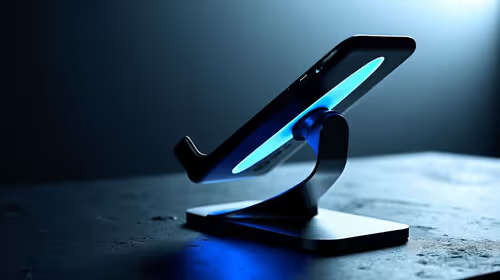
Both a magnetic phone mount and an active clamp mount attach your phone in the car, but they do it through fundamentally different mechanisms, and those differences show up clearly the moment you try to use them with one hand or drive over a rough stretch of road. This comparison focuses on clamp mechanics specifically, not the broad landscape of holder types.
Quick Answer
A magnetic mount is faster to use daily but its holding force depends on a steel plate and magnet alignment; an auto-clamp mount uses spring-loaded arms that grip the phone body physically, offering unconditional mechanical security at the cost of slower, two-hand placement. Choose magnetic for lighter phones and smooth routes, and clamp for heavier devices or unpredictable road surfaces.
🤜 How Auto-Clamp Mechanics Work
An auto-clamp mount uses a spring-loaded arm mechanism, typically triggered either by a push button at the base or by simply pressing the phone inward. The arms extend under spring tension and clamp against the sides of the phone when released, maintaining constant inward pressure regardless of how the car moves. There are no magnets and no dependency on any phone accessory; the phone itself becomes the anchored object.
Better designs add a bottom lip rest that bears the phone's weight, leaving the side arms to resist only lateral forces. This three-point contact is more stable on corrugated roads than a two-arm-only design.
The drawback is cycle speed. Placing the phone means positioning it against the bottom rest, pressing inward until the arms close, then releasing. Removal requires a button press to spread the arms. That sequence takes roughly five seconds, which is noticeably slower than the single-touch snap of a magnetic mount when you are in a hurry.
🧲 Where Magnetic Holds Its Own and Where It Falls Short
Magnetic mounts use a neodymium magnet array in the mount head to attract a steel plate or ring fixed to the phone back. The interaction is instantaneous, silent, and requires only the hand holding the phone to approach the mount face. Removal is equally effortless. For a driver who places and removes the phone dozens of times a week, the difference in daily friction compared to an auto-clamp is real.
Magnetic grip scales with mount quality and plate precision. A six-magnet N52 array on a centred plate delivers 2,000 gram-force or more, ample for most phones on typical SA roads. The grip characteristic differs from mechanical clamping, though: a magnet holds perpendicular but shear resistance is not absolute. Sustained vibration from a corrugated gravel road can gradually shift a phone sideways on a lower-rated magnetic mount in a way spring-loaded arms will not allow.
Phone weight also interacts differently with each type. A 180-gram phone in a slim case suits a magnetic mount well. A 240-gram phone inside a rugged case sits more securely in an auto-clamp, because the arms grip the case directly and the thick case's air gap is irrelevant to clamping force.
📐 Decision Framework: Speed vs Mechanical Grip Security
Route type is the clearest dividing line. SA city commuters on surfaced roads in Cape Town, Joburg, or Pretoria will find a quality magnetic mount fully adequate and substantially more convenient. Drivers who regularly use gravel routes, rough township roads, or off-road tracks should lean toward auto-clamp for grip that does not depend on magnet rating or plate precision.
Phone weight is the second filter. A phone above 200 grams in an armoured case pushes mid-range magnetic mounts hard on rough roads; auto-clamp arms hold that combination without compromise. A lighter phone in a slim case suits magnetic perfectly. Both types sit in the R150 to R350 range for quality units in SA.
Frequently Asked Questions
Will auto-clamp arms scratch my phone or case?
Quality auto-clamp mounts use silicone or foam-padded contact arms that are soft enough to avoid marking most phone cases. Naked glass-back phones are at slightly higher risk if the padding is thin or worn. Magnetic mounts cause zero contact marking because the only physical interaction is the plate adhering to the back.
Can an auto-clamp mount hold my phone portrait and landscape?
Yes, if the mount head has a swivel or ball joint. Most do. The critical spec to check is arm travel width; wider arms handle today's large flagship phones comfortably, while narrow arms designed for older narrower phones can struggle to open wide enough.
What happens if the spring mechanism on an auto-clamp weakens over time?
Weakened spring tension reduces clamping force, which can allow a phone to slide out gradually, especially from a vent mount where the base itself can flex. Spring fatigue is the primary failure mode of clamp mounts over a two- to three-year product lifespan. Magnetic mounts have no moving parts and therefore no equivalent wear mechanism.
Do auto-clamp mounts work with car charging?
Yes. The most common configuration is a wireless-charging auto-clamp where the back plate of the mount includes a Qi coil, and the phone is held by the spring arms in precise alignment with that coil for charging. This is a more involved engineering task than a passive clamp, and those units typically cost R250 to R450 or more.
Which is safer to operate while the car is moving, magnetic or clamp?
Magnetic, by a clear margin. A single-touch placement or removal from a magnetic mount requires only the hand holding the phone to approach the mount face; no button press and no arm manipulation is needed. Safer still is placing the phone before moving and removing it only when stationary.
Decided which mechanism fits your driving?
Shop the full car phone mount range at Evetech and find the magnetic or clamp model that matches your phone, your case, and your roads.