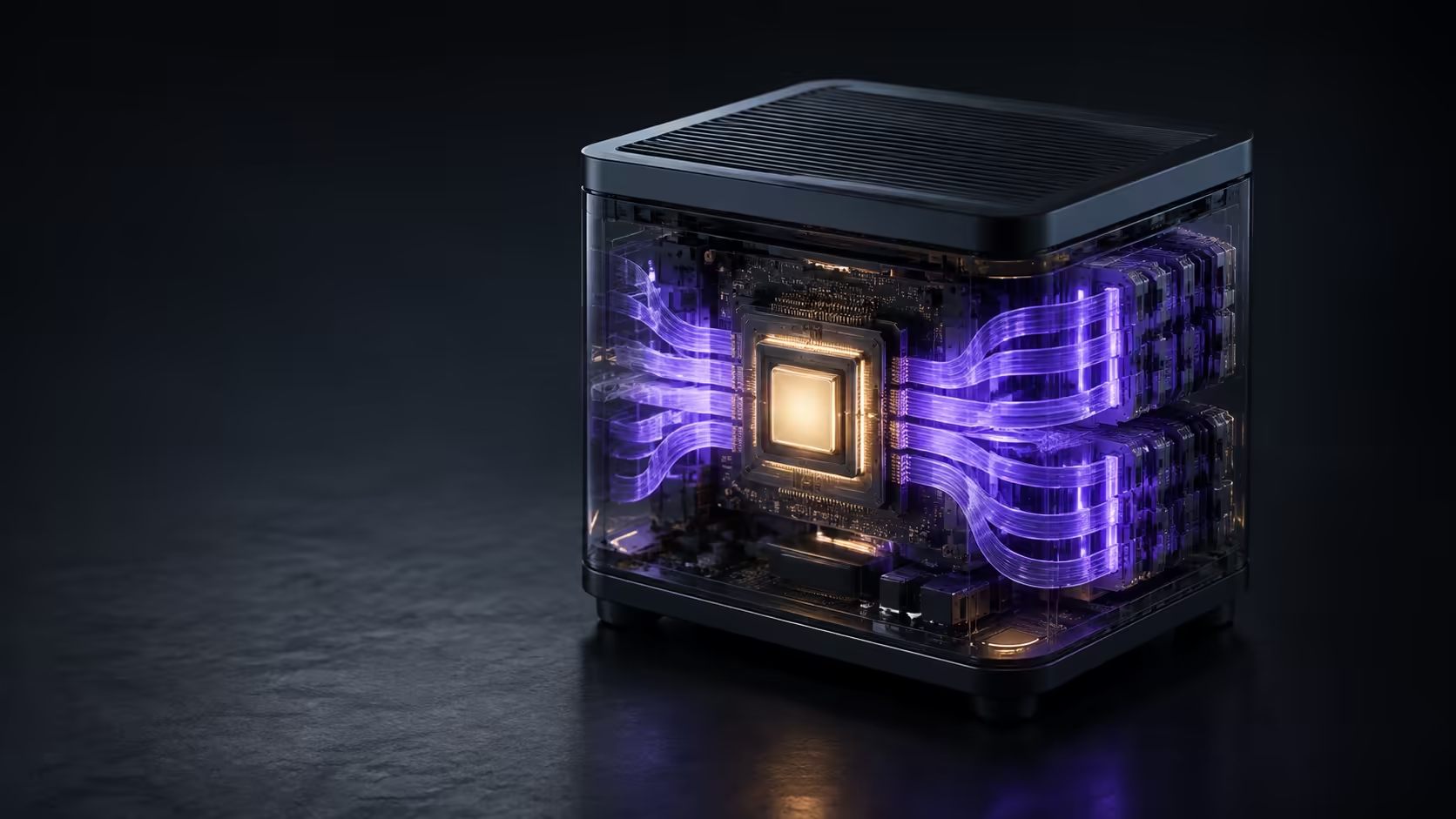
The MINISFORUM MS-S1 MAX-P495 puts an unusually large shared memory pool into a compact workstation. Its headline configuration combines AMD's Ryzen AI Max+ PRO 495 with up to 192GB of LPDDR5X memory, opening a different route for local AI and graphics workloads that run out of conventional video memory.
Quick Answer
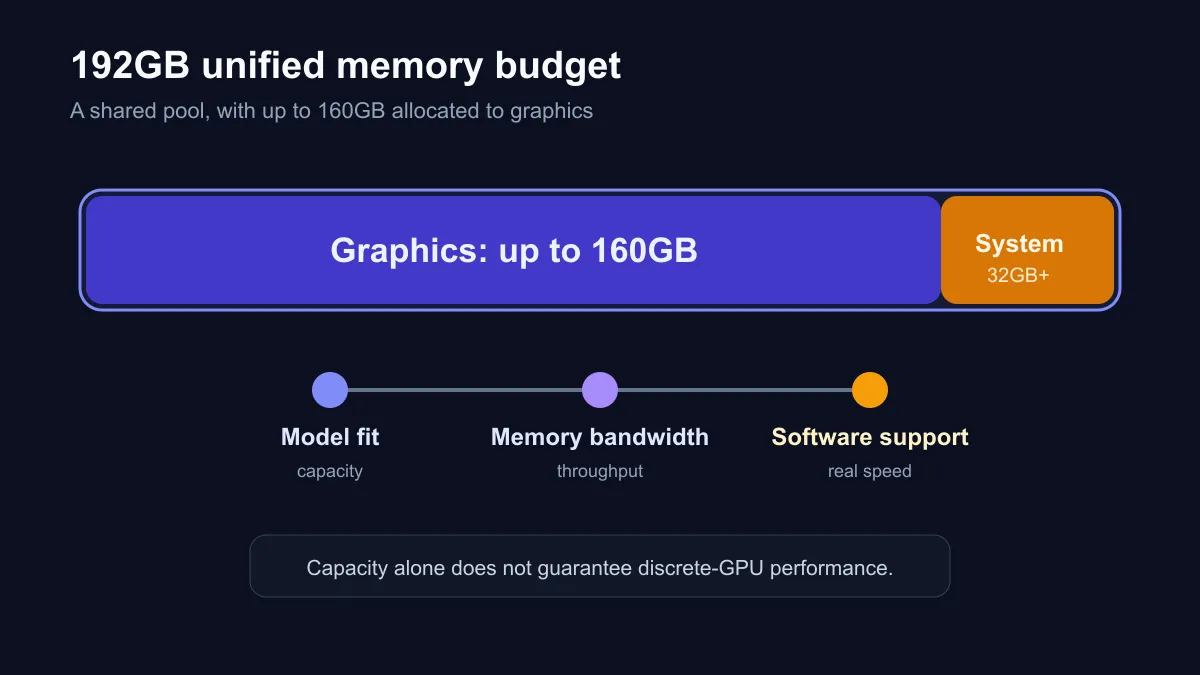
The MS-S1 MAX-P495 uses a 16-core, 32-thread Ryzen AI Max+ PRO 495 and can be configured with 192GB of unified memory. MINISFORUM says as much as 160GB can be allocated to graphics workloads. Local price and availability are unconfirmed; current stocked MINISFORUM mini PCs in the captured catalogue ranged from R8,299 to R15,999.
🧠 What the shared memory changes
In a conventional workstation, system memory and graphics memory are separate pools. A demanding model can hit the graphics card's memory ceiling even when plenty of system RAM is free. The P495 design allows the integrated graphics processor to use a much larger portion of the shared 192GB pool, with a stated maximum graphics allocation of 160GB.
Capacity is not the same as speed. A large model fitting in memory does not guarantee the throughput of a powerful discrete workstation GPU. Software support, memory bandwidth, quantisation, model architecture and sustained cooling all influence the result. The useful question is whether the target workload needs exceptional capacity, exceptional speed, or a balance of both. Record the expected tokens per second, batch size and maximum model footprint before comparing systems. Those measurements turn a striking specification into a workload decision and expose cases where a smaller, faster accelerator remains the practical choice.
🧪 Define the workload before the hardware
The Ryzen AI Max+ PRO 495 brings 16 CPU cores and 32 threads, so the box can also handle compilation, content creation, virtual machines and data preparation. For a local AI buyer, make a list of the exact models, context sizes, precision settings and applications that must run. Then find measured results for that stack before committing.
Compare the compact system with current mini PC options, but do not treat their prices as direct equivalents. The captured catalogue had MINISFORUM models at R8,299, R8,999, R9,799, R9,999, R13,999 and R15,999. Those are useful baselines for ordinary office and compact-computing needs; the P495 targets a far more memory-heavy niche.
💰 Compare total workstation cost
No South African P495 price was verified. When a local listing arrives, compare the complete configuration rather than the bare processor name. Memory capacity, storage, network ports, expansion, warranty and the supplied operating system can materially change value.
Also compare a traditional build using workstation graphics cards and current desktop processors. A discrete GPU workstation may be faster for well-supported workloads. The compact unified-memory machine becomes interesting when fitting the workload locally, reducing system size or simplifying memory management matters more than peak benchmark performance.
Frequently Asked Questions
Which processor is in the MS-S1 MAX-P495?
It uses AMD's Ryzen AI Max+ PRO 495 with 16 CPU cores and 32 threads. Application performance still depends on cooling and software support.
How much memory can it have?
MINISFORUM lists configurations up to 192GB of LPDDR5X unified memory. That pool is shared by system and graphics tasks.
Can all 192GB be used as graphics memory?
No. The stated maximum graphics allocation is up to 160GB, leaving the remainder for the operating system and other work.
Is it faster than a discrete workstation GPU?
Not automatically. Its strongest advantage is memory capacity in a compact shared design; performance varies by workload and optimisation.
What do current MINISFORUM mini PCs cost locally?
The captured stocked sample ranged from R8,299 to R15,999. Those systems occupy a lower performance and memory class than the P495.
Planning a local AI workstation?
Measure the model memory requirement first, then compare a large shared pool with a discrete GPU build at complete-system prices.