The Noctua NT-CP1 puts a different question on the cooling shopping list: how much is a tidy, durable thermal interface worth when your existing cooler already works? The November launch follows an earlier preview, so this is a product-release milestone rather than the first appearance of carbon nanotube pads. Start with the CPU socket and installation instructions, then decide whether the convenience solves a problem in your build.
Quick Answer
Noctua NT-CP1 AM5/4 is a precut thermal pad for supported AMD AM5 and AM4 processors, intended to provide long-term interface stability. Its announced US MSRP is $24.95; that is not a South African price. A current local comparison is the Gamdias BOREAS E1 410 Mono cooler at R399, a different product that includes cooling hardware rather than just an interface material.
🔧 Match the material to the processor
The launch describes a 33 x 33mm pad with a 90-micron profile. Those dimensions do not make it a universal replacement for every pad inside a PC. A graphics-card memory pad, an SSD pad and a processor interface fill different jobs, often with very different thickness requirements. Do not buy this item to fill an arbitrary gap because the word thermal appears on both products.
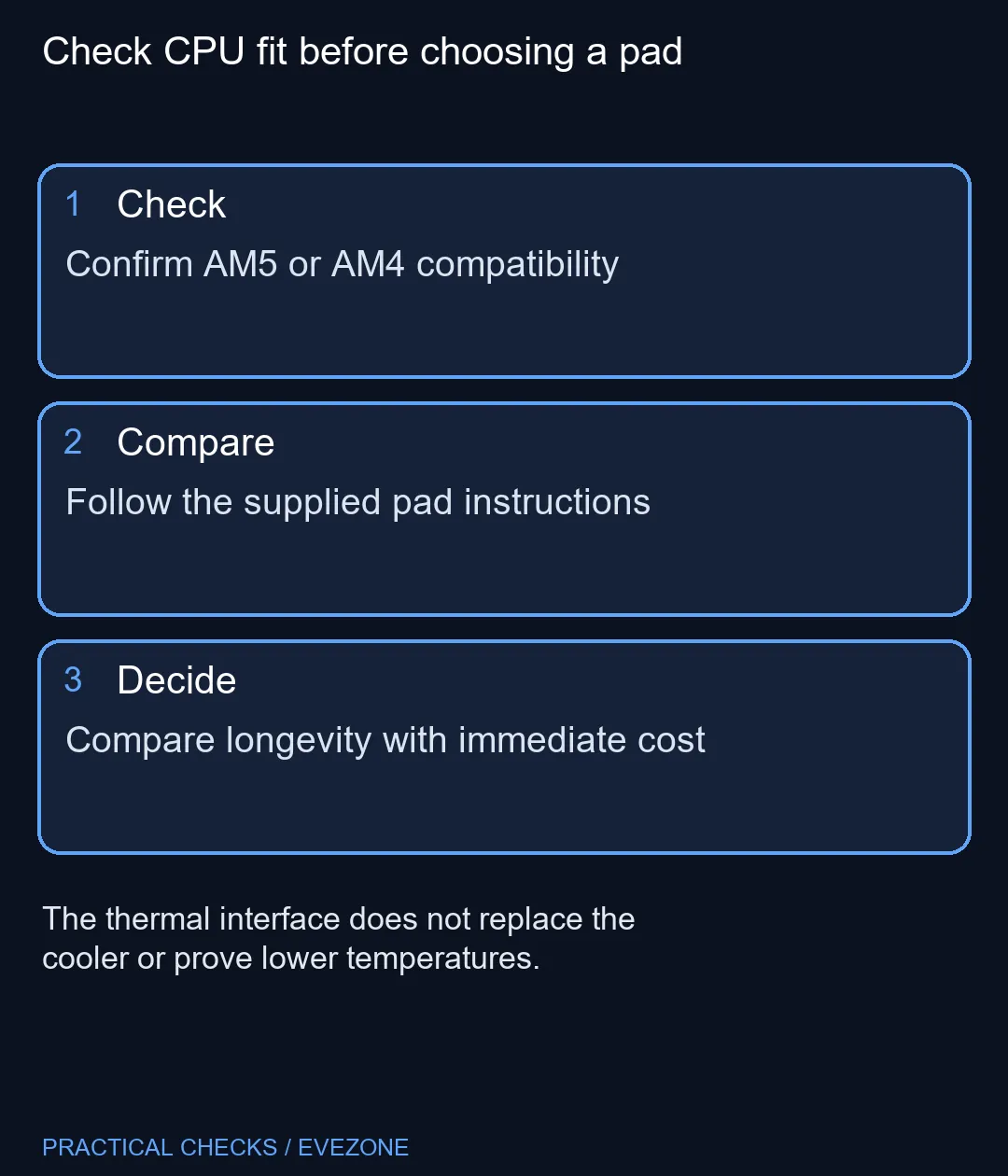
Check the exact processor platform before opening the packaging. The named AM5/4 version is for the supported AMD sockets, not an automatic recommendation for Intel. Keep the cooler's mounting hardware and instructions in the decision as well. A new interface cannot compensate for an incompatible bracket, uneven mounting or a fan that is not working.
The all processors/cpus category helps you identify the platform you intend to build around. Write down the CPU and cooler model together before comparing interface materials; a shopping list that says only Ryzen leaves too much room for a mistaken assumption.
🧪 Separate durability claims from temperature results
Noctua describes an aluminium-supported carbon nanotube structure with a polymer coating, designed to settle into microscopic surface irregularities through thermal cycling. Treat the associated long-term performance statements as manufacturer claims. They are not independent results for your processor, case airflow and ambient conditions, and they do not establish a particular temperature reduction.
The coating also needs careful interpretation. The release describes the contact surfaces as electrically non-conductive before use unless the polymer is penetrated. That is narrower than saying the material is electrically safe in every condition. Follow the supplied handling guidance, avoid damage and keep the pad away from unintended contacts. Do not cut or repurpose it based on a generic online pad tutorial.
For a working machine, record temperatures and noise under your usual workload before disturbing the mount. An unexplained hot CPU needs diagnosis first. Check dust, fan operation and the existing mount rather than assuming that an expensive interface is the missing upgrade.
💰 Compare the whole cooling purchase
The R399 catalogue example is a complete air cooler, not a Rand conversion of the NT-CP1 and not proof that it fits your chosen CPU. That comparison shows why the part's role matters: interface convenience and heatsink capacity belong in separate budget lines. Review cpu coolers for the actual cooling assembly, socket support and available mounting space.
Someone who repeatedly rebuilds test hardware may value clean handling differently from someone assembling one PC and leaving it untouched. Neither preference proves better cooling. If your current temperatures and acoustics are acceptable, there is no need to disturb a stable mount merely because a new material has launched.
The sensible buying point is an exact compatible item with clear instructions and a local total you can assess. Until that offer is established, keep the announcement separate from stock or arrival expectations. Choose the material for a supported use case, then judge the completed system through measurements rather than the packaging story.
Frequently Asked Questions
Does NT-CP1 replace the CPU cooler?
No. It is the interface between supported surfaces; a suitable heatsink or liquid-cooling assembly is still required.
Which AMD sockets does this version name?
The announced NT-CP1 AM5/4 version names AM5 and AM4. Check the exact processor and installation instructions.
Is the US MSRP a South African price?
No. The $24.95 announcement does not establish a Rand offer, local stock or a South African arrival date.
Can I use it as an SSD gap pad?
Do not assume that. A thin CPU interface is not a substitute for an SSD or memory gap pad of a specified thickness.
Does it guarantee lower temperatures?
No. The launch focuses on durability; actual temperatures depend on the cooler, mount, airflow and workload.
Should I replace a working thermal interface immediately?
Only if there is a reason to disturb the mount. Measure the existing system and confirm compatibility before changing it.
Check CPU fit before choosing a pad
Confirm AM5 or AM4 compatibility.